
Anglo-Saxons & Scots Trace & Write Handwriting Workbook
Free printable Foundation handwriting resource
Anglo-Saxons and Scots handwriting explores 40 words for settlement, everyday life, belief and historical evidence. Pupils read terms such as hearth, loom, monastery and hoard before tracing and copying Foundation models.
Preview what is inside

1 of 3
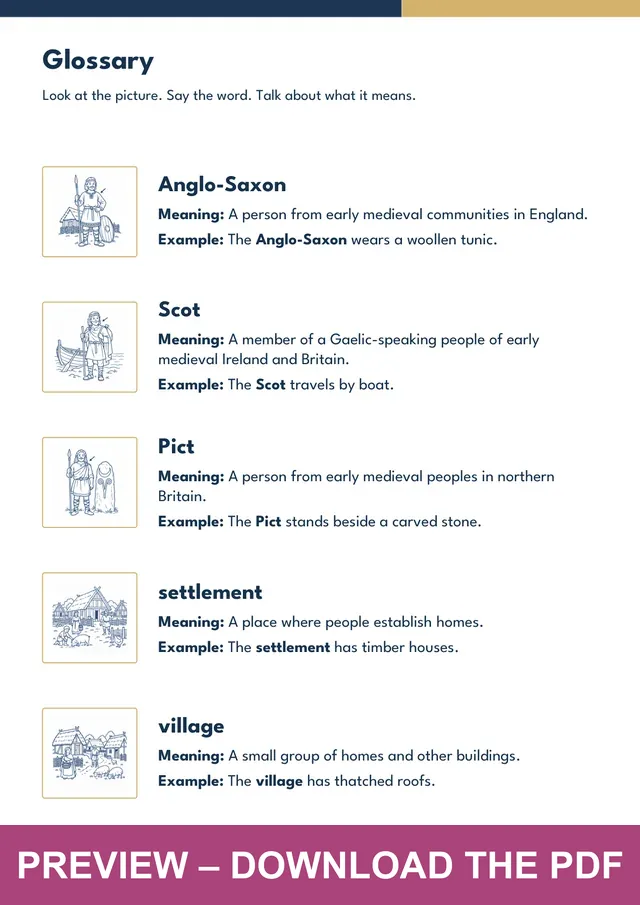
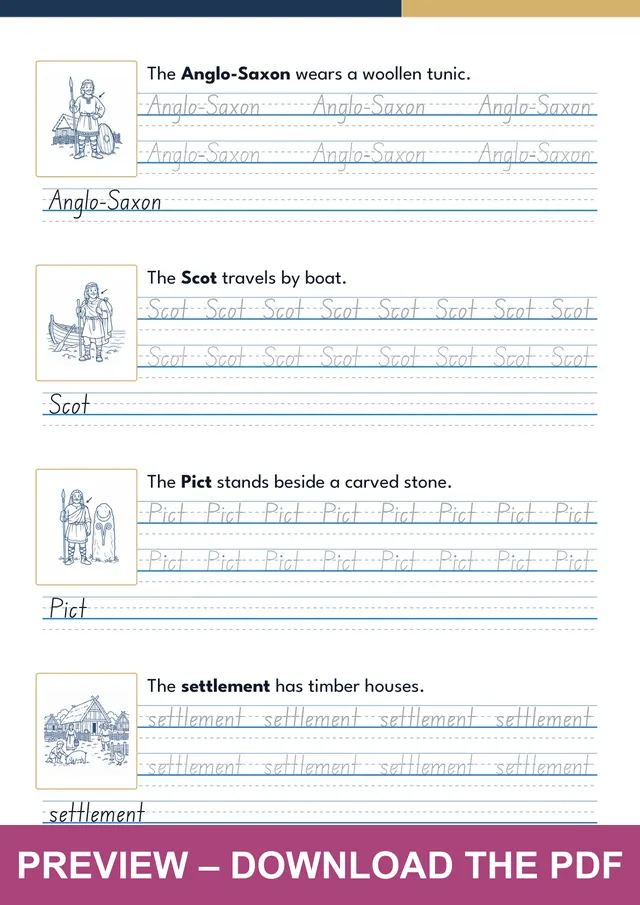
Use the arrows or dots to see the front cover, one glossary page and one handwriting sheet. The two inside-page previews are watermarked; download the PDF for clean printable pages.
Establish an earlier historical context through The Roman Empire Trace & Write Handwriting Workbook. Compare settlement structures with Castles Trace & Write Handwriting Workbook.
Explore anglo-saxons and scots handwriting
The entries include people and places alongside objects and enquiry terms. Sutton Hoo, Iona, Northumbria and Wessex need geographical and historical context; artefact and archaeology help pupils discuss how information about the past is obtained. The title does not make the vocabulary independently readable for beginning readers.
What is included?
- 40 words: Anglo-Saxon, Scot, Pict, settlement, village, kingdom, king, farmer, crop, plough, livestock, thatch, timber, hall, hearth, loom, wool, tunic, brooch, shield, spear, helmet, blacksmith, pottery, rune, monastery, monk, manuscript, missionary, Christianity, burial, hoard, artefact, archaeology, migration, trade, Sutton Hoo, Iona, Northumbria, Wessex.
- 8 picture-glossary pages with meanings and example sentences.
- 10 handwriting sheets using grey models, dotted letters and independent copying space.
- 22 PDF pages in total: front cover, instructions, glossary, handwriting sheets and two terms pages.
Teaching anglo-saxons and scots handwriting
Start with a picture of a settlement or an artefact from the taught topic. Read the matching glossary entry and explain its use or significance at an appropriate level. Model the spelling, then complete the three strips. Compare a pair such as loom and wool or monastery and manuscript to make a meaningful vocabulary connection.
Meanings in the anglo-saxons and scots handwriting glossary
Anglo-Saxon
Meaning: A person from early medieval communities in England.
Example: The Anglo-Saxon wears a woollen tunic.
Scot
Meaning: A member of a Gaelic-speaking people of early medieval Ireland and Britain.
Example: The Scot travels by boat.
Pict
Meaning: A person from early medieval peoples in northern Britain.
Example: The Pict stands beside a carved stone.
settlement
Meaning: A place where people establish homes.
Example: The settlement has timber houses.
village
Meaning: A small group of homes and other buildings.
Example: The village has thatched roofs.
kingdom
Meaning: Land ruled by a king or queen.
Example: The kingdom includes farms and villages.
king
Meaning: A male monarch who rules a kingdom.
Example: The king meets people in the hall.
farmer
Meaning: A person who grows crops or keeps livestock.
Example: The farmer works beside the crops.
crop
Meaning: A plant grown for food or other uses.
Example: The crop grows in the field.
plough
Meaning: A tool used to turn soil before planting.
Example: The plough turns the soil.
livestock
Meaning: Farm animals kept for food, materials or work.
Example: The livestock includes sheep and cattle.
thatch
Meaning: A roof covering made from straw or reeds.
Example: The thatch covers the timber house.
timber
Meaning: Wood prepared for building or other work.
Example: The timber forms the house frame.
hall
Meaning: A large room or building used for gatherings.
Example: The hall has a central hearth.
hearth
Meaning: The place where a fire burns in a home.
Example: The hearth warms the hall.
loom
Meaning: A frame used to weave cloth.
Example: The loom holds threads upright.
wool
Meaning: Fibre from a sheep's fleece.
Example: The wool is spun into yarn.
tunic
Meaning: A simple garment worn over the body.
Example: The tunic reaches the knees.
brooch
Meaning: A decorative pin used to fasten clothing.
Example: The brooch fastens the cloak.
shield
Meaning: A protective object carried in battle.
Example: The round shield has a central boss.
spear
Meaning: A long shaft with a pointed end.
Example: The spear has an iron point.
helmet
Meaning: A protective covering for the head.
Example: The helmet has a metal face guard.
blacksmith
Meaning: A craftsperson who shapes heated iron.
Example: The blacksmith works at an anvil.
pottery
Meaning: Objects shaped from clay and fired.
Example: The pottery includes a cooking pot.
rune
Meaning: A letter in an early Germanic writing system.
Example: The rune is carved into wood.
monastery
Meaning: A religious community where monks or nuns live.
Example: The monastery has a small church.
monk
Meaning: A member of a male religious community.
Example: The monk copies a manuscript.
manuscript
Meaning: A text written by hand.
Example: The manuscript has decorated letters.
missionary
Meaning: A person who travels to spread a religion.
Example: The missionary carries a cross.
Christianity
Meaning: A religion centred on Jesus Christ.
Example: The cross is a symbol of Christianity.
burial
Meaning: Placing a dead person in a grave.
Example: The burial mound covers a grave.
hoard
Meaning: A group of valuable objects hidden or stored together.
Example: The hoard contains coins and jewellery.
artefact
Meaning: An object made or changed by people.
Example: The pot is an artefact from the past.
archaeology
Meaning: The study of past people through material remains.
Example: Archaeology uses finds from the ground.
migration
Meaning: The movement of people to live in another place.
Example: Migration brought families across the sea.
trade
Meaning: Buying, selling or exchanging goods.
Example: Trade brings pottery to the market.
Sutton Hoo
Meaning: An early medieval burial site in Suffolk.
Example: Sutton Hoo has burial mounds.
Iona
Meaning: A Scottish island with an early Christian monastery.
Example: Iona has a historic abbey.
Northumbria
Meaning: An early medieval kingdom in northern Britain.
Example: Northumbria lay in northern Britain.
Wessex
Meaning: An Anglo-Saxon kingdom in southern Britain.
Example: Wessex lay in southern Britain.
Teaching and follow-up ideas
- Group farming words including crop, plough and livestock.
- Compare an artefact with the term archaeology.
- Place selected named locations on a teacher-provided historical map.
Support and challenge
Use hall, wool and crop as short starting words before specialised terms. Demonstrate the capital and hyphen in Anglo-Saxon and provide a model for Northumbria. Extend into a sentence explaining what an object might tell a historian, distinguishing observation from inference.
Choosing pages to print
The anglo-saxons and scots handwriting practice sheets are PDF pages 11 to 20. Picture meanings appear on pages 3 to 10; select the entries that match the words on your chosen writing sheet. The last two PDF pages contain the terms of use.
When helping pupils form unfamiliar letters in historical names, use NSW Department of Education handwriting resources.
Resource licence
Free for personal, homeschool or single-classroom use under the terms included in the PDF. Resale, redistribution and uploading the file to another website are not permitted.
Questions about this workbook
Are historical maps or source investigations included?
The workbook provides vocabulary pictures, meanings, sentences and handwriting. Historical maps and source investigations are optional teaching materials to add alongside it.
What is in the anglo-saxons and scots handwriting PDF?
The 22-page file includes a cover, instructions, 8 glossary pages, 10 handwriting practice sheets and two terms pages.
Which anglo-saxons and scots words can pupils practise?
Anglo-Saxon, Scot, Pict, settlement, village, kingdom, king, farmer, crop, plough, livestock, thatch, timber, hall, hearth, loom, wool, tunic, brooch, shield, spear, helmet, blacksmith, pottery, rune, monastery, monk, manuscript, missionary, Christianity, burial, hoard, artefact, archaeology, migration, trade, Sutton Hoo, Iona, Northumbria, Wessex.
What activity can follow anglo-saxons and scots handwriting?
Place selected named locations on a teacher-provided historical map.
Leave a Reply