
Local History Trace & Write Handwriting Workbook
Free printable Foundation handwriting resource
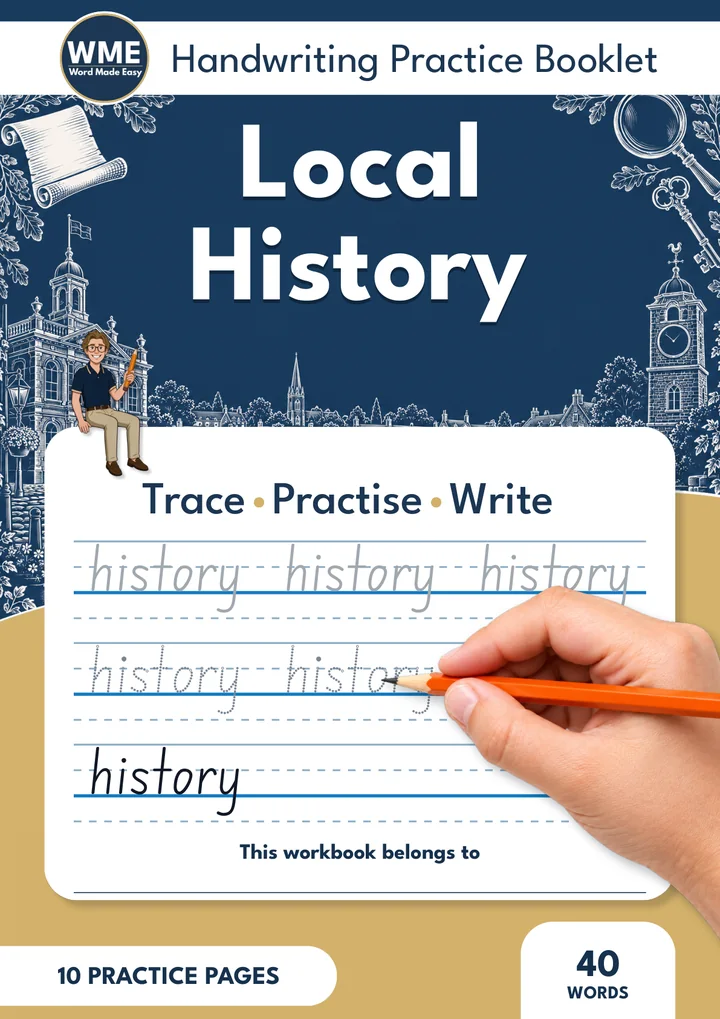
Local history handwriting develops 40 words for investigating places and change over time. Photograph, archive, census and oral history sit alongside building, street and community, with picture meanings and Foundation writing practice.
Preview what is inside

1 of 3
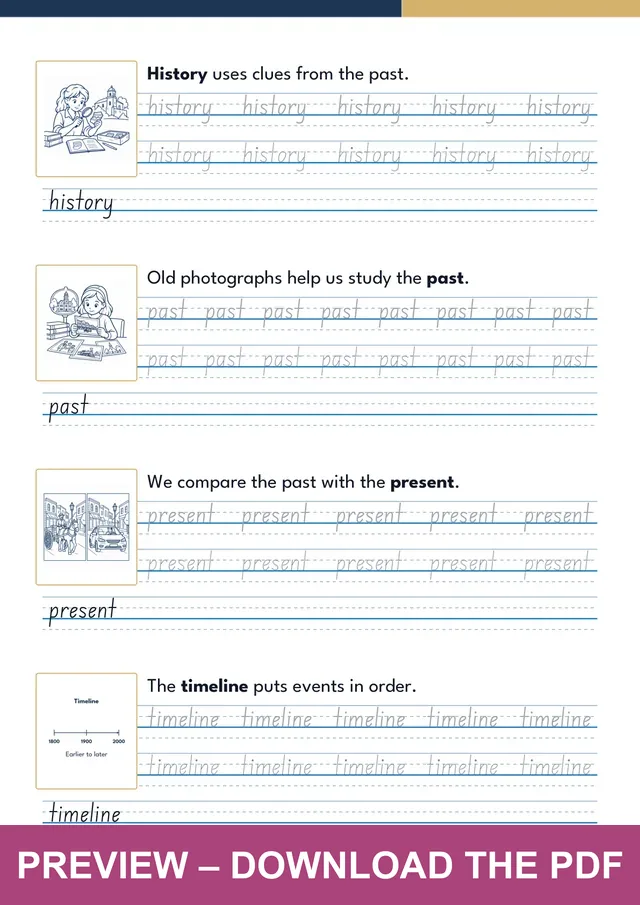
Use the arrows or dots to see the front cover, one glossary page and one handwriting sheet. The two inside-page previews are watermarked; download the PDF for clean printable pages.
Locate selected places through UK Counties & Cities Trace & Write Handwriting Workbook. Use Victorian Britain Trace & Write Handwriting Workbook as one possible period for a local investigation.
Explore local history handwriting
The vocabulary connects familiar local features with the language of enquiry. Source and evidence are central terms, while chronology, change and continuity help pupils organise a comparison. The workbook is not tied to a named town, allowing teachers to use appropriate material from their own locality.
What is included?
- 40 words: history, past, present, timeline, date, decade, century, source, evidence, artefact, photograph, map, building, street, school, church, bridge, market, shop, factory, railway, canal, museum, archive, document, diary, letter, newspaper, census, interview, oral history, memory, monument, memorial, heritage, community, change, continuity, chronology, historian.
- 8 picture-glossary pages with meanings and example sentences.
- 10 handwriting sheets using grey models, dotted letters and independent copying space.
- 22 PDF pages in total: front cover, instructions, glossary, handwriting sheets and two terms pages.
Teaching local history handwriting
Compare an old and a recent photograph of a familiar place. Read the entries for photograph, past and present, then model and copy them. Introduce source and evidence when discussing what the images can tell us. Write a short caption after tracing, keeping observation separate from an unsupported explanation of why a change occurred.
Meanings in the local history handwriting glossary
history
Meaning: The study of people and events in the past.
Example: History uses clues from the past.
past
Meaning: The time before the present.
Example: Old photographs help us study the past.
present
Meaning: The time happening now.
Example: We compare the past with the present.
timeline
Meaning: A diagram showing events in time order.
Example: The timeline puts events in order.
date
Meaning: A particular day, month or year.
Example: The date is written on the document.
decade
Meaning: A period of ten years.
Example: The timeline marks one decade.
century
Meaning: A period of one hundred years.
Example: The timeline marks one century.
source
Meaning: Something that provides information about the past.
Example: The old letter is a historical source.
evidence
Meaning: Information or objects used to support an explanation.
Example: The old map provides evidence of change.
artefact
Meaning: An object made or changed by people.
Example: The pot is an artefact from the past.
photograph
Meaning: An image made using a camera.
Example: The photograph records an old street.
map
Meaning: A drawing representing a place.
Example: The map shows the town's streets.
building
Meaning: A structure with walls and a roof.
Example: The building has changed over time.
street
Meaning: A road with buildings beside it.
Example: The street has homes beside it.
school
Meaning: A place where children learn.
Example: The school has a clock above the door.
church
Meaning: A building used for Christian worship.
Example: The church has a tall tower.
bridge
Meaning: A structure carrying a route across a gap.
Example: The bridge crosses the river.
market
Meaning: A place where goods are bought and sold.
Example: The market has stalls selling fruit.
shop
Meaning: A place where goods are sold.
Example: The shop has a display window.
factory
Meaning: A building where goods are made.
Example: The factory makes goods for shops.
railway
Meaning: A track along which trains travel.
Example: The railway has two steel rails.
canal
Meaning: An artificial waterway used for transport or water supply.
Example: The canal has a narrow boat.
museum
Meaning: A place that collects, studies and displays objects.
Example: The museum displays historic objects.
archive
Meaning: A collection of records kept for future study.
Example: The archive stores old documents.
document
Meaning: A written or printed record giving information.
Example: The document has handwriting on it.
diary
Meaning: A personal record written over time.
Example: The diary records daily events.
letter
Meaning: A written message sent to someone.
Example: The letter comes in an envelope.
newspaper
Meaning: A printed publication containing news.
Example: The newspaper lies open on the table.
census
Meaning: An official count and record of a population.
Example: The census records household information.
interview
Meaning: A conversation in which someone asks questions to learn information.
Example: The interview records an older person's story.
oral history
Meaning: Recorded accounts of the past spoken by people.
Example: Oral history preserves people's memories.
memory
Meaning: Something a person remembers.
Example: The photograph brings back a memory.
monument
Meaning: A structure marking a person, event or important place.
Example: The monument stands in the town square.
memorial
Meaning: An object or place created to remember people or events.
Example: The memorial has a wreath at its base.
heritage
Meaning: Traditions, places and objects passed down from the past.
Example: The old building is part of our heritage.
community
Meaning: People connected by a place or something they share.
Example: The community works in the garden.
change
Meaning: A difference that develops over time.
Example: The two street views show change.
continuity
Meaning: Something that continues over time.
Example: The surviving bridge shows continuity.
chronology
Meaning: The order in which events happened.
Example: Chronology places earlier events first.
historian
Meaning: A person who studies and explains the past.
Example: The historian compares old records.
Teaching and follow-up ideas
- Label an old street photograph with visible features such as bridge, shop and railway.
- Arrange dated sources on a simple timeline.
- Compare an oral-history memory with a photograph, discussing what each contributes.
Support and challenge
Start with a place pupils recognise and a small set of concrete labels. Explain century and decade with a timeline before writing them. Extend confident pupils into a supported comparison using change and continuity, and teach permission and respectful listening before any real interview activity.
Choosing pages to print
The local history handwriting practice sheets are PDF pages 11 to 20. Picture meanings appear on pages 3 to 10; select the entries that match the words on your chosen writing sheet. The last two PDF pages contain the terms of use.
When modelling legible labels and captions for local sources, refer to NSW Department of Education handwriting resources.
Resource licence
Free for personal, homeschool or single-classroom use under the terms included in the PDF. Resale, redistribution and uploading the file to another website are not permitted.
Questions about this workbook
Is the workbook about a particular local area?
No. It supplies general enquiry and place vocabulary that teachers can connect to their own photographs, maps and local sources.
What is in the local history handwriting PDF?
The 22-page file includes a cover, instructions, 8 glossary pages, 10 handwriting practice sheets and two terms pages.
Which local history words can pupils practise?
history, past, present, timeline, date, decade, century, source, evidence, artefact, photograph, map, building, street, school, church, bridge, market, shop, factory, railway, canal, museum, archive, document, diary, letter, newspaper, census, interview, oral history, memory, monument, memorial, heritage, community, change, continuity, chronology, historian.
What activity can follow local history handwriting?
Compare an oral-history memory with a photograph, discussing what each contributes.
Leave a Reply