
The Maya Civilization Trace & Write Handwriting Workbook
Free printable Foundation handwriting resource
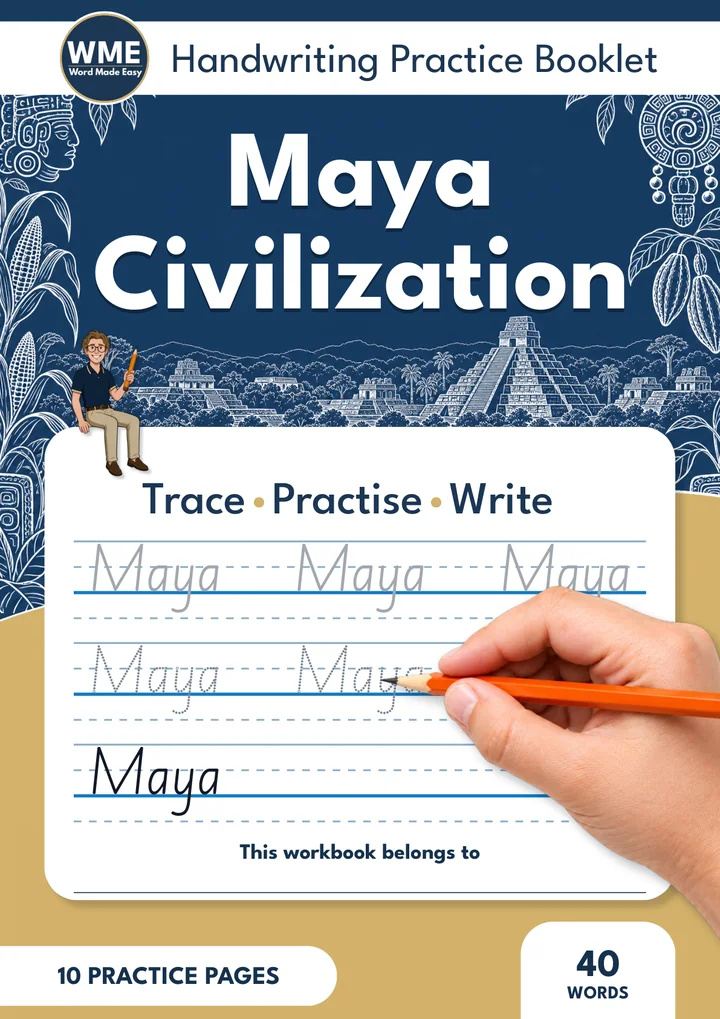
Maya civilisation handwriting introduces 40 topic words for places, crops, writing, number and material culture. Maize, cacao, glyph and codex appear alongside calendar, zero and heritage, with meanings and Foundation tracing and copying.
Preview what is inside

1 of 3
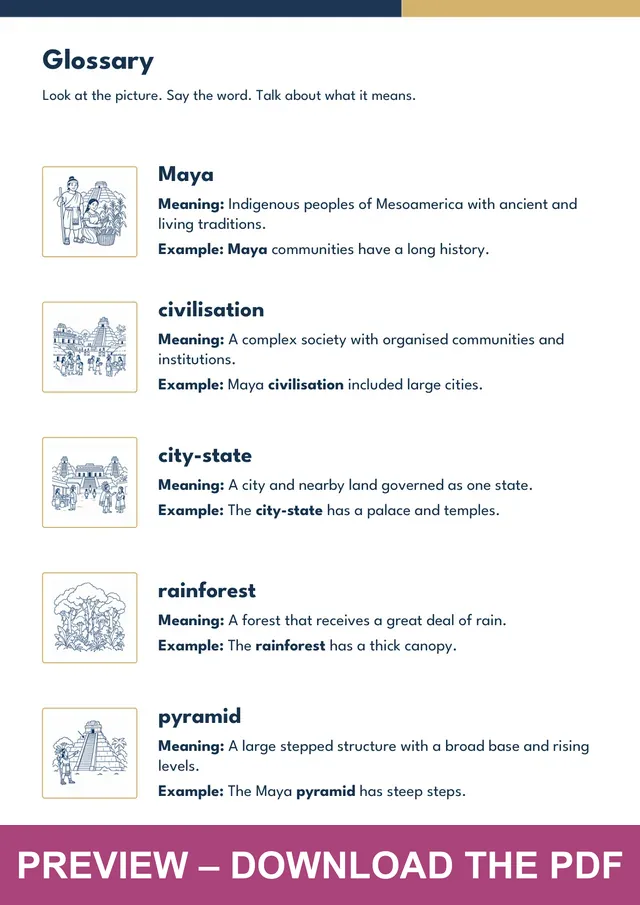
Use the arrows or dots to see the front cover, one glossary page and one handwriting sheet. The two inside-page previews are watermarked; download the PDF for clean printable pages.
Compare writing and agriculture vocabulary using Ancient Egypt Trace & Write Handwriting Workbook. Explore the environmental setting with Rainforests Trace & Write Handwriting Workbook.
Explore maya civilisation handwriting
The collection offers links between agriculture, settlement and recording information. Pyramid, temple and plaza relate to the built environment; glyph, scribe and codex relate to writing. Frame the ancient topic carefully without suggesting that Maya people or cultures no longer exist.
What is included?
- 40 words: Maya, civilisation, city-state, rainforest, pyramid, temple, palace, plaza, ruler, farmer, maize, bean, squash, cacao, chilli, cotton, loom, pottery, jade, obsidian, glyph, scribe, codex, calendar, astronomy, observatory, zero, number, stela, lintel, ball court, rubber, trade, market, canoe, causeway, reservoir, cenote, archaeologist, heritage.
- 8 picture-glossary pages with meanings and example sentences.
- 10 handwriting sheets using grey models, dotted letters and independent copying space.
- 22 PDF pages in total: front cover, instructions, glossary, handwriting sheets and two terms pages.
Teaching maya civilisation handwriting
Choose a connected group such as maize, bean and squash or glyph, scribe and codex. Read each glossary meaning, discuss a suitable historical image and model the written form. Complete the three strips, then ask pupils to explain the connection between two terms. Use appropriate sources to place the topic geographically and historically.
Meanings in the maya civilisation handwriting glossary
Maya
Meaning: Indigenous peoples of Mesoamerica with ancient and living traditions.
Example: Maya communities have a long history.
civilisation
Meaning: A complex society with organised communities and institutions.
Example: Maya civilisation included large cities.
city-state
Meaning: A city and nearby land governed as one state.
Example: The city-state has a palace and temples.
rainforest
Meaning: A forest that receives a great deal of rain.
Example: The rainforest has a thick canopy.
pyramid
Meaning: A large stepped structure with a broad base and rising levels.
Example: The Maya pyramid has steep steps.
temple
Meaning: A building used for religious worship.
Example: The temple stands above the plaza.
palace
Meaning: A large building used by a ruler and their household.
Example: The palace has several rooms.
plaza
Meaning: An open public square.
Example: The plaza lies between large buildings.
ruler
Meaning: A person who governs a community or state.
Example: The ruler sits on a carved seat.
farmer
Meaning: A person who grows crops or keeps animals.
Example: The farmer tends the maize.
maize
Meaning: A cereal crop also called corn.
Example: The maize has a cob inside its husk.
bean
Meaning: A seed used as food and grown in a pod.
Example: The bean grows inside a pod.
squash
Meaning: A plant grown for its large edible fruit.
Example: The squash grows on a trailing vine.
cacao
Meaning: A tropical tree whose seeds are used to make chocolate.
Example: The cacao pod contains seeds.
chilli
Meaning: A pepper fruit used to flavour food.
Example: The chilli grows on a small plant.
cotton
Meaning: A plant fibre used to make thread and cloth.
Example: The cotton has fluffy seed fibres.
loom
Meaning: A device used to weave threads into cloth.
Example: The backstrap loom holds the threads.
pottery
Meaning: Objects made from clay and hardened by heat.
Example: The pottery includes a painted bowl.
jade
Meaning: A hard stone valued for ornaments and carvings.
Example: The jade is carved into an ornament.
obsidian
Meaning: A volcanic glass used to make sharp tools.
Example: The obsidian has a sharp edge.
glyph
Meaning: A written sign representing a sound, word or idea.
Example: The glyph is carved in stone.
scribe
Meaning: A person trained to write.
Example: The scribe paints signs in a book.
codex
Meaning: An ancient book, often made from folded pages.
Example: The codex opens into folded sections.
calendar
Meaning: A system for organising days and longer periods.
Example: The calendar records the passage of time.
astronomy
Meaning: The study of objects and events in the sky.
Example: Astronomy includes observing the stars.
observatory
Meaning: A place used to observe the sky.
Example: The observatory has openings towards the sky.
zero
Meaning: A number representing no quantity.
Example: The Maya used a sign for zero.
number
Meaning: A value used for counting or measuring.
Example: Dots and bars can show a Maya number.
stela
Meaning: An upright stone monument, often carved with writing or figures.
Example: The stela stands in the plaza.
lintel
Meaning: A beam spanning the top of a doorway.
Example: The carved lintel sits above the door.
ball court
Meaning: An area where a ball game was played.
Example: The ball court has sloping sides.
rubber
Meaning: An elastic material made from tree latex or other sources.
Example: The rubber ball can bounce.
trade
Meaning: Buying, selling or exchanging goods.
Example: Trade brought goods between Maya cities.
market
Meaning: A place where goods are bought and sold.
Example: The market has pottery and food.
canoe
Meaning: A narrow boat moved with paddles.
Example: The canoe carries goods along the river.
causeway
Meaning: A raised route across low or difficult ground.
Example: The causeway links two places.
reservoir
Meaning: A place where water is stored for later use.
Example: The reservoir stores rainwater.
cenote
Meaning: A natural sinkhole containing water.
Example: The cenote has steep rocky sides.
archaeologist
Meaning: A person who studies past people through material remains.
Example: The archaeologist brushes soil from a pot.
heritage
Meaning: Traditions and remains passed down from earlier generations.
Example: Maya heritage continues in communities today.
Teaching and follow-up ideas
- Compare crops named in the glossary, including maize and cacao.
- Group writing and number vocabulary such as glyph, codex and zero.
- Label a teacher-supplied settlement image with plaza, temple and palace.
Support and challenge
Begin with farmer, market and number before unfamiliar terms. Rehearse obsidian and observatory orally, keeping the full model visible. Extend secure vocabulary into a short explanation about recording information or growing crops, supported by the taught historical source.
Choosing pages to print
The maya civilisation handwriting practice sheets are PDF pages 11 to 20. Picture meanings appear on pages 3 to 10; select the entries that match the words on your chosen writing sheet. The last two PDF pages contain the terms of use.
When modelling the longer spellings in the Maya vocabulary, refer to NSW Department of Education handwriting resources.
Resource licence
Free for personal, homeschool or single-classroom use under the terms included in the PDF. Resale, redistribution and uploading the file to another website are not permitted.
Questions about this workbook
Is this a general rainforest animal workbook?
No. Its focus is Maya topic vocabulary, including settlement, farming, writing, number, materials and heritage.
What is in the maya civilisation handwriting PDF?
The 22-page file includes a cover, instructions, 8 glossary pages, 10 handwriting practice sheets and two terms pages.
Which maya civilisation words can pupils practise?
Maya, civilisation, city-state, rainforest, pyramid, temple, palace, plaza, ruler, farmer, maize, bean, squash, cacao, chilli, cotton, loom, pottery, jade, obsidian, glyph, scribe, codex, calendar, astronomy, observatory, zero, number, stela, lintel, ball court, rubber, trade, market, canoe, causeway, reservoir, cenote, archaeologist, heritage.
What activity can follow maya civilisation handwriting?
Label a teacher-supplied settlement image with plaza, temple and palace.
Leave a Reply