
Climate Zones & Biomes Trace & Write Handwriting Workbook
Free printable Foundation handwriting resource
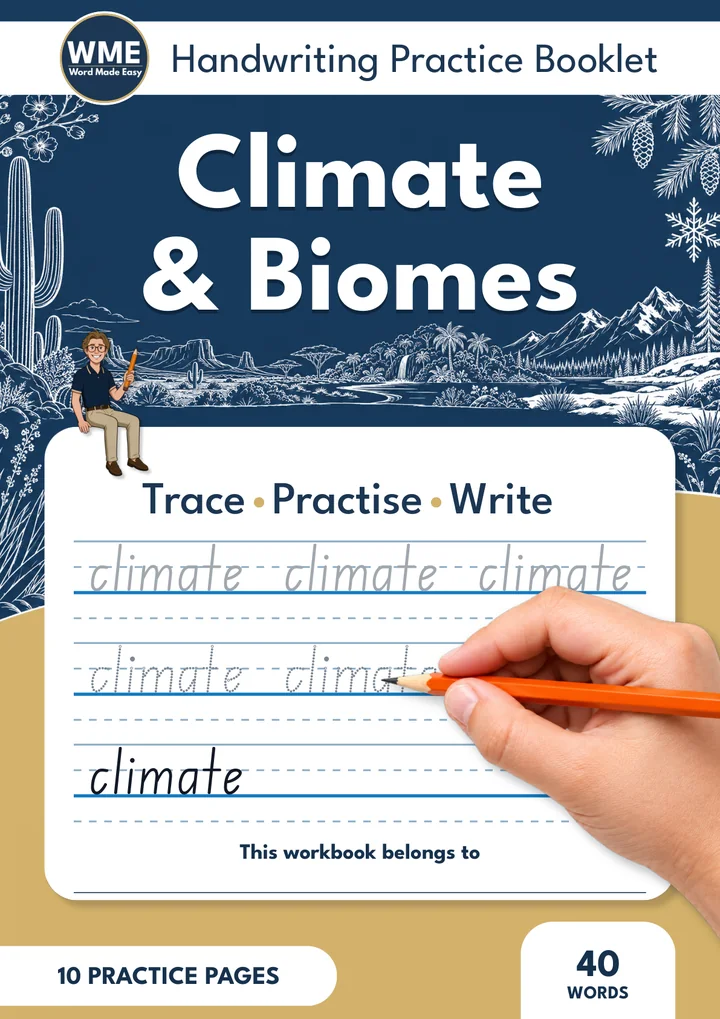
Climate zones and biomes handwriting brings 40 environmental terms onto Foundation writing guides. Pupils explore weather, climate, tropical, tundra and ecosystem through picture meanings and example sentences before tracing and copying.
Preview what is inside

1 of 3
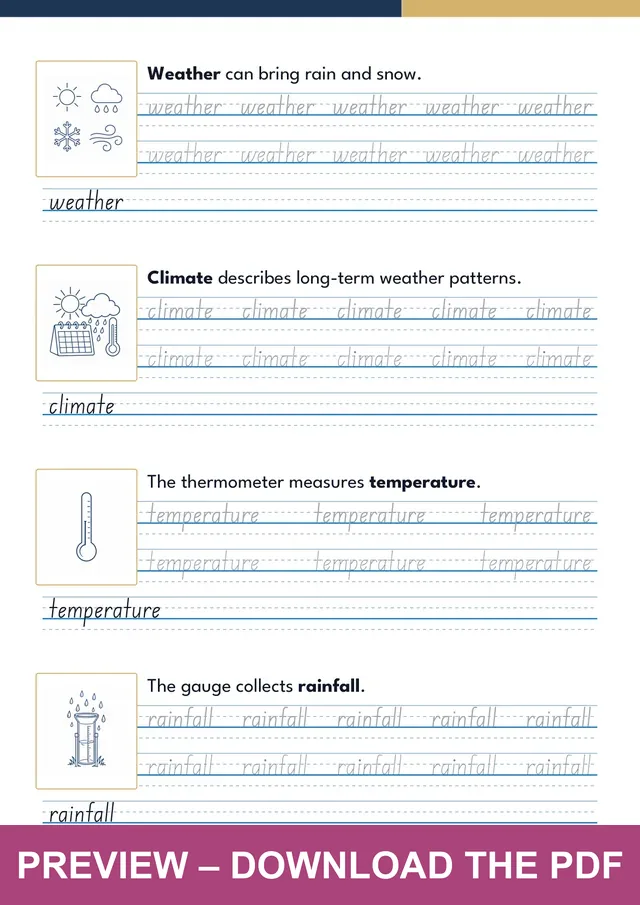
Use the arrows or dots to see the front cover, one glossary page and one handwriting sheet. The two inside-page previews are watermarked; download the PDF for clean printable pages.
Establish global location words through Continents & Oceans Trace & Write Handwriting Workbook. Make vegetation terms concrete with Trees Trace & Write Handwriting Workbook.
Explore climate zones and biomes handwriting
The collection spans location, long-term conditions, habitats and ecological relationships. Weather and climate require a careful contrast; tropical, temperate and polar can be connected to a world map. Biome names and words such as adaptation should be introduced in meaningful groups rather than as an isolated spelling list.
What is included?
- 40 words: weather, climate, temperature, rainfall, season, equator, pole, latitude, tropical, temperate, polar, arid, biome, habitat, vegetation, rainforest, desert, grassland, woodland, tundra, savanna, taiga, deciduous forest, coniferous forest, Mediterranean, alpine, wetland, freshwater, marine, biodiversity, adaptation, drought, humidity, precipitation, canopy, permafrost, evergreen, deciduous, food chain, ecosystem.
- 8 picture-glossary pages with meanings and example sentences.
- 10 handwriting sheets using grey models, dotted letters and independent copying space.
- 22 PDF pages in total: front cover, instructions, glossary, handwriting sheets and two terms pages.
Teaching climate zones and biomes handwriting
Compare a daily weather observation with a longer-term description of a place. Read the two glossary entries and write the words. Use a map to locate the equator and poles before selecting tropical or polar vocabulary. After tracing, ask pupils to connect a biome name with one taught feature, avoiding the assumption that one picture shows every variation.
Meanings in the climate zones and biomes handwriting glossary
weather
Meaning: The conditions outside at a particular time.
Example: Weather can bring rain and snow.
climate
Meaning: The usual pattern of weather over many years.
Example: Climate describes long-term weather patterns.
temperature
Meaning: A measure of how hot or cold something is.
Example: The thermometer measures temperature.
rainfall
Meaning: The amount of rain falling in a place.
Example: The gauge collects rainfall.
season
Meaning: One of the main divisions of the year.
Example: Each season brings different weather.
equator
Meaning: An imaginary line halfway between Earth's poles.
Example: The equator circles Earth's middle.
pole
Meaning: One of the two points where Earth's axis meets its surface.
Example: The pole is at the top of this globe.
latitude
Meaning: Distance north or south of the equator, measured in degrees.
Example: Latitude lines run around the globe.
tropical
Meaning: Relating to the warm region near the equator.
Example: The tropical forest has tall trees.
temperate
Meaning: Having a climate without extreme heat or cold overall.
Example: The temperate woodland has leafy trees.
polar
Meaning: Relating to the regions around Earth's poles.
Example: The polar landscape has ice and snow.
arid
Meaning: Having very little rainfall.
Example: The arid landscape has dry ground.
biome
Meaning: A large region with characteristic climate and living things.
Example: A desert is one type of biome.
habitat
Meaning: The place where a living thing normally lives.
Example: The pond is a habitat for frogs.
vegetation
Meaning: The plants growing in an area.
Example: Vegetation covers the hillside.
rainforest
Meaning: A forest that receives a great deal of rain.
Example: The rainforest has a thick canopy.
desert
Meaning: A region with very little precipitation.
Example: The desert has sandy dunes.
grassland
Meaning: Land where grasses are the main vegetation.
Example: The grassland stretches across the plain.
woodland
Meaning: Land covered with trees.
Example: The woodland has many trees.
tundra
Meaning: A cold, mostly treeless biome with low plants.
Example: The tundra has low-growing plants.
savanna
Meaning: Tropical grassland with scattered trees.
Example: The savanna has widely spaced trees.
taiga
Meaning: A northern biome dominated by coniferous forest.
Example: The taiga has many conifers.
deciduous forest
Meaning: A forest dominated by trees that shed leaves seasonally.
Example: The deciduous forest loses leaves in autumn.
coniferous forest
Meaning: A forest dominated by cone-bearing trees.
Example: The coniferous forest has tall pine trees.
Mediterranean
Meaning: A climate type with hot dry summers and mild wetter winters.
Example: The Mediterranean climate has dry summers.
alpine
Meaning: Relating to high mountains, especially above the tree line.
Example: The alpine plants grow near rocky peaks.
wetland
Meaning: Land covered or soaked with water for much of the time.
Example: The wetland has shallow water and reeds.
freshwater
Meaning: Water with very little dissolved salt.
Example: Freshwater fills the stream.
marine
Meaning: Relating to the sea.
Example: The marine habitat contains seaweed.
biodiversity
Meaning: The variety of living things in a place.
Example: Biodiversity includes plants and animals.
adaptation
Meaning: A feature or behaviour that helps survival.
Example: Thick fur is a cold-weather adaptation.
drought
Meaning: A long period with unusually little rain.
Example: The drought leaves the ground dry.
humidity
Meaning: The amount of water vapour in the air.
Example: The instrument measures humidity.
precipitation
Meaning: Water falling from clouds as rain, snow or hail.
Example: Precipitation falls from the cloud.
canopy
Meaning: The upper layer formed by tree crowns.
Example: The canopy forms a leafy roof.
permafrost
Meaning: Ground that stays frozen for at least two years.
Example: Permafrost lies beneath the surface.
evergreen
Meaning: Keeping living leaves throughout the year.
Example: The evergreen tree keeps its leaves.
deciduous
Meaning: Shedding leaves at a particular season.
Example: The deciduous tree drops its leaves.
food chain
Meaning: A sequence showing how food energy passes between organisms.
Example: The food chain begins with grass.
ecosystem
Meaning: Living things and their surroundings interacting together.
Example: The pond ecosystem includes plants and animals.
Teaching and follow-up ideas
- Sort rainforest, desert and tundra as biome names.
- Compare evergreen and deciduous using tree photographs.
- Build a short description combining temperature, rainfall and vegetation.
Support and challenge
Anchor the topic in weather the class can observe and introduce climate through adult explanation. Keep long words such as biodiversity visible while copying. A next step is a comparison of two biomes using evidence from a taught source and correctly spaced names such as deciduous forest.
Choosing pages to print
The climate zones and biomes handwriting practice sheets are PDF pages 11 to 20. Picture meanings appear on pages 3 to 10; select the entries that match the words on your chosen writing sheet. The last two PDF pages contain the terms of use.
When modelling long environmental terms rather than rushing their spelling, consult NSW Department of Education handwriting resources.
Resource licence
Free for personal, homeschool or single-classroom use under the terms included in the PDF. Resale, redistribution and uploading the file to another website are not permitted.
Questions about this workbook
Does the workbook treat weather and climate as the same thing?
They are separate glossary entries. Teach the distinction between everyday conditions and patterns described over a much longer period.
What is in the climate zones and biomes handwriting PDF?
The 22-page file includes a cover, instructions, 8 glossary pages, 10 handwriting practice sheets and two terms pages.
Which climate zones and biomes words can pupils practise?
weather, climate, temperature, rainfall, season, equator, pole, latitude, tropical, temperate, polar, arid, biome, habitat, vegetation, rainforest, desert, grassland, woodland, tundra, savanna, taiga, deciduous forest, coniferous forest, Mediterranean, alpine, wetland, freshwater, marine, biodiversity, adaptation, drought, humidity, precipitation, canopy, permafrost, evergreen, deciduous, food chain, ecosystem.
What activity can follow climate zones and biomes handwriting?
Build a short description combining temperature, rainfall and vegetation.
Leave a Reply