
Solar System Trace & Write Handwriting Workbook
Free printable Foundation handwriting resource
Solar system handwriting gives pupils 24 space words to read, discuss and write. The Sun, eight planets and the Moon sit alongside terms such as orbit, rotation, asteroid and dwarf planet, with picture meanings and Foundation tracing strips.
Preview what is inside


1 of 3
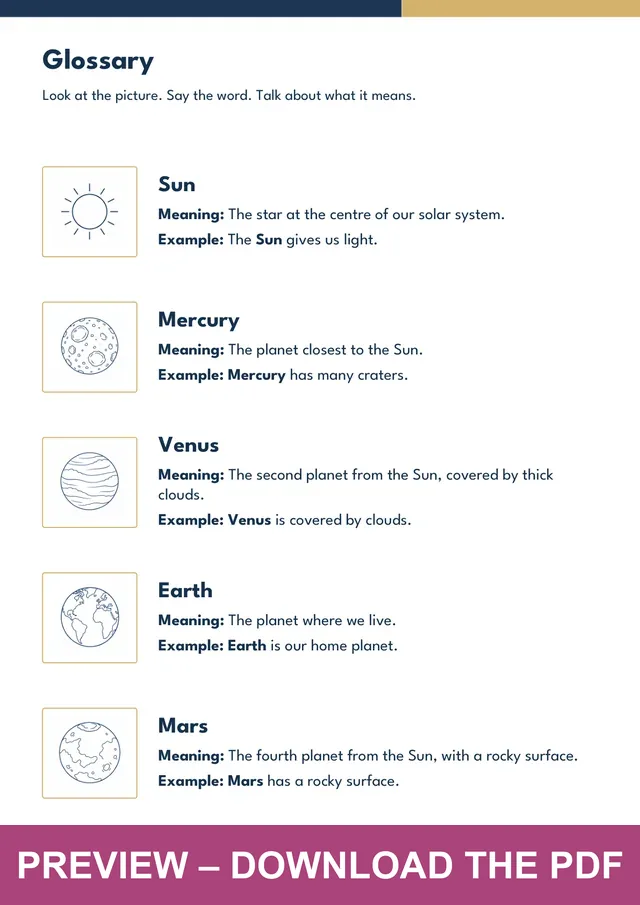
Use the arrows or dots to see the front cover, one glossary page and one handwriting sheet. The two inside-page previews are watermarked; download the PDF for clean printable pages.
Use 3D Shapes Handwriting Workbook: 7 Words when discussing a sphere. Broaden the Earth vocabulary with Continents & Oceans Trace & Write Handwriting Workbook.
Explore solar system handwriting
The vocabulary separates named bodies from descriptive terms. Earth and Mars need capitals, while planet and satellite are general words. Pluto appears with dwarf planet, providing a useful opportunity to discuss the category without adding it to the list of eight planets.
What is included?
- 24 words: Sun, Mercury, Venus, Earth, Mars, Jupiter, Saturn, Uranus, Neptune, Moon, planet, star, solar system, orbit, rotation, axis, sphere, satellite, asteroid, comet, meteor, meteorite, dwarf planet, Pluto.
- 5 picture-glossary pages with meanings and example sentences.
- 6 handwriting sheets using grey models, dotted letters and independent copying space.
- 15 PDF pages in total: front cover, instructions, glossary, handwriting sheets and two terms pages.
Teaching solar system handwriting
Use a simple model to show a planet travelling around the Sun and distinguish orbit from rotation. Read those glossary entries before handwriting practice. Introduce a few planet names in order, pronounce each with the class and then trace and copy them. Explain that a picture showing several bodies together need not represent their actual sizes or distances.
Meanings in the solar system handwriting glossary
Sun
Meaning: The star at the centre of our solar system.
Example: The Sun gives us light.
Mercury
Meaning: The planet closest to the Sun.
Example: Mercury has many craters.
Venus
Meaning: The second planet from the Sun, covered by thick clouds.
Example: Venus is covered by clouds.
Earth
Meaning: The planet where we live.
Example: Earth is our home planet.
Mars
Meaning: The fourth planet from the Sun, with a rocky surface.
Example: Mars has a rocky surface.
Jupiter
Meaning: The largest planet in our solar system.
Example: Jupiter has bands of clouds.
Saturn
Meaning: The sixth planet from the Sun, famous for its large rings.
Example: Saturn has wide rings.
Uranus
Meaning: The seventh planet from the Sun, which spins on its side.
Example: Uranus spins on its side.
Neptune
Meaning: The eighth planet from the Sun.
Example: Neptune is far from the Sun.
Moon
Meaning: Earth's natural satellite, which travels around Earth.
Example: The Moon can look like a crescent.
planet
Meaning: A large, nearly round body that orbits a star and has cleared its path.
Example: Earth is a planet.
star
Meaning: A huge ball of hot gas that gives out its own light.
Example: The Sun is a star.
solar system
Meaning: The Sun and all the objects held around it by gravity.
Example: Our solar system has eight planets.
orbit
Meaning: The curved path of an object around another object in space.
Example: Earth follows an orbit.
rotation
Meaning: The spinning of an object around its axis.
Example: Earth's rotation gives us day and night.
axis
Meaning: An imaginary line through the centre of a spinning object.
Example: Earth spins around its axis.
sphere
Meaning: A three-dimensional shape that is round like a ball.
Example: A planet is nearly a sphere.
satellite
Meaning: An object that travels around a larger object in space.
Example: The Moon is Earth's satellite.
asteroid
Meaning: A small rocky object that orbits the Sun.
Example: An asteroid is made of rock.
comet
Meaning: An icy object that can form a tail near the Sun.
Example: A comet can have a long tail.
meteor
Meaning: The bright streak made when space material enters the atmosphere.
Example: A meteor makes a bright streak.
meteorite
Meaning: A piece of space rock that reaches the ground.
Example: A meteorite has reached the ground.
dwarf planet
Meaning: A nearly round body orbiting the Sun that has not cleared its path.
Example: Pluto is a dwarf planet.
Pluto
Meaning: A dwarf planet beyond Neptune.
Example: Pluto has an icy surface.
Teaching and follow-up ideas
- Sort Sun, Moon and Earth separately from general words such as star and planet.
- Compare meteor and meteorite using the glossary meanings.
- Write labels for a classroom solar-system model and check each capital.
Support and challenge
Keep Sun, Moon and Earth as an initial group and provide pronunciation help for Uranus and Neptune. Use a moving object to reinforce orbit before expecting a written explanation. Confident pupils can compose a sentence distinguishing a planet from a star or describing rotation.
Choosing pages to print
The solar system handwriting practice sheets are PDF pages 8 to 13. Picture meanings appear on pages 3 to 7; select the entries that match the words on your chosen writing sheet. The last two PDF pages contain the terms of use.
For consistent writing models while pupils learn planet names, consult NSW Department of Education handwriting resources.
Resource licence
Free for personal, homeschool or single-classroom use under the terms included in the PDF. Resale, redistribution and uploading the file to another website are not permitted.
Questions about this workbook
Is Pluto included as a ninth planet?
Pluto is included with the vocabulary term dwarf planet. The workbook also names the eight planets from Mercury to Neptune.
What is in the solar system handwriting PDF?
There are 15 PDF pages: a cover, instructions, 5 glossary pages, 6 handwriting sheets and two terms pages.
Which vocabulary does this workbook cover?
Sun, Mercury, Venus, Earth, Mars, Jupiter, Saturn, Uranus, Neptune, Moon, planet, star, solar system, orbit, rotation, axis, sphere, satellite, asteroid, comet, meteor, meteorite, dwarf planet, Pluto.
What activity can follow solar system handwriting?
Write labels for a classroom solar-system model and check each capital.
Leave a Reply