
3D Shapes Handwriting Workbook: 7 Words
Free printable Foundation handwriting resource
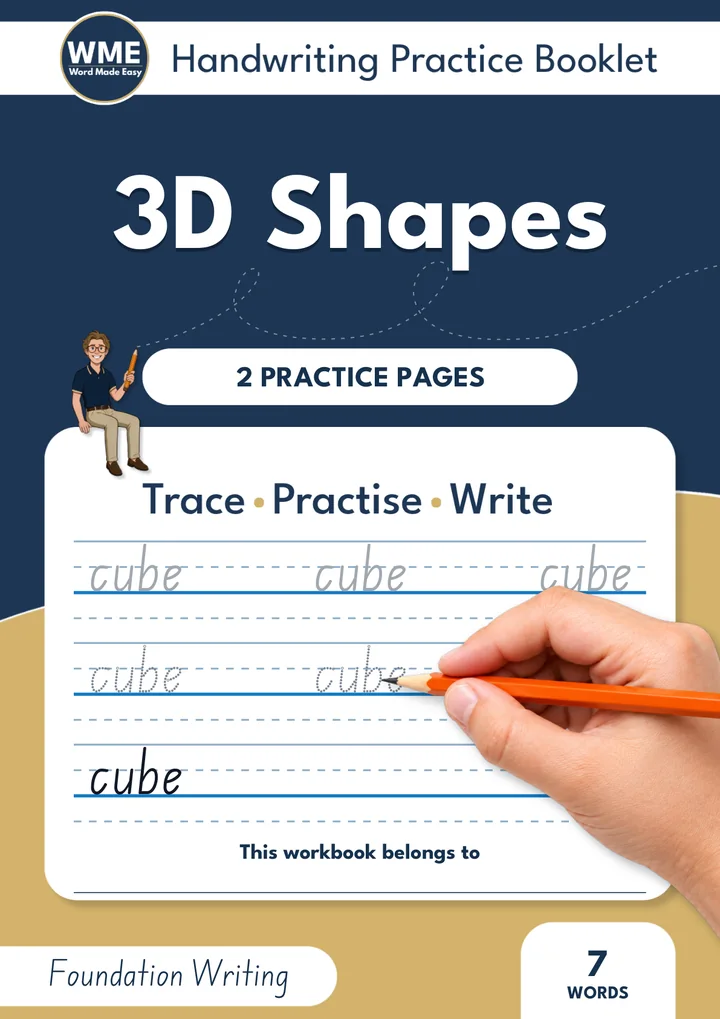
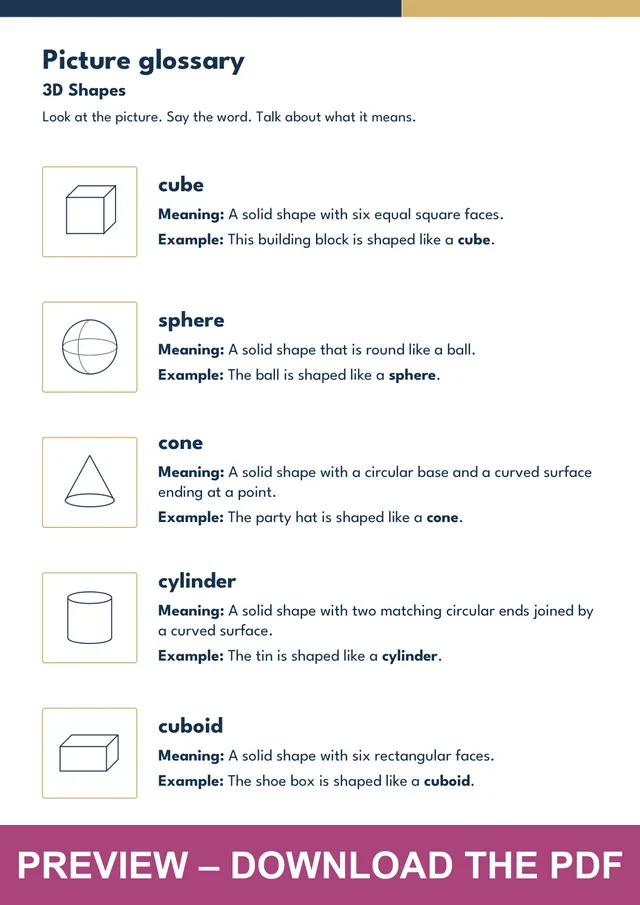
This 3D shapes handwriting workbook introduces cube, sphere, cone, cylinder, cuboid, pyramid and prism. Children explore the glossary drawings and meanings, then practise the seven solid-shape names using grey tracing, dotted Foundation lettering and independent copying strips.
Preview what is inside

1 of 4
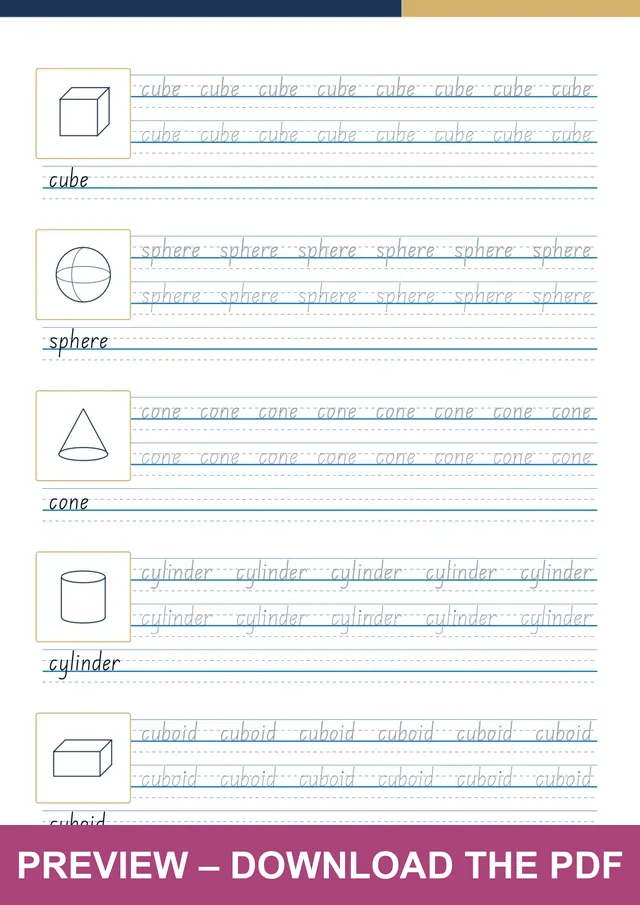
Use the arrows or dots to see the front cover, one glossary page and two handwriting sheets. The three inside-page previews are watermarked; download the PDF for clean printable pages.
Compare solid forms with the flat outlines in 2D Shapes Poster. Use 2D Shape Tracing Worksheet when pupils need to apply 2D-shape vocabulary in a separate activity.
About this 3D shapes handwriting workbook
The glossary connects shape names with drawings, short definitions and familiar examples such as a building block, ball or tin. Real objects can make these ideas easier to discuss because a flat drawing represents a solid form. The handwriting activity records the shape's name; it does not ask pupils to draw accurate perspective diagrams.
The first practice sheet contains cube, sphere, cone, cylinder and cuboid. The second contains pyramid and prism. Each word has three strips, progressing from grey models through dotted forms to an independent line after a black starting model. Pictures beside the groups help learners return to the meaning after focusing on the letters.
What is included?
- 7 words: cube, sphere, cone, cylinder, cuboid, pyramid, prism.
- 2 picture-glossary pages with meanings and example sentences.
- 2 handwriting sheets using grey models, dotted letters and independent copying space.
- 8 PDF pages in total: front cover, instructions, glossary, handwriting sheets and two terms pages.
How to use this 3D shapes handwriting workbook
Show a block or ball and compare it with the matching glossary drawing. Say cube or sphere, read the explanation and turn the object so the child can see it from different sides. Clarify that the written label stays the same even when the object changes position.
Model cube on the guides, keeping the smaller letters consistent and b tall. For cylinder, check the descending y and tall l and d against the baseline. Follow all three strips for the selected word, then ask the learner to choose the corresponding object from a small collection.
Teaching and follow-up ideas
- Match a block, ball and tin to cube, sphere and cylinder labels, discussing how everyday objects approximate those shapes.
- Turn a solid object and ask whether its name changes with the viewing angle.
- Compare a cube and cuboid using the glossary and physical examples rather than relying only on the drawings.
- Use a practised word as a label for a model-building display, with an adult checking the chosen name.
Support and challenge
Begin with two contrasting objects and two names instead of presenting every solid at once. Use cube or cone for a shorter spelling and explain sphere aloud before expecting a child to copy it. Give extra time for cylinder and pyramid, with frequent returns to the model. Extend the task by asking for an oral description of a feature, keeping that geometry discussion separate from judging handwriting.
Where this fits in learning
Build experience of handling and describing solid objects first, introduce accurate names through the glossary, then practise writing labels. Compare flat outlines and solid forms when useful, but do not assume children have mastered geometry simply because they can copy a word. Later, they can select labels for constructions or explain a difference between two solids using supported mathematical language.
Choosing pages to print
For this 3D shapes handwriting workbook, pDF page 5 provides the five groups from cube to cuboid and page 6 provides pyramid and prism. Glossary page 3 introduces the first five names, while page 4 explains the last two. This makes it possible to select matching vocabulary and handwriting pages without printing the entire booklet for every lesson. Keep the instruction page available when introducing the grey, dotted and independent sequence. Check the small diagrams and pale letters on one printed copy before making a class set, and use physical solids alongside the page where possible.
Use the handwriting reference when demonstrating letter height and descending strokes in cylinder before independent writing. NSW handwriting teaching resources.
Resource licence
Free for personal, homeschool or single-classroom use under the terms included in the PDF. Resale, redistribution and uploading the file to another website are not permitted.
Questions about this workbook
What is included in the 3D shapes handwriting workbook?
Cube, sphere, cone, cylinder, cuboid, pyramid and prism.
Do pupils draw the 3D shapes?
No. The core task is tracing and writing their names; drawings are supplied as vocabulary prompts.
What is on the second handwriting sheet?
It contains the pyramid and prism practice groups.
How many pages are in the PDF?
Eight: cover, instructions, two glossary pages, two handwriting sheets and two terms pages.
Should I use physical objects?
They are helpful for connecting a flat drawing with a solid form, but the glossary still provides pictures and explanations.
Does neat copying demonstrate geometry mastery?
No. Discuss shape meanings and features separately from the learner's handwriting performance.
Leave a Reply