AB Word Family Handwriting Workbook
Free printable Foundation handwriting resource
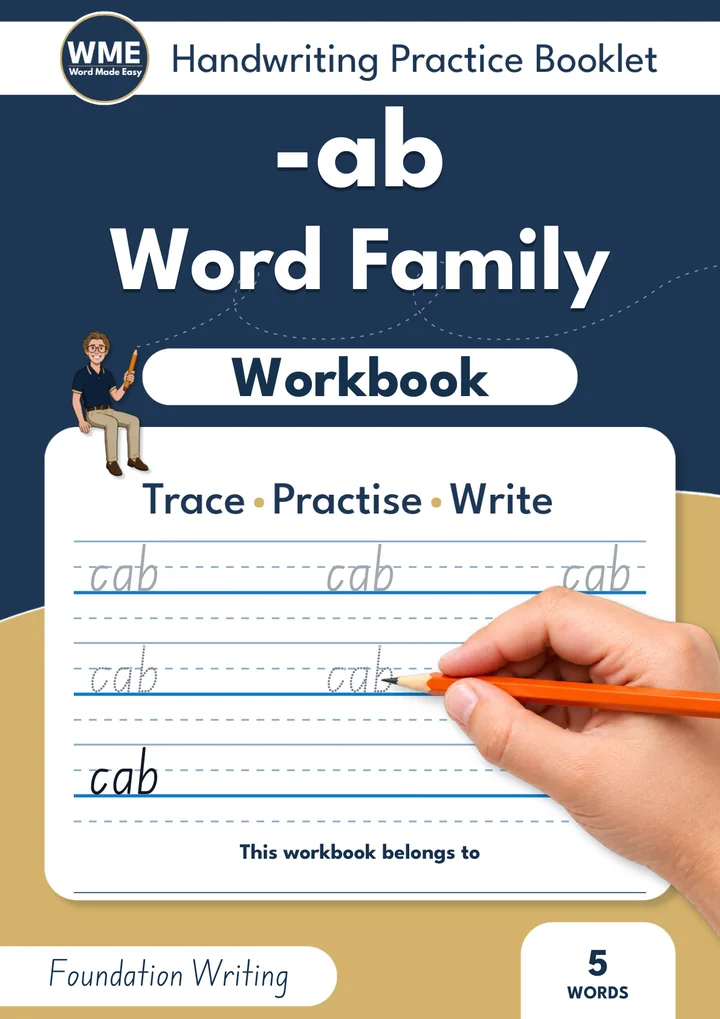
Explore the ab word family through cab, dab, jab, lab and tab. This free Foundation handwriting workbook pairs a picture glossary with grey tracing, dotted tracing and independent word writing, helping children connect five short spellings with their meanings.
Preview what is inside

1 of 3
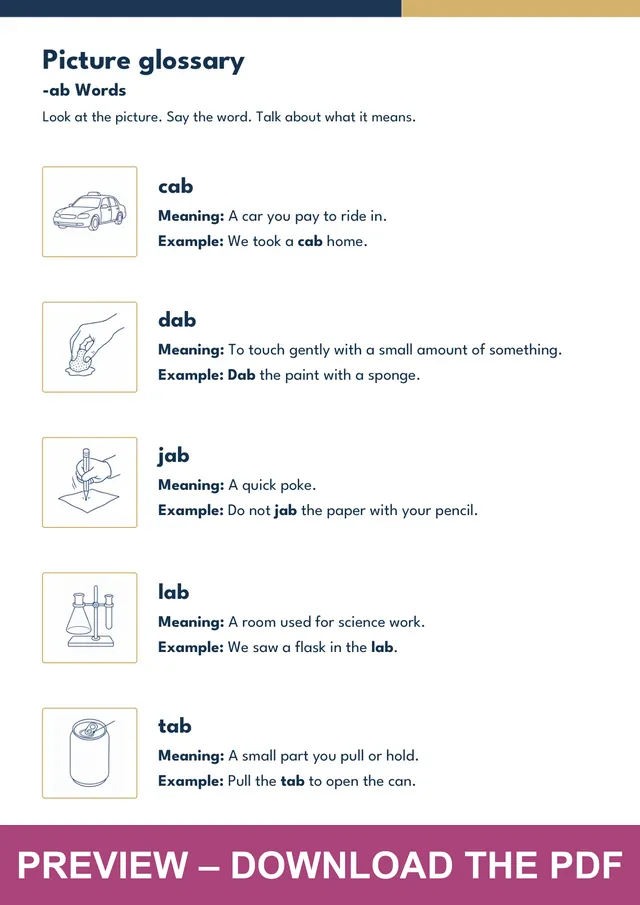
Use the arrows or dots to see the front cover, one glossary page and one handwriting sheet. The two inside-page previews are watermarked; download the PDF for clean printable pages.
Use Short A CVC Words Poster (12 Picture Words) to revisit the short-a sound in a wider set of words. If forming the final b is still difficult, return to the relevant page in Alphabet Letter Formation Worksheets A-Z before asking for a whole written word.
About this ab word family
In the ab word family, the ending stays the same while the initial letter changes: c, d, j, l and t each join ab. Read every word by attending to all three letters, then ask children to identify the part they can see again. Recognising the shared ending should support careful blending rather than replace it.
Several words may need an explanation before handwriting begins. Cab is a car that passengers pay to use; lab is a short form of laboratory. Dab and jab describe different movements, while a tab is something small that can be held or pulled. The glossary provides meanings and short sentences so these less familiar examples are not simply copied without understanding.
What is included?
- 5 words: cab, dab, jab, lab, tab.
- 1 picture-glossary page with meanings and example sentences.
- 1 handwriting sheet using grey models, dotted letters and independent copying space.
- 6 PDF pages in total: front cover, instructions, glossary, handwriting sheets and two terms pages.
How to use this ab word family
Begin with cab and point to each letter as you model the sounds and blend them. Read its glossary sentence, then invite a child to explain when someone might use a cab. Turn to the handwriting sheet only after the spoken word has a clear meaning.
Show the route through the three strips for one word: trace the pale models, follow the dotted letters, and finally copy from the black model into the remaining space. Keep the tall stem of b above the middle guide and its rounded part on the baseline. In dab, draw attention to the different starting movements for d and b.
Work through the other examples in short sections. Ask pupils to say the word they have just written and check the first letter, the a and the final b against the model. A readable, correctly ordered word is a more useful goal than filling the whole sheet quickly.
Teaching and follow-up ideas
- Compare dab and jab orally: describe a gentle touch with paint and a quick poke, without asking children to poke each other.
- Use separate letter cards to change cab into lab, then tab. Read each new word before writing it.
- Ask learners to find a real tab on suitable packaging and explain how it is used.
- Cover a completed cab row and invite pupils to write cab once from memory on separate paper, then check all three letters.
Support and challenge
For a learner who reverses b and d, isolate dab and rehearse the two formations separately before returning to the whole word. Keep the printed model visible and reduce the number of repetitions.
For an additional challenge, ask pupils to compose an oral sentence containing lab or tab and explain its meaning. Write an agreed sentence together on separate paper; the workbook itself supplies word-writing practice, not a sentence-writing exercise.
Where this fits in learning
This booklet suits a lesson in which the short-a sound and the five initial consonants have already been introduced. Choose individual words if some correspondences are still new. After secure reading and writing, mix these words with another short-a ending so children must attend to the final consonant instead of assuming every word ends in b.
Teachers planning a consistent approach to starting points, direction and letter size can consult the handwriting guidance and resources collected by NSW Education. Match the demonstrations to the script taught in your setting: NSW handwriting teaching resources.
Resource licence
Free for personal, homeschool or single-classroom use under the terms included in the PDF. Resale, redistribution and uploading the file to another website are not permitted.
Questions about this workbook
Which ab word family words are included?
The five practice words are cab, dab, jab, lab and tab. Each has a glossary meaning and example sentence, followed by handwriting practice.
Does the workbook teach the meanings of lab and tab?
Yes. Lab is presented as a room used for science work, and tab as a small part that can be pulled or held. Discuss the accompanying examples before writing.
How many pages will I download?
The PDF has six pages: a cover, an instruction page, one picture glossary, one handwriting sheet and two terms pages.
Is this joined handwriting?
No. This edition uses Foundation letterforms, with grey and dotted tracing followed by independent copying.
Should children memorise ab as a whole word?
No. It is a shared spelling ending. Model each complete word through its individual letter-sound correspondences, then notice the repeated ending.
Can I print just the activity sheet?
Yes. Select the glossary or handwriting page in the print dialogue as needed, and retain the supplied terms of use with the resource.
Leave a Reply