AD Word Family Handwriting Workbook
Free printable Foundation handwriting resource
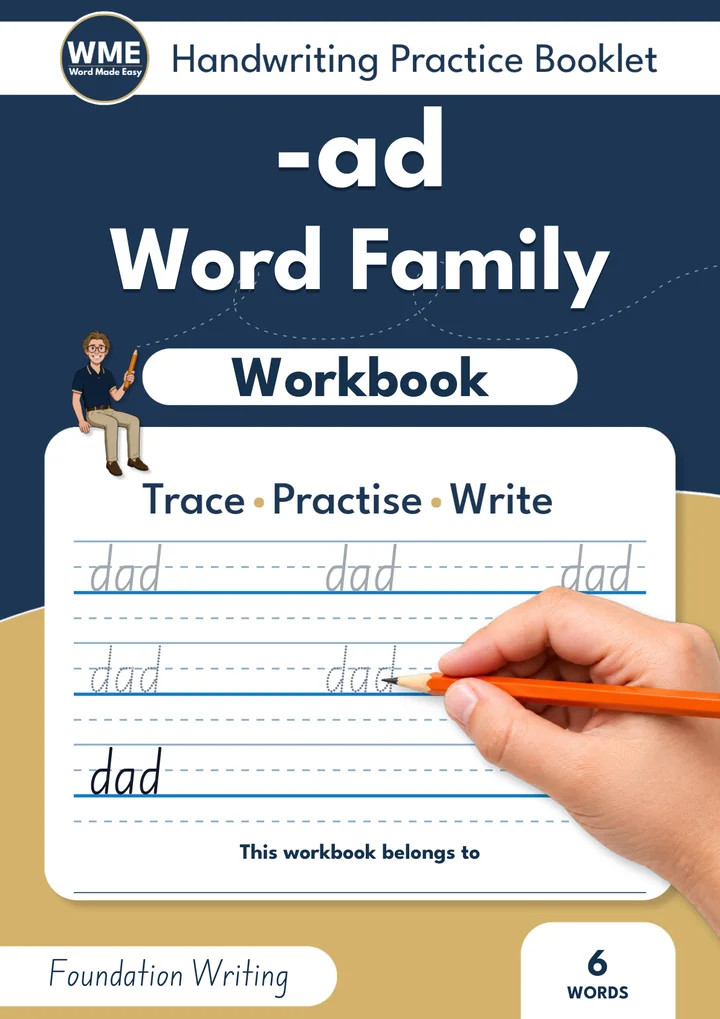
Practise the ad word family with dad, had, lad, mad, pad and sad. Two Foundation handwriting sheets follow a glossary that explains both familiar people and feelings and the less concrete word had.
Preview what is inside

1 of 3
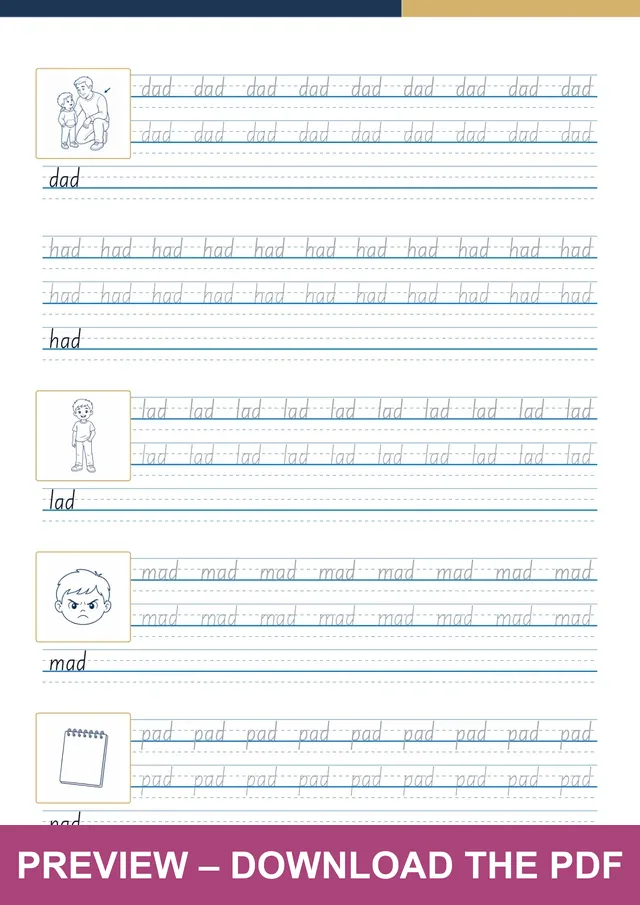
Use the arrows or dots to see the front cover, one glossary page and one handwriting sheet. The two inside-page previews are watermarked; download the PDF for clean printable pages.
Compare the ad ending with the groups on CVC Word Families Poster. For the individual letter movements used in dad and sad, select the relevant examples from Alphabet Letter Formation Worksheets A-Z.
About this ad word family
Dad and lad refer to people, pad names an object, and mad and sad describe feelings. Had is different: its meaning becomes clearer in a sentence about something someone possessed or experienced. Read the glossary examples aloud before treating all six words as equally familiar.
The repeated a-d ending provides a stable writing sequence while the first letter changes. Dad gives children two opportunities to form d in one word. Check that the rounded part and tall stem follow the model, particularly when learners confuse d with b.
What is included?
- 6 words: dad, had, lad, mad, pad, sad.
- 2 picture-glossary pages with meanings and example sentences.
- 2 handwriting sheets using grey models, dotted letters and independent copying space.
- 8 PDF pages in total: front cover, instructions, glossary, handwriting sheets and two terms pages.
How to use this ad word family
Introduce dad and pad together, reading every letter before comparing their endings. Let children point out what changes at the beginning. Demonstrate the d movement slowly, then work through the grey, dotted and independent strips for the selected word.
Pause at had and use a spoken sentence such as 'I had a bag'. Ask who had the bag and what they had. This checks understanding without asking pupils to illustrate an abstract verb. Return to the printed model and write had with the h reaching above the middle guide.
For mad and sad, discuss a fictional character rather than requiring personal disclosures. Children can explain how the character might feel, then copy the word and reread it. Split the two handwriting sheets across lessons if concentration starts to decline.
Meanings in the ad word family glossary
dad
Meaning: Another word for father.
Example: My dad reads with me.
had
Meaning: Owned or experienced something in the past.
Example: I had a nap.
lad
Meaning: A boy.
Example: The lad has a cap.
mad
Meaning: Feeling very angry.
Example: I felt mad when my toy broke.
pad
Meaning: A set of paper sheets joined together.
Example: Draw a cat on the pad.
sad
Meaning: Feeling unhappy.
Example: The lost dog looks sad.
Teaching and follow-up ideas
- Make a spoken contrast between a sad lad and a glad character; explain that glad is an extra oral example, not a word on these sheets.
- Sort the six printed words into people, feelings, an object and a word needing sentence context.
- Compare the first and last d in dad and select the clearer formation.
- Ask a partner to read pad after you have written it, then check whether p descends below the baseline.
Support and challenge
Keep dad and pad visible side by side when p and d are confused. Rehearse their different directions and heights before copying either whole word. Extend secure writing by composing a short oral sentence with had and choosing the next word together.
Where this fits in learning
Use the ad word family after the relevant initial sounds have been taught. It can connect letter practice with simple discussion of people and feelings, but accurate decoding still requires attention to the initial consonant. Later, contrast pad with another short-a word whose final consonant changes.
For further teacher reference when modelling the letter movements in dad and sad, NSW Education collects handwriting sequences and advice on formation, posture and pencil grasp. These are background teaching resources, not a claim that this booklet follows a particular syllabus: NSW handwriting teaching resources.
Resource licence
Free for personal, homeschool or single-classroom use under the terms included in the PDF. Resale, redistribution and uploading the file to another website are not permitted.
Questions about this workbook
Why does had need an example sentence?
Had describes a past situation rather than an easily pictured object. An oral example helps children understand the word they are tracing.
Which ad word family spellings are practised?
dad, had, lad, mad, pad, sad. The glossary gives a meaning and sentence for every entry.
What is in the downloadable PDF?
There are 8 pages altogether: a front cover, one instruction page, 2 glossary page(s), 2 handwriting sheet(s) and two terms pages.
What handwriting style does this edition use?
Foundation letterforms, with grey models and dotted tracing followed by copying into ruled space.
Can I use dad on its own?
Yes. Choose the word group that matches your lesson and leave the others for another session. Read its glossary meaning and example first.
Leave a Reply