
SATPIN Sound and Picture Matching Worksheet
Free printable Phase 2 phonics resource
This free satpin sound picture matching worksheet helps pupils match the graphemes a, n, i, s, p and t to six pictures. It uses igloo, apple, nose, spaghetti, tiger and pear to build confidence with connecting each initial phoneme with its written grapheme.
Preview the worksheet
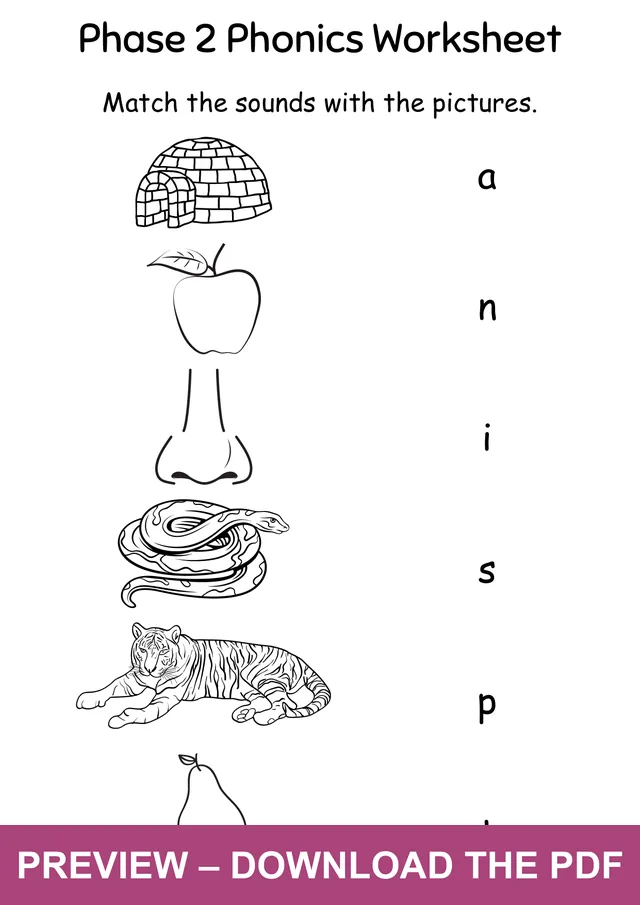
This satpin sound picture matching worksheet is shown as a reduced-resolution, watermarked preview. The downloaded PDF is the clean printable version.
For a nearby activity, open P Sound Recognition and Word Completion Worksheet. Continue the sequence with SATPIN Initial Sound Multiple-Choice Worksheet after pupils can explain their choices independently.
About this satpin sound picture matching worksheet
The SATPIN Sound and Picture Matching Worksheet asks children to match the graphemes a, n, i, s, p and t to six pictures. Pupils encounter igloo, apple, nose, spaghetti, tiger and pear, so the written explanation matches the prompts on the printable rather than describing a generic phonics sheet.
Its specific teaching purpose is connecting each initial phoneme with its written grapheme. Introduce the relevant vocabulary and sound correspondence first, then use the SATPIN Sound and Picture Matching Worksheet to see whether children can apply that knowledge to these examples without relying on guesswork.
What is included?
The satpin sound picture matching worksheet task: Learners match the graphemes a, n, i, s, p and t to six pictures.
The exact prompt set: This resource uses igloo, apple, nose, spaghetti, tiger and pear.
A defined learning focus: Responses provide practice with connecting each initial phoneme with its written grapheme.
The complete SATPIN Sound and Picture Matching Worksheet PDF: The download has 1 printable activity page and two Word Made Easy information pages, giving 3 pages altogether.
What children will practise
- using the instructions on the satpin sound picture matching worksheet accurately;
- pronouncing and discussing igloo, apple, nose, spaghetti, tiger and pear;
- applying sound, spelling and meaning clues while they match the graphemes a, n, i, s, p and t to six pictures;
- checking each response against the central aim of connecting each initial phoneme with its written grapheme;
- explaining which clue made a selected answer appropriate.
How to use the SATPIN Sound and Picture Matching Worksheet
Establish the language: Before showing the satpin sound picture matching worksheet, name or read the relevant examples and confirm that pupils understand what each one means.
Model its exact response: Demonstrate how to match the graphemes a, n, i, s, p and t to six pictures with the first suitable prompt. For the SATPIN Sound and Picture Matching Worksheet, say which sound or grapheme you notice and why the chosen response fits.
Watch for the learning aim: As children continue the SATPIN Sound and Picture Matching Worksheet, listen for evidence of connecting each initial phoneme with its written grapheme. Use a short satpin sound picture matching worksheet question to uncover their reasoning instead of immediately giving an answer.
Read the completed work: Revisit igloo, apple, nose, spaghetti, tiger and pear after marking. While reviewing the SATPIN Sound and Picture Matching Worksheet, correct confusion and ask pupils to explain one response in a full sentence.
Extension ideas for this resource
- Recreate two prompts from the satpin sound picture matching worksheet with movable letters or word cards.
- Compare selected items from igloo, apple, nose, spaghetti, tiger and pear by sound position, spelling or word length.
- Ask pupils to use one answer from the SATPIN Sound and Picture Matching Worksheet in a spoken sentence.
- Hide the picture support from the SATPIN Sound and Picture Matching Worksheet and see which items can still be read or recalled.
- Collect one new example that demonstrates connecting each initial phoneme with its written grapheme and explain why it belongs.
Support and challenge
Support for the satpin sound picture matching worksheet: Reveal only a few prompts, rehearse their names and offer the smallest useful set of choices. On the SATPIN Sound and Picture Matching Worksheet, let the pupil point or build an answer before requiring independent writing.
Challenge after the SATPIN Sound and Picture Matching Worksheet: Remove one scaffold, request oral segmentation where appropriate and ask the learner to create another item that practises connecting each initial phoneme with its written grapheme.
Where this resource fits
Use the satpin sound picture matching worksheet after the featured correspondence has been taught and before expecting the same skill in less controlled reading or writing. Because the activity asks pupils to match the graphemes a, n, i, s, p and t to six pictures, it can work as guided practice, an independent check or a focused revisit.
Plan the SATPIN Sound and Picture Matching Worksheet within your school’s established phonics order. The Department for Education reading framework explains why systematic progression and accurate decoding matter; the next step should transfer connecting each initial phoneme with its written grapheme into decodable words or connected text.
Resource licence
Free for personal and classroom use. You may print copies for yourself or your learners. Resale, redistribution and uploading the file to other websites are not permitted.
Questions about the satpin sound picture matching worksheet
What does the satpin sound picture matching worksheet practise?
Its main focus is connecting each initial phoneme with its written grapheme.
Which examples are in the SATPIN Sound and Picture Matching Worksheet?
The printable uses igloo, apple, nose, spaghetti, tiger and pear.
How should I introduce this satpin sound picture matching worksheet?
Review the target correspondence and vocabulary, then model how to match the graphemes a, n, i, s, p and t to six pictures with the first appropriate prompt.
How can I support a learner using the SATPIN Sound and Picture Matching Worksheet?
Show fewer prompts from the SATPIN Sound and Picture Matching Worksheet, rehearse their names and reduce the letter or word choices before expecting an independent response.
How many printable pages are in the SATPIN Sound and Picture Matching Worksheet PDF?
The SATPIN Sound and Picture Matching Worksheet PDF contains 1 printable activity page plus the Word Made Easy thank-you and terms-of-use pages.
What should pupils do after completing the satpin sound picture matching worksheet?
Read or discuss the completed examples, correct any uncertain responses and transfer the focus on connecting each initial phoneme with its written grapheme to a fresh word or sentence.
Leave a Reply