
Phase 2 Word and Picture Matching Worksheet
Free printable Phase 2 phonics resource
This free Phase 2 word and picture matching worksheet asks pupils to draw lines between six printed words and their illustrations. The choices tap, pig, igloo, apple, nose and snake turn initial-sound recognition into a purposeful reading and vocabulary task.
Preview the worksheet
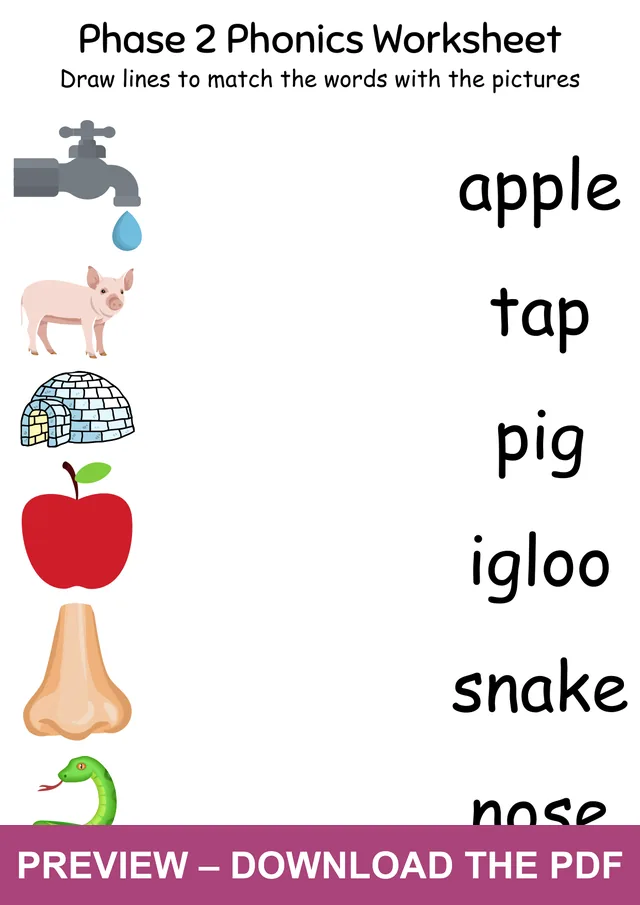
This Phase 2 word and picture matching worksheet is shown as a reduced-resolution, watermarked preview. The downloaded PDF is the clean printable version.
Rehearse segmenting and letter order first with the CVC Word Unscrambling Worksheet. Once pupils can justify all six matches here, use the Phase 2 Real and Nonsense Words Worksheet to shift attention from picture meaning to decoding.
About this Phase 2 word and picture matching worksheet
Six illustrations appear opposite a separate word list. Children draw one line from each picture to the correct label: tap, pig, igloo, apple, nose or snake. The initial letters cover s, a, t, p, i and n, so learners can use the first phoneme to narrow the choices before checking the complete word.
The words vary in length and spelling complexity. Tap and pig offer short blending practice, while apple, igloo, nose and snake are better treated as adult-supported word-recognition choices. This keeps the task honest: it practises initial-sound discrimination and matching rather than pretending every label is independently decodable at the start of Phase 2.
What is included?
Six matching prompts: The worksheet shows pictures of a tap, pig, igloo, apple, nose and snake beside a mixed word list.
Initial-sound coverage: The six answers begin with s, a, t, p, i and n, the first group of Phase 2 graphemes.
Three-page PDF package: One printable activity page is followed by the Word Made Easy thank-you and terms-of-use pages.
What children will practise
- hearing the initial phoneme in six familiar picture names;
- finding a printed word that begins with the corresponding grapheme;
- using word length and known letter patterns to confirm a choice;
- checking that every picture and every label has been used once.
How to use this matching worksheet
Name the pictures: Point to each illustration and agree the intended word before pupils look at the labels. Stretch the first phoneme without adding an extra schwa.
Compare the choices: Ask the learner to find a word beginning with the same grapheme, read or hear the whole choice, and draw the line only when the meaning fits.
Read back each pair: Follow the completed lines in turn. Reread the word, name the picture and check that no item has two matches.
Teaching and activity ideas
- Cover the word list and place letter cards s, a, t, p, i and n beside the pictures before revealing the full labels.
- Read the six words aloud in a different order and ask pupils to point to the correct picture without drawing.
- Sort the completed pairs into short words and longer words, then discuss which clues helped with each group.
- Choose tap and pig for oral phoneme segmentation and blend the sounds back into complete words.
Support and challenge
Support: Offer two labels at a time, say both choices aloud and emphasise their first sounds. Let the pupil point and explain before drawing a line.
Challenge: Hide the labels and ask the learner to write the initial grapheme for every picture. Confident writers can attempt tap and pig from sound talk, then compare their spelling with the printed words.
Where this fits in Phase 2 learning
Use the sheet after children can recognise s, a, t, p, i and n and can hear these sounds at the beginning of spoken words. It bridges isolated grapheme recognition and reading complete labels. Follow it with controlled CVC blending or a real-and-nonsense-word activity, where the picture no longer supplies the answer.
Place this Phase 2 word and picture matching worksheet within the grapheme order used by your school rather than treating it as a stand-alone test. The Department for Education reading framework explains the value of a planned phonics progression and gives schools guidance on early reading practice.
Resource licence
Free for personal and classroom use. You may print copies for yourself or your learners. Resale, redistribution and uploading the file to other websites are not permitted.
Questions about the matching worksheet
What does this Phase 2 word and picture matching worksheet practise?
It practises hearing initial phonemes, locating words that begin with s, a, t, p, i or n, and matching six labels to their pictures.
Which words are included?
The worksheet includes tap, pig, igloo, apple, nose and snake. Each word matches one illustration on the page.
Should pupils read every word independently?
Not necessarily. Several labels extend beyond the earliest Phase 2 correspondences, so an adult can read unfamiliar choices while the learner concentrates on the initial sound and meaning.
How can I reduce the number of choices?
Cover part of the word list and present two or three labels at a time. Reveal the remaining choices when the first matches are secure.
What file will I download?
The download is a three-page PDF containing one printable worksheet plus the Word Made Easy thank-you and terms-of-use pages.
Can I share the PDF with another teacher?
You may print copies for your own learners. Please share the link to this resource page rather than uploading or redistributing the PDF.
Leave a Reply