
Area and Perimeter Worksheets: 10 Free Printables with Answers
Preview every worksheet, choose colour or black and white and your paper size, then download your area and perimeter worksheets in one small ZIP file.
A4 and US Letter10 worksheetsFree
Can’t find the template you need? Request a template and I’ll make it in Word, free.
Get new free printables first: follow Word Made Easy on Pinterest
These free area and perimeter worksheets work through the two measures side by side, so children see why a shape can have a long way round and a small inside, or the other way about. The pack opens with shapes on a squared grid, where the answers come from counting edges and squares, then moves to labelled rectangles, L, U and T shapes, and finishes with compound shapes whose missing sides have to be worked out first. Every drawing uses one scale on its sheet, so a 10 cm side really is twice as long as a 5 cm side. Every answer has been checked, and the shapes on each sheet are drawn to scale.
Below you’ll find the difference between area and perimeter, which sheet to give first, and the mistakes to watch for with compound shapes.
What’s in the Area and Perimeter Worksheets Pack
| Worksheet | What is on it |
|---|---|
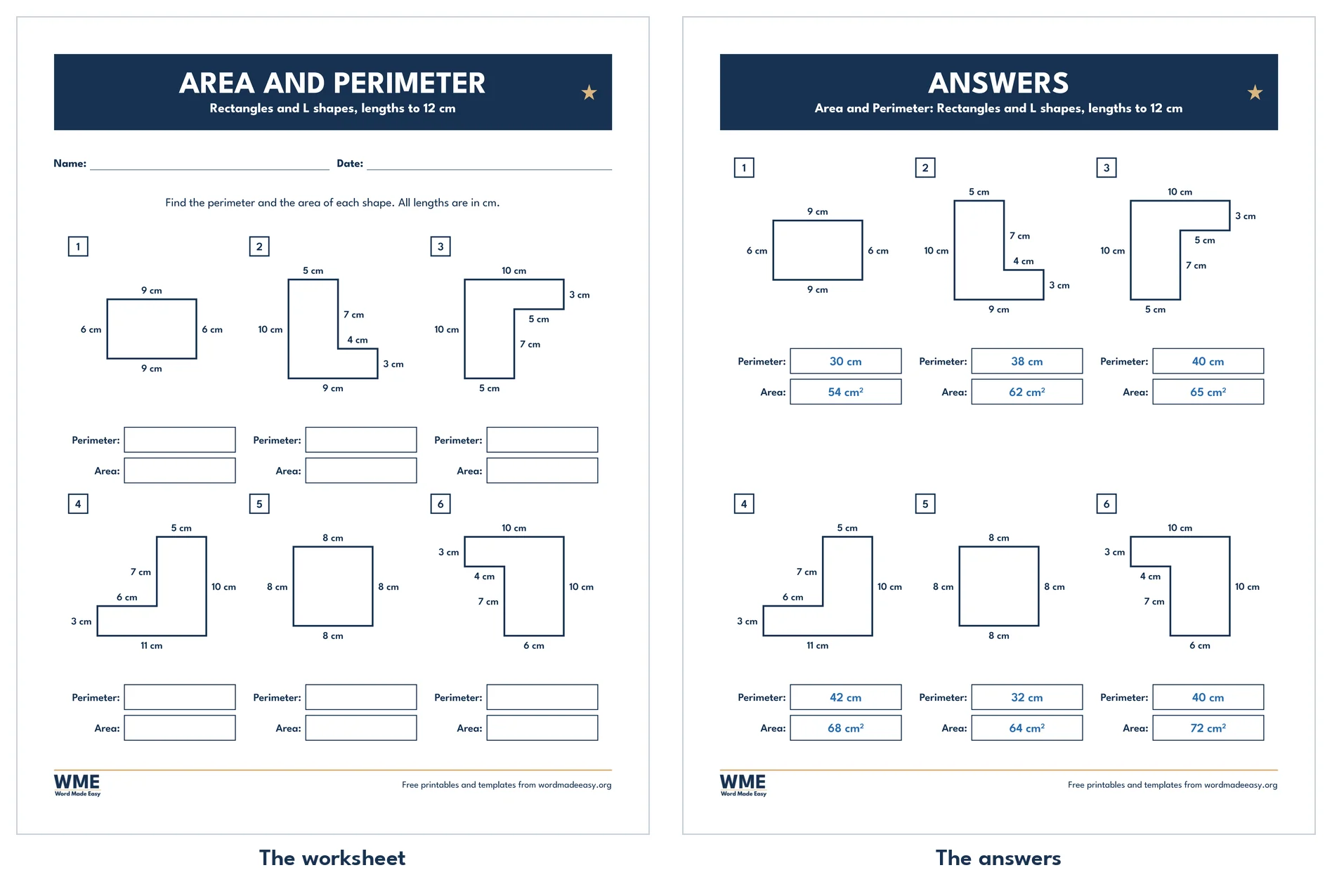
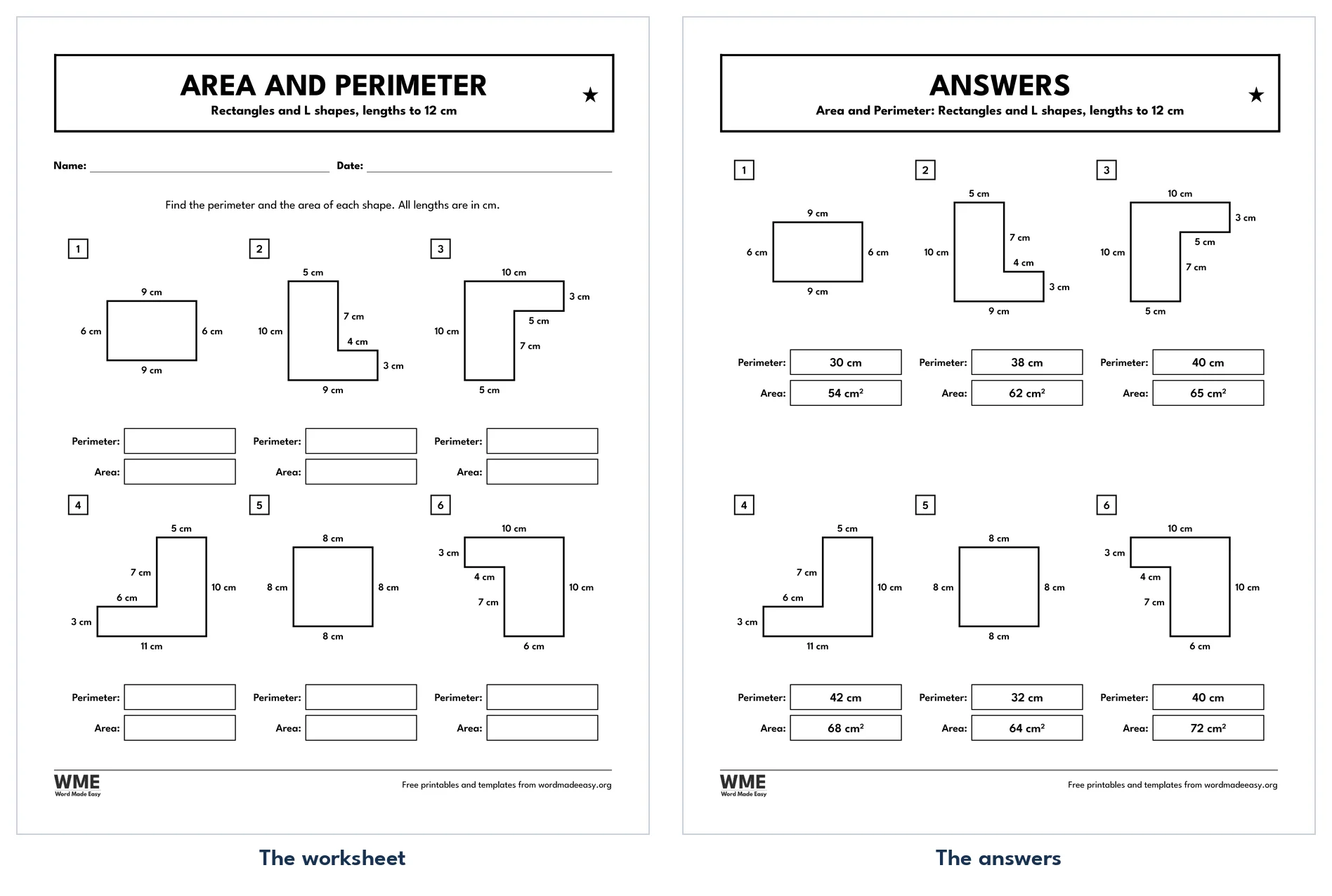
| Rectangles and L Shapes 1 | 1 star: Perimeter and area of rectangles and L shapes, with answers |
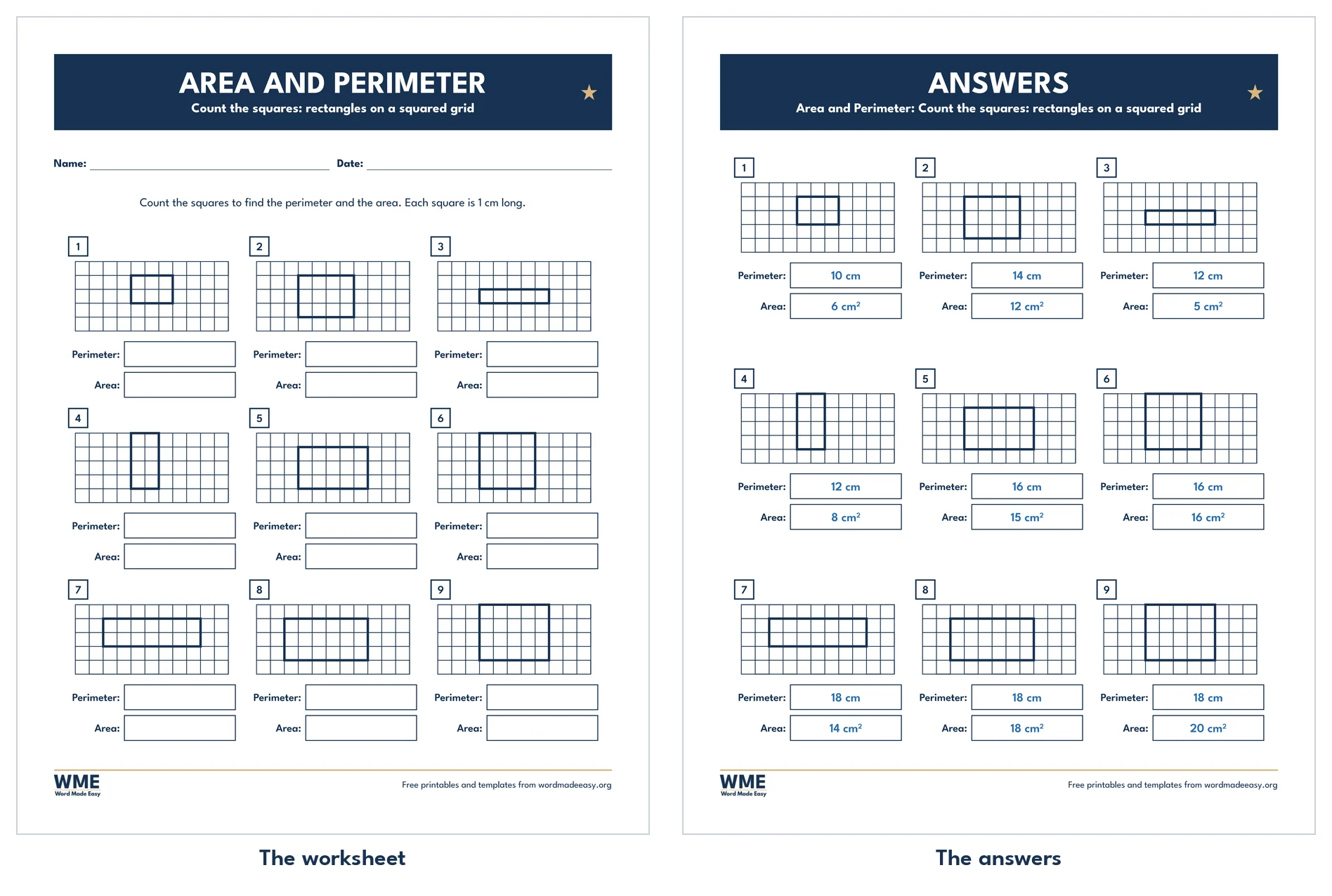
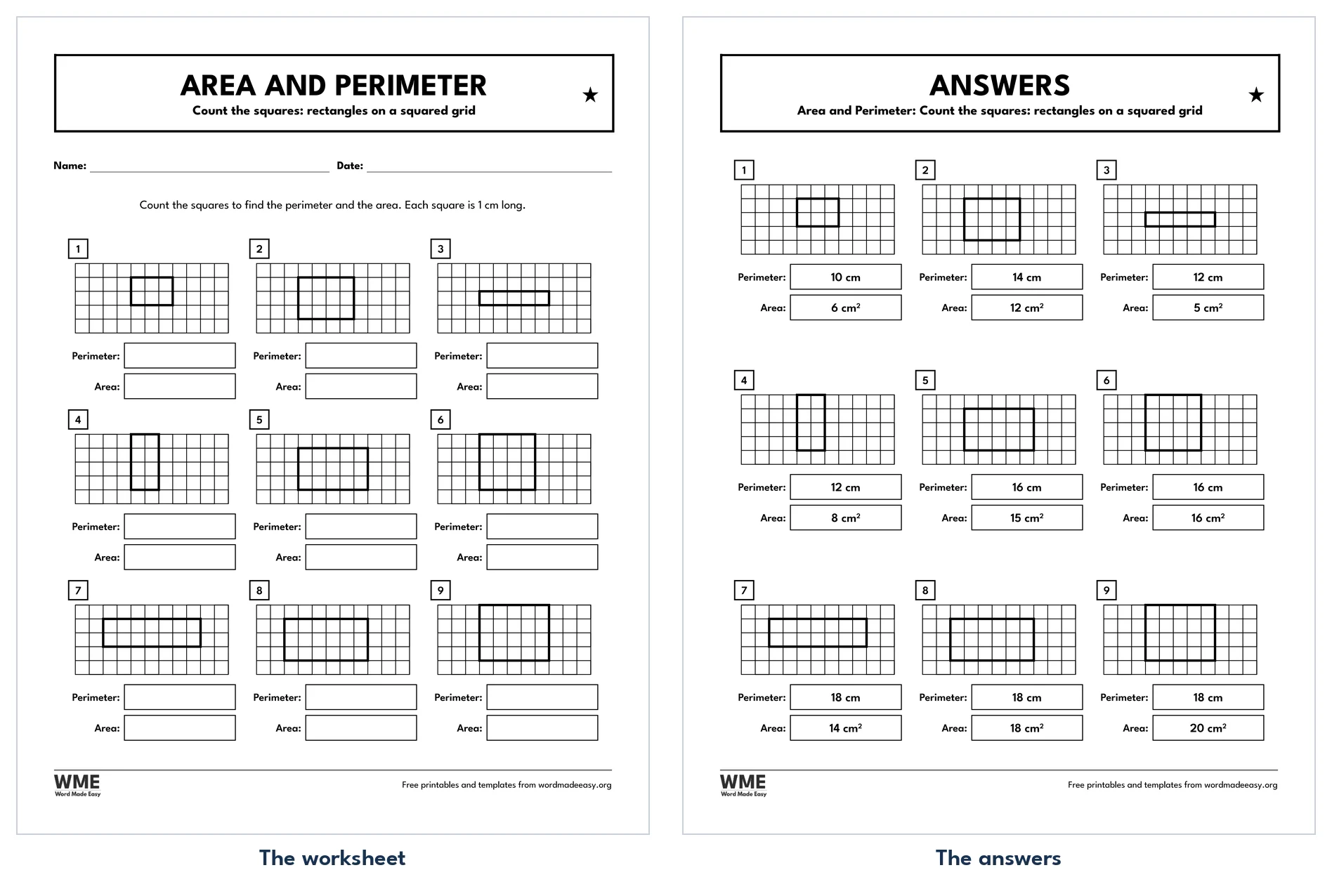
| Count the Squares 2 | 1 star: Count squares to find the perimeter and area of rectangles, with answers |
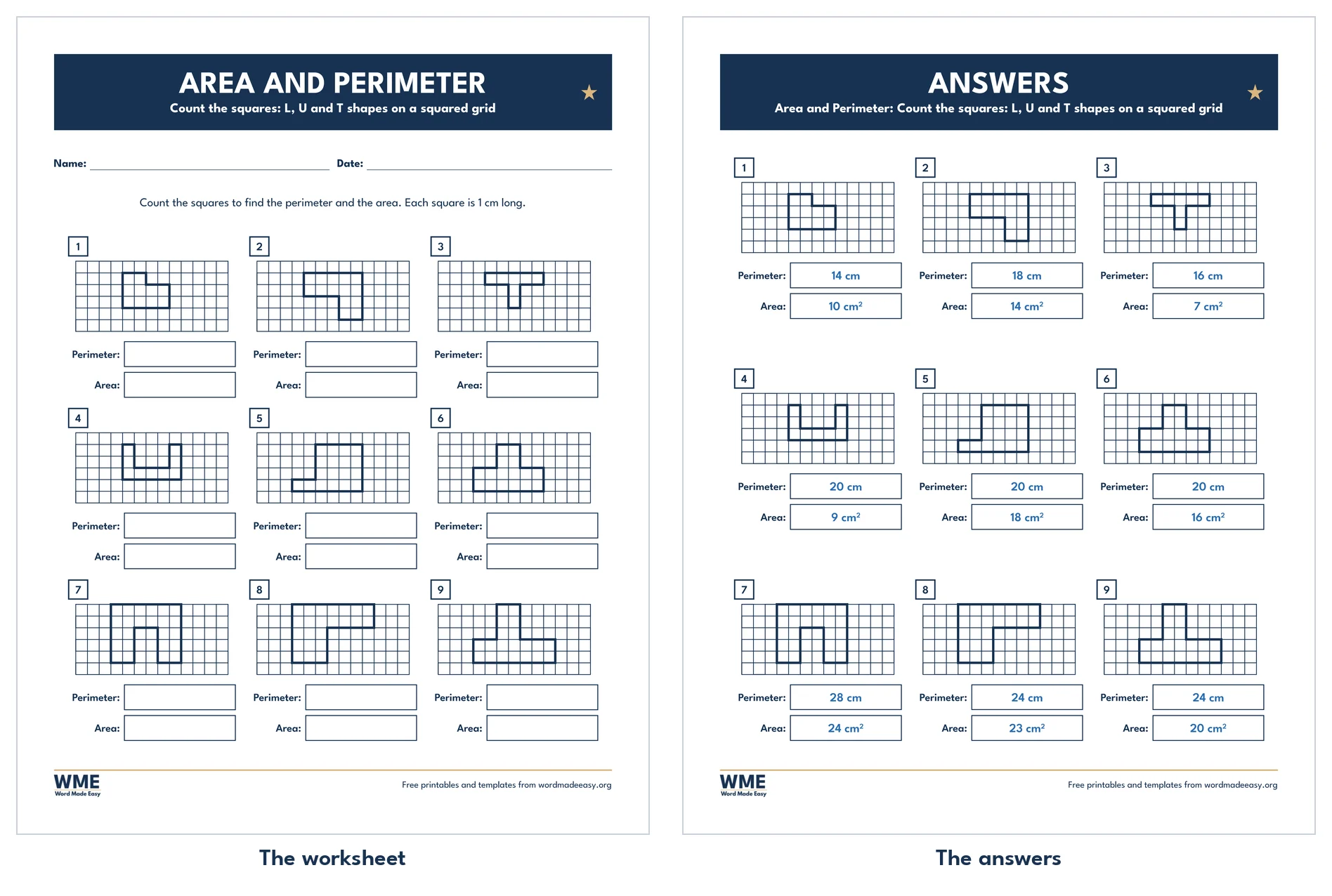
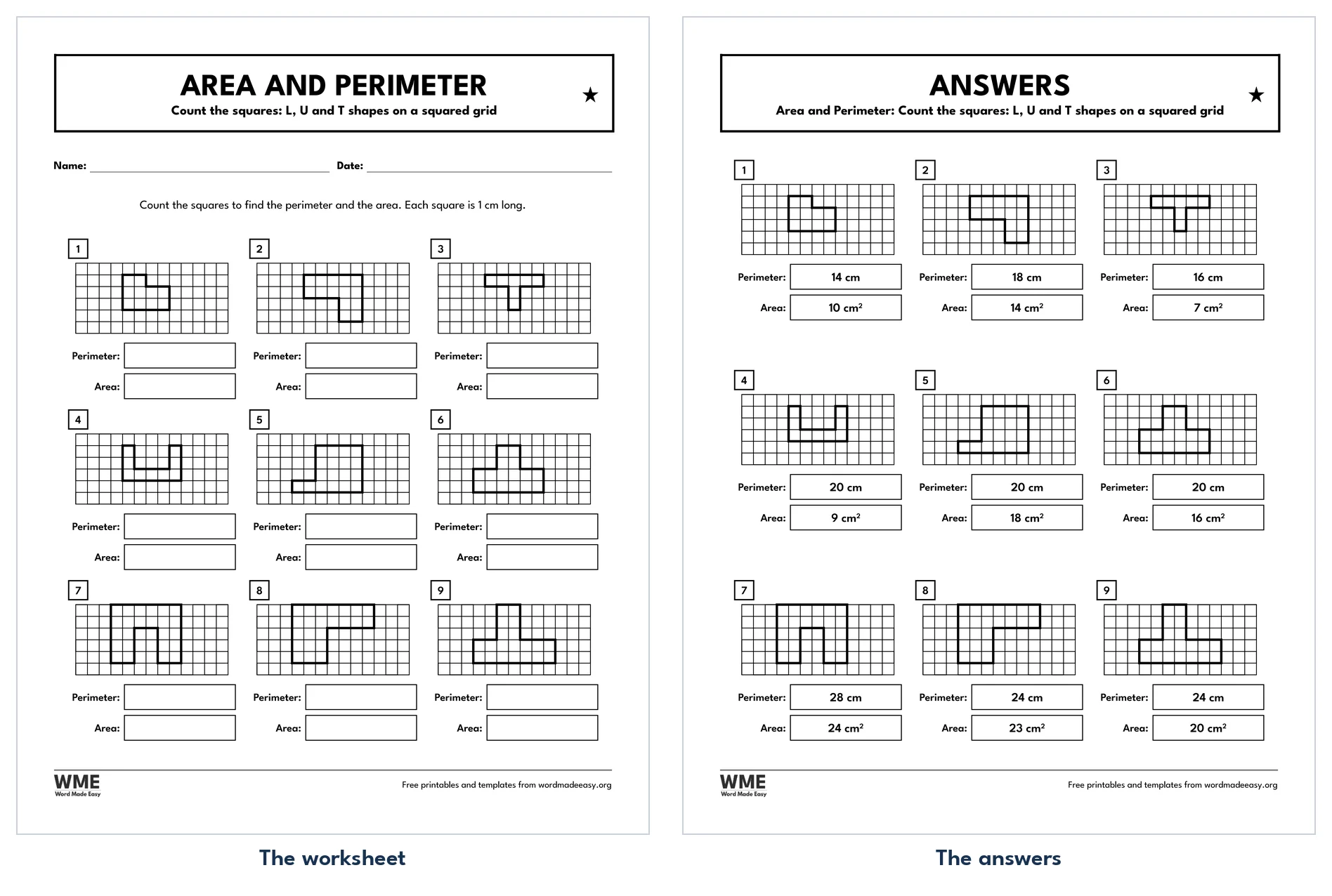
| Count the Squares 3 | 1 star: Count squares to find the perimeter and area of L, U and T shapes, with answers |
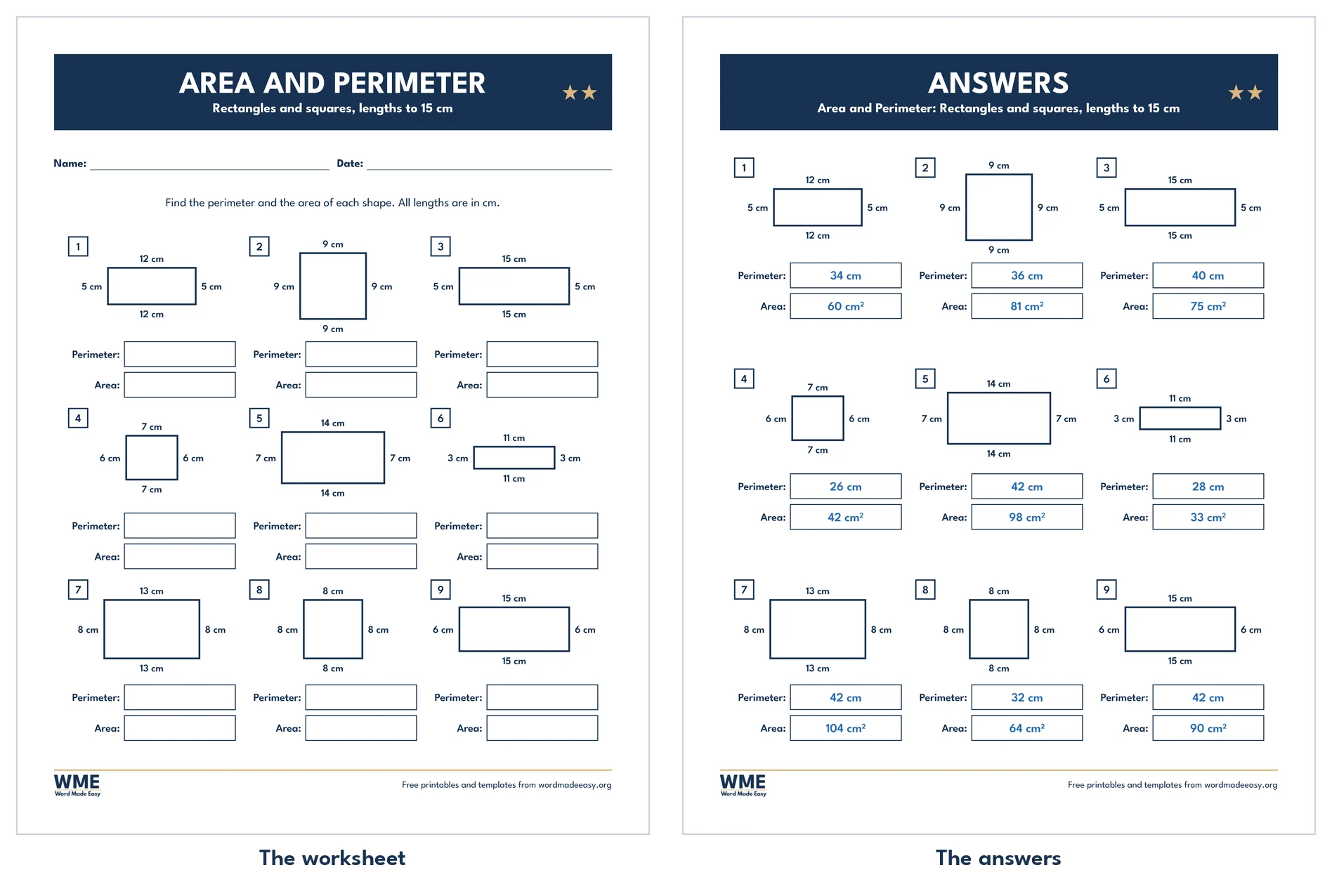
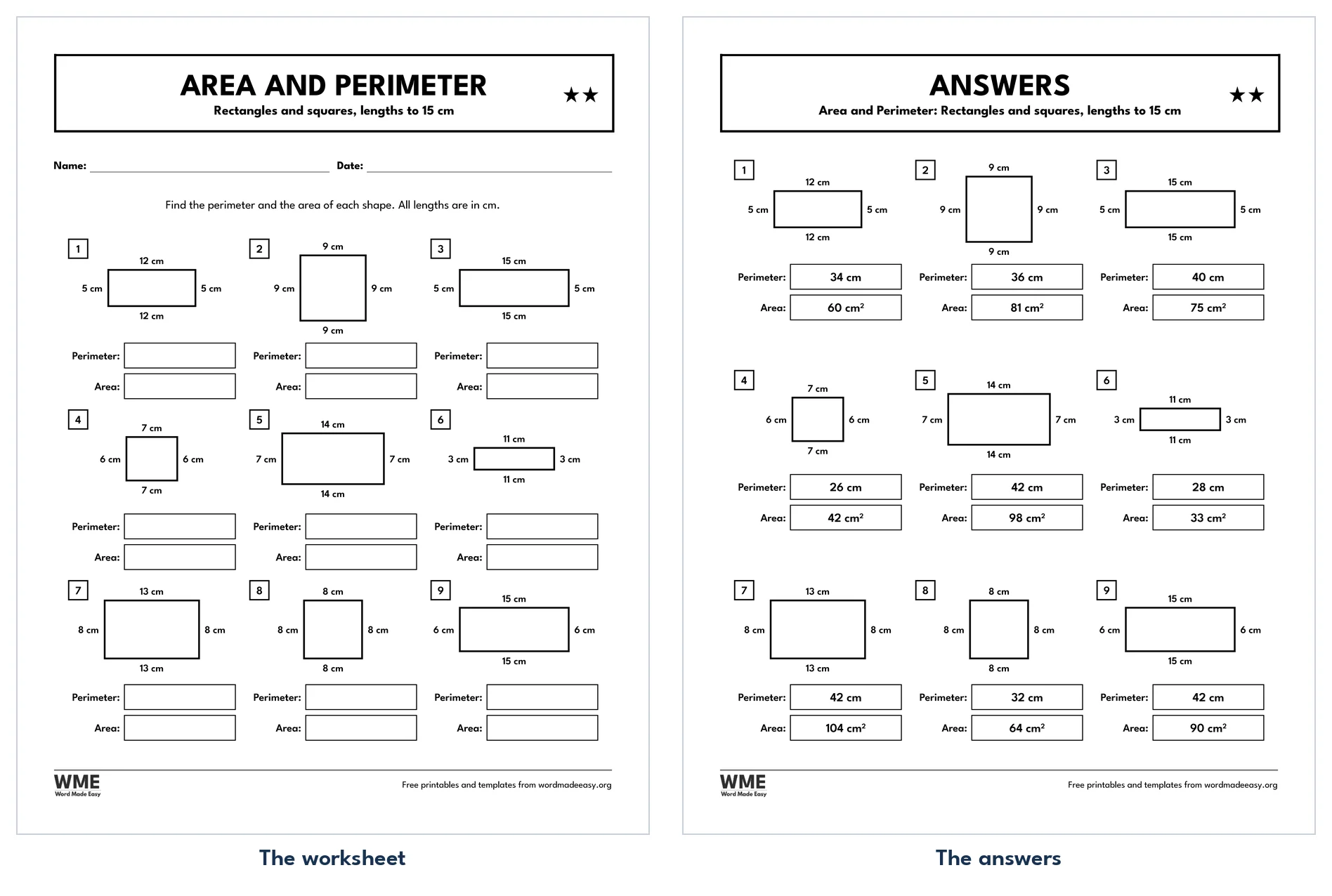
| Rectangles 4 | 2 stars: Perimeter and area of rectangles and squares to 15 cm, with answers |
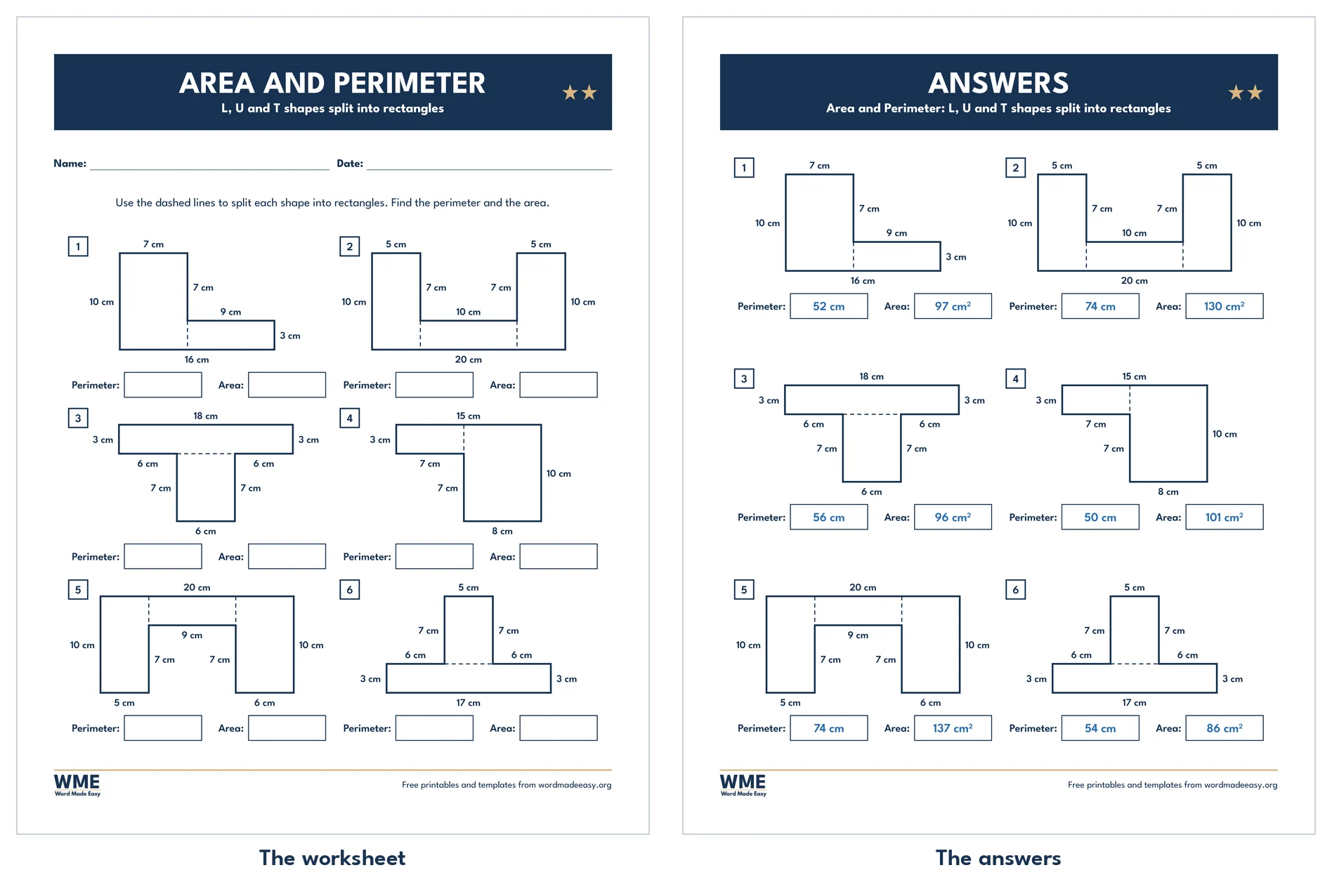
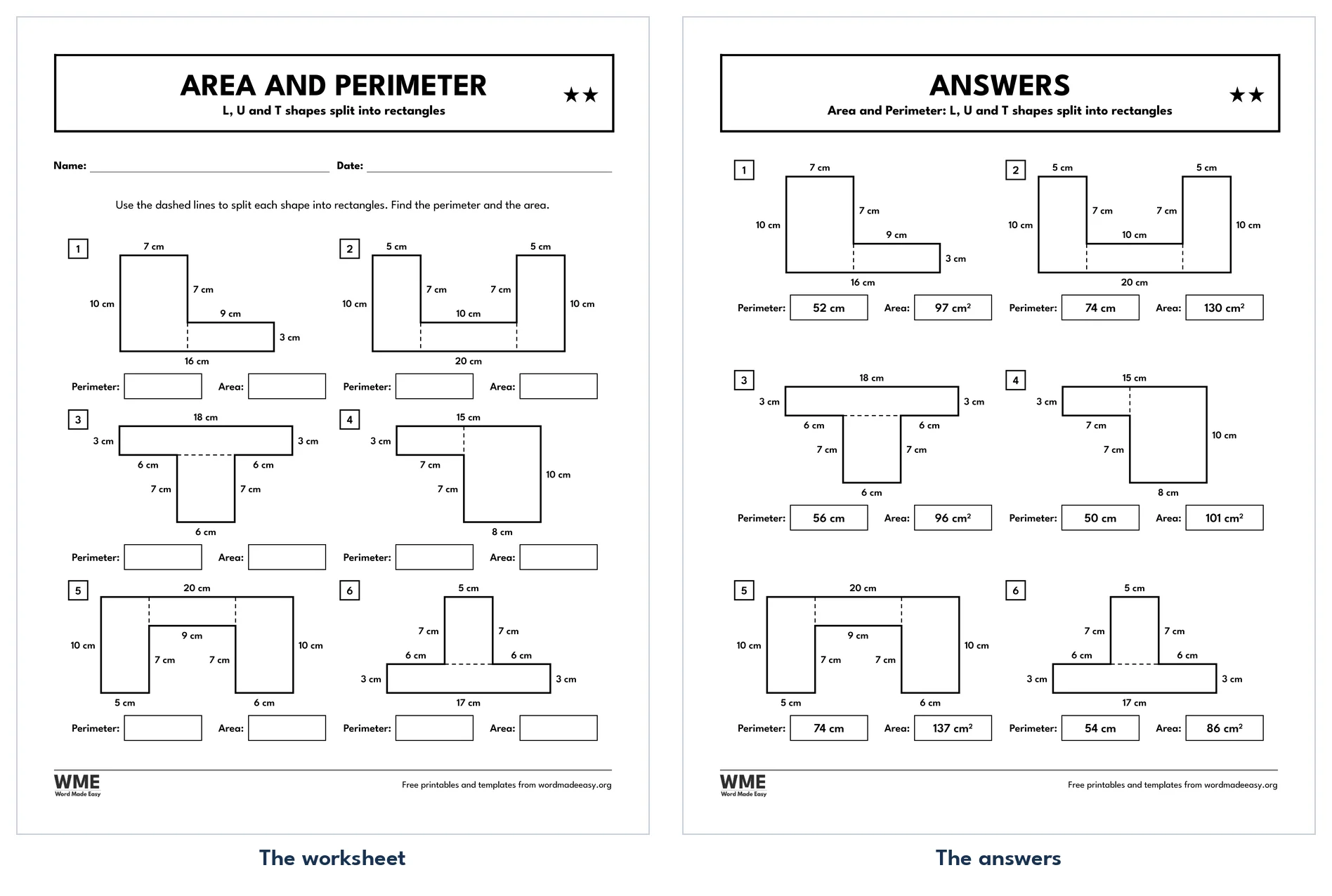
| Compound Shapes 5 | 2 stars: Compound shapes split into rectangles by dashed lines, with answers |
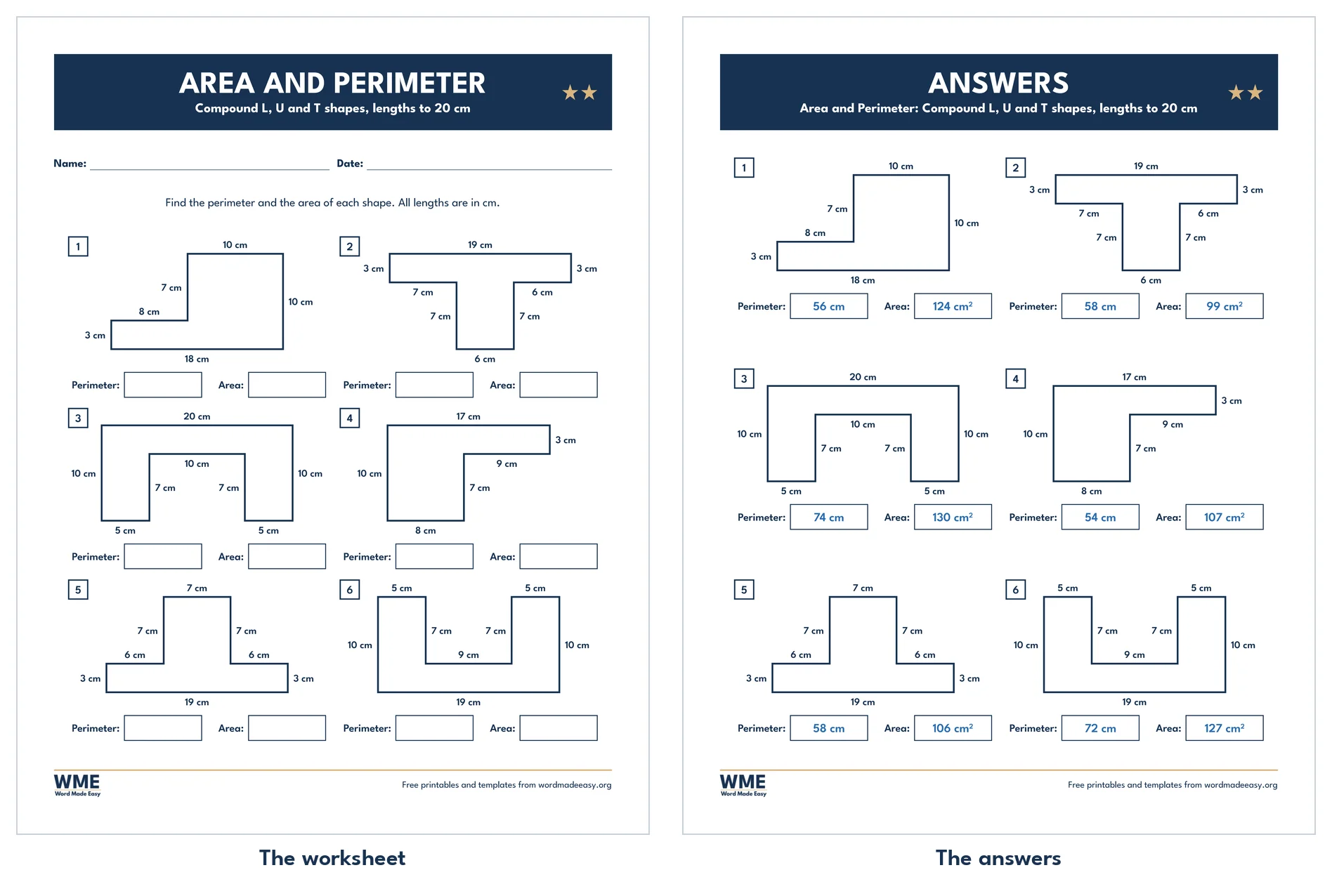
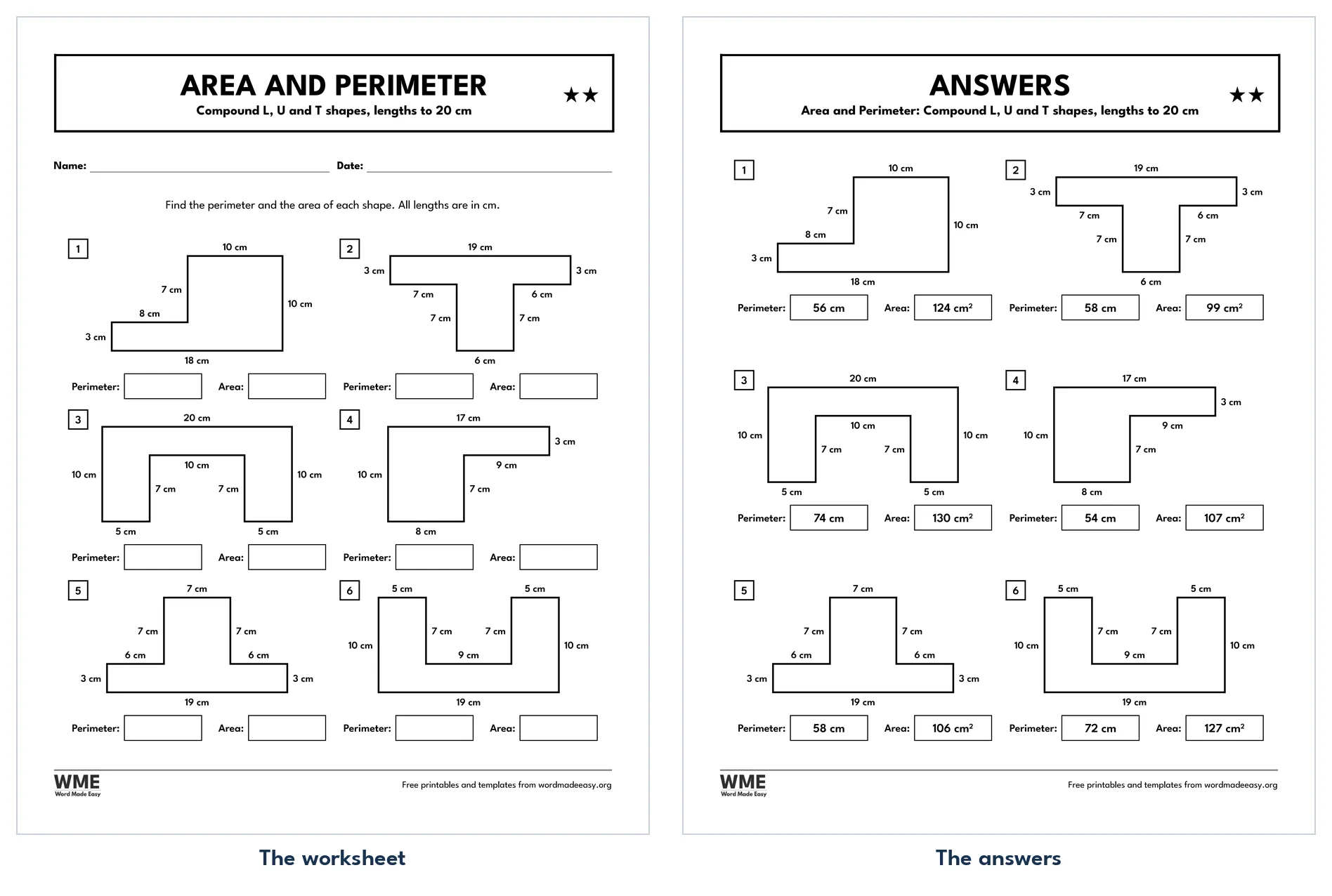
| Compound Shapes 6 | 2 stars: Perimeter and area of compound L, U and T shapes to 20 cm, with answers |
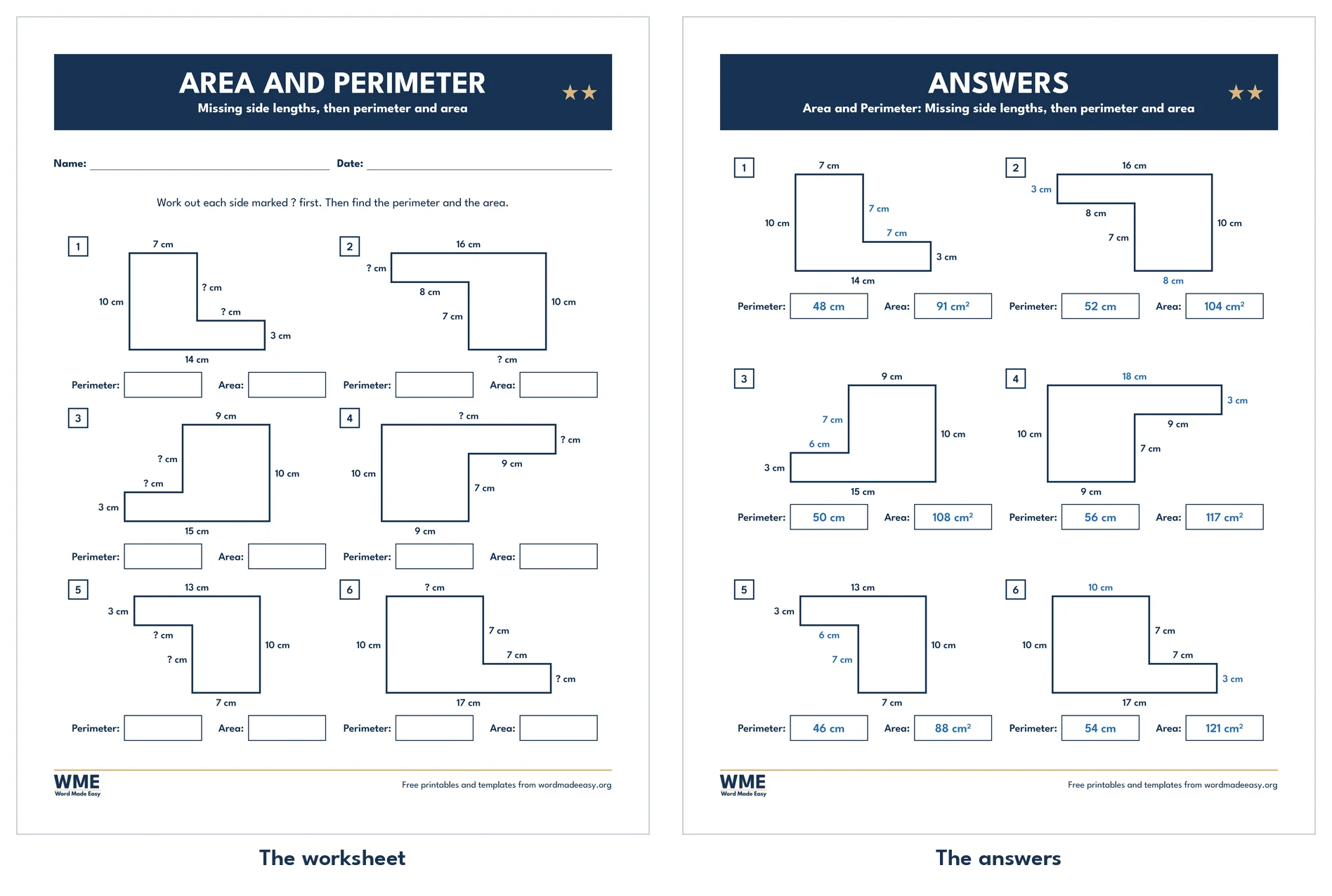
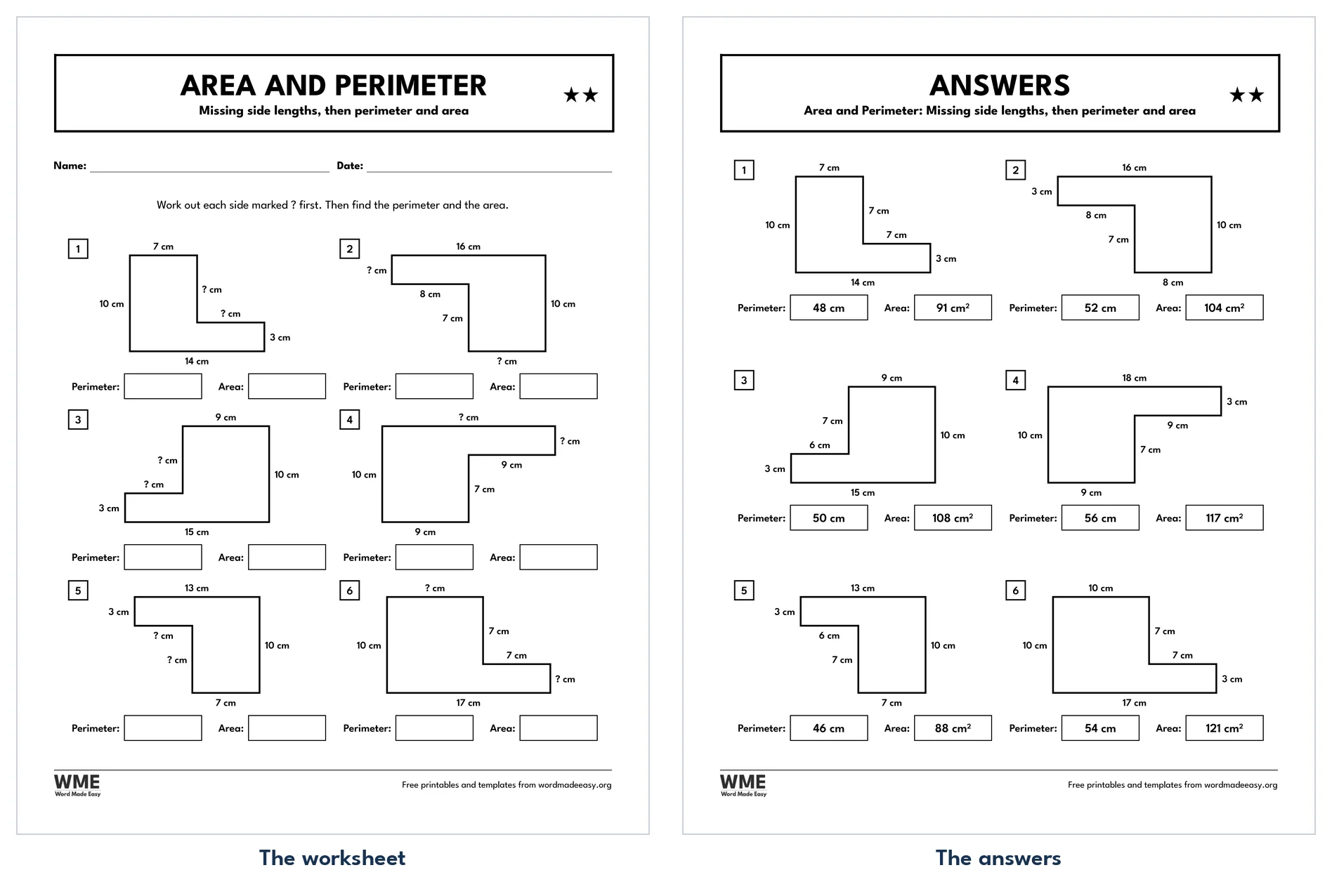
| Missing Side Lengths 7 | 2 stars: Work out the missing sides of L shapes, then perimeter and area, with answers |
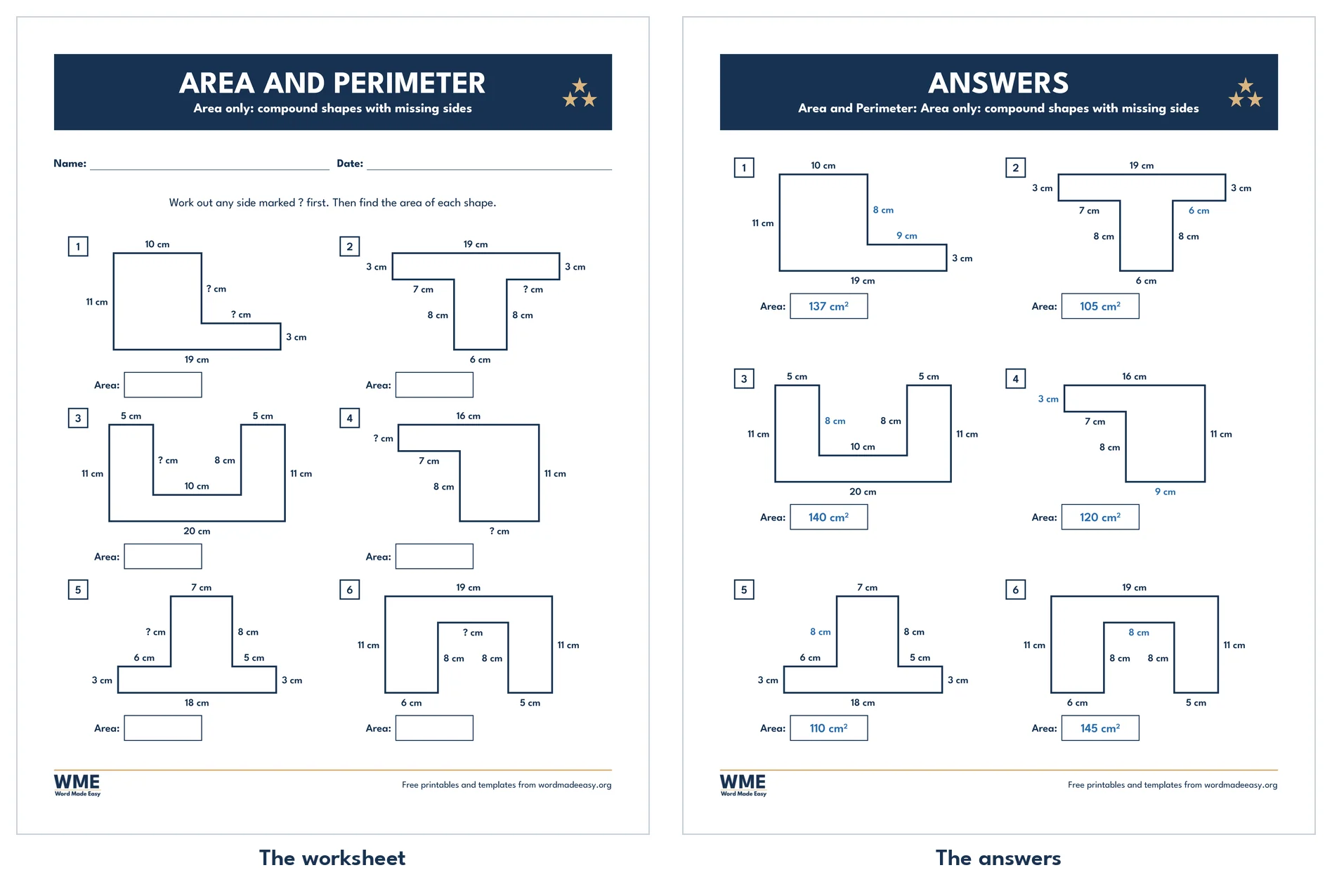
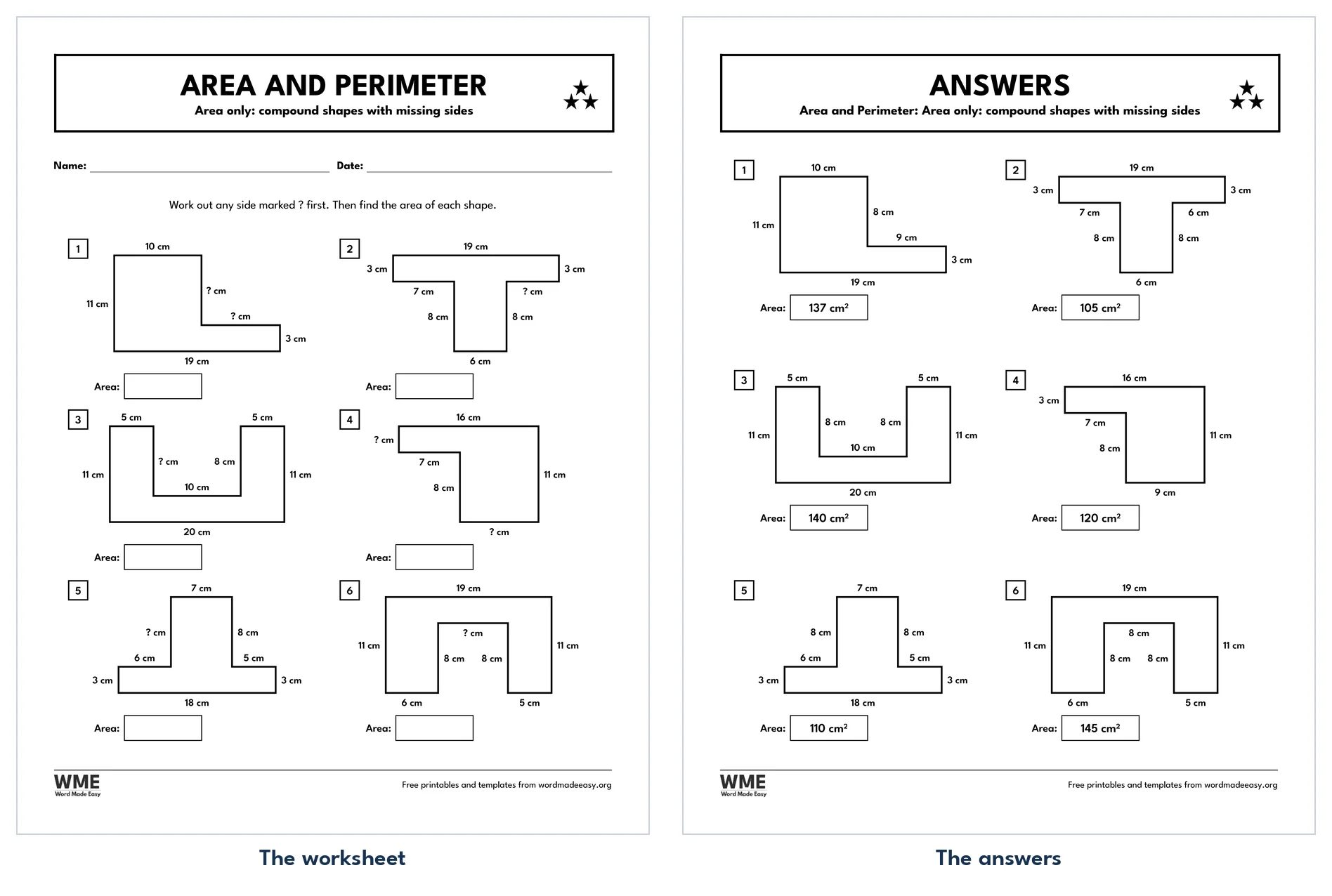
| Area Only 8 | 3 stars: Area of compound shapes with missing sides, with answers |
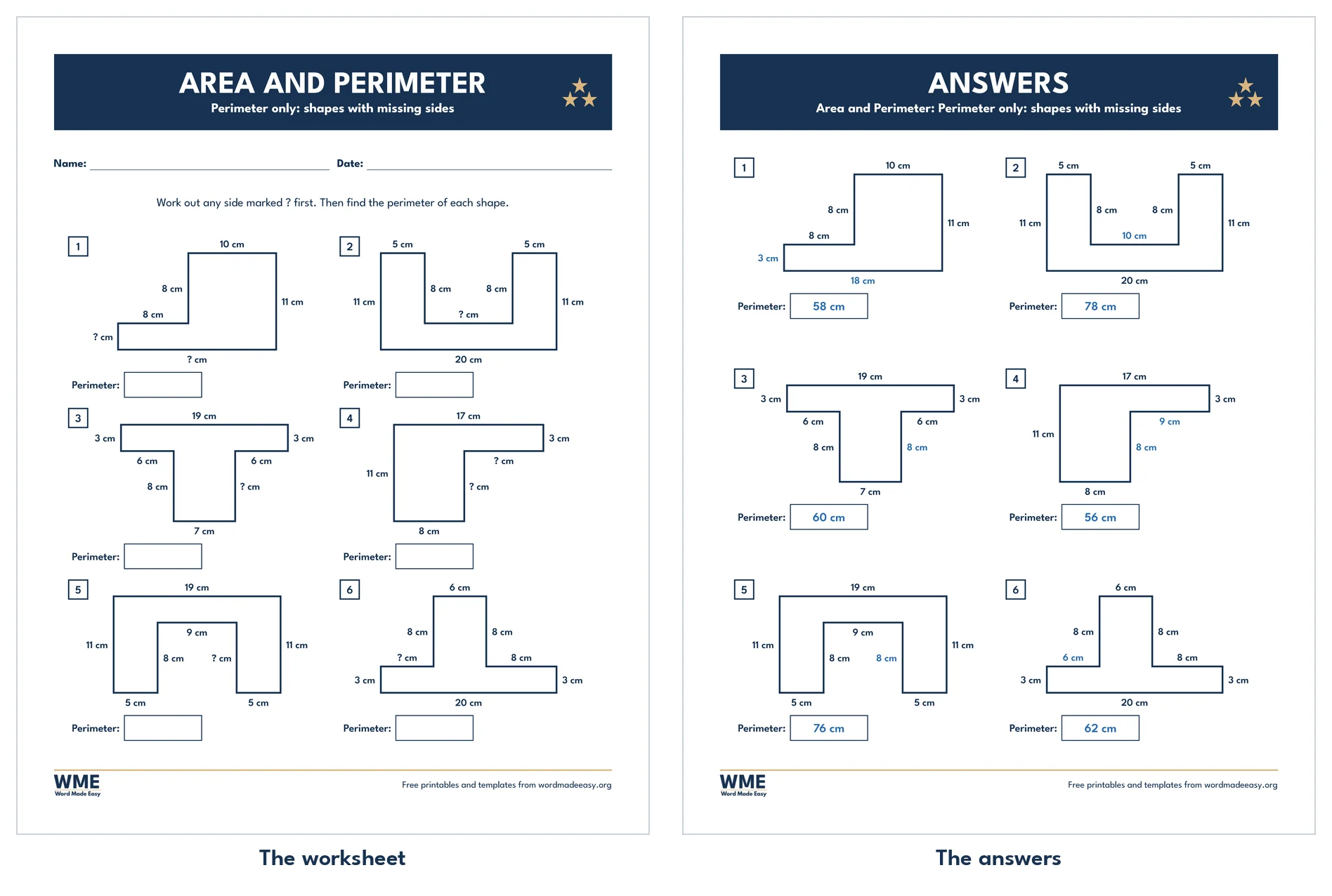
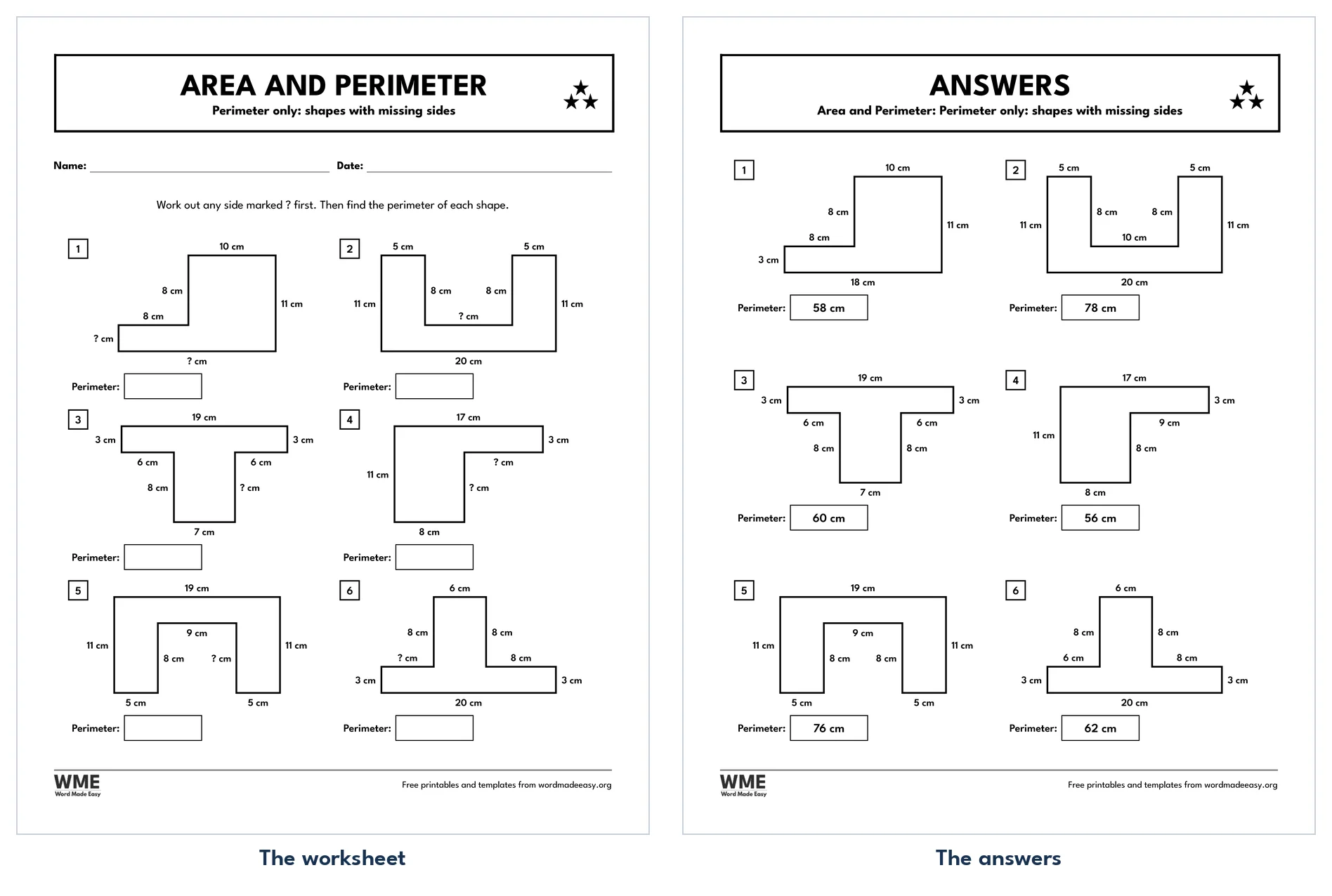
| Perimeter Only 9 | 3 stars: Perimeter of compound shapes with missing sides, with answers |
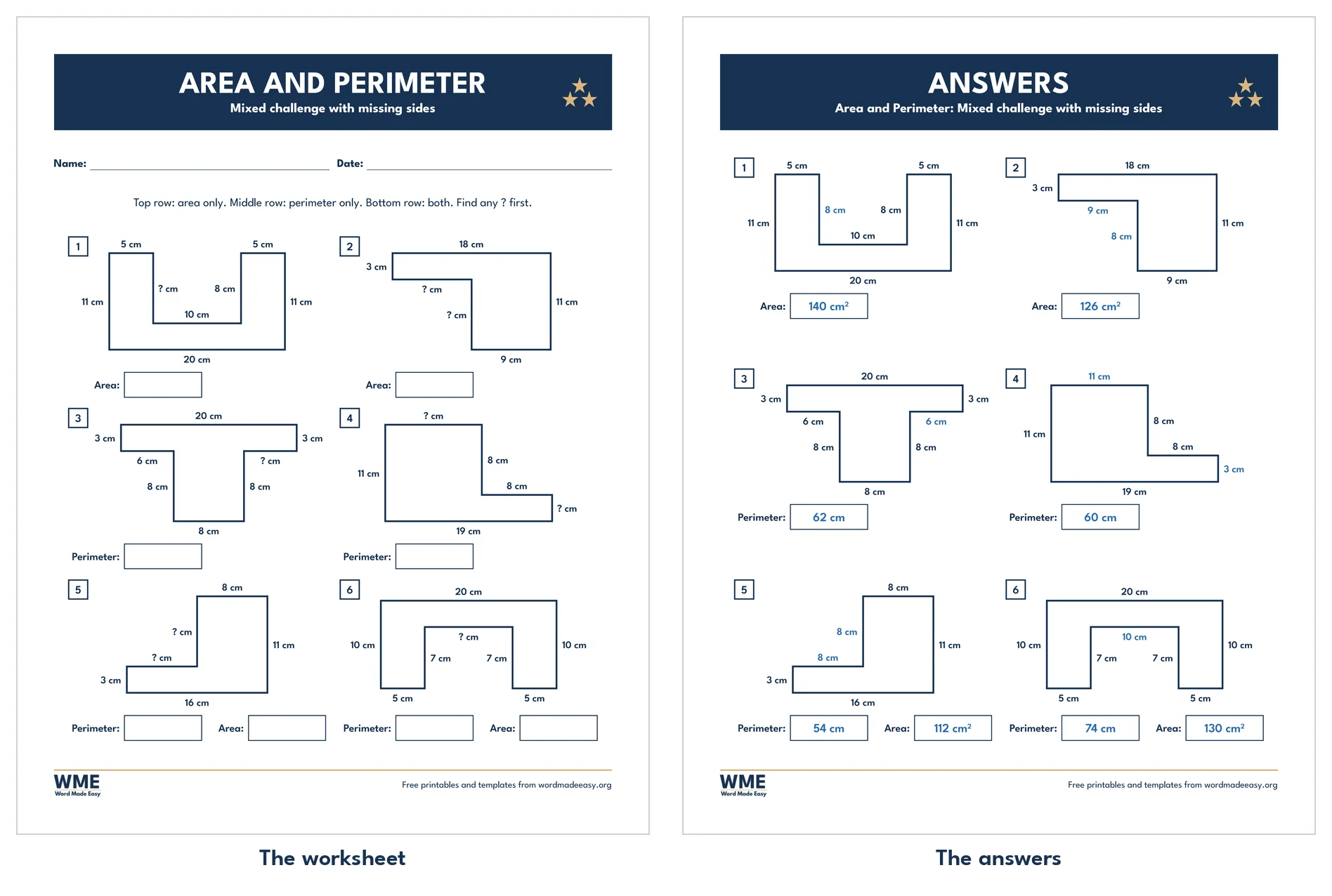
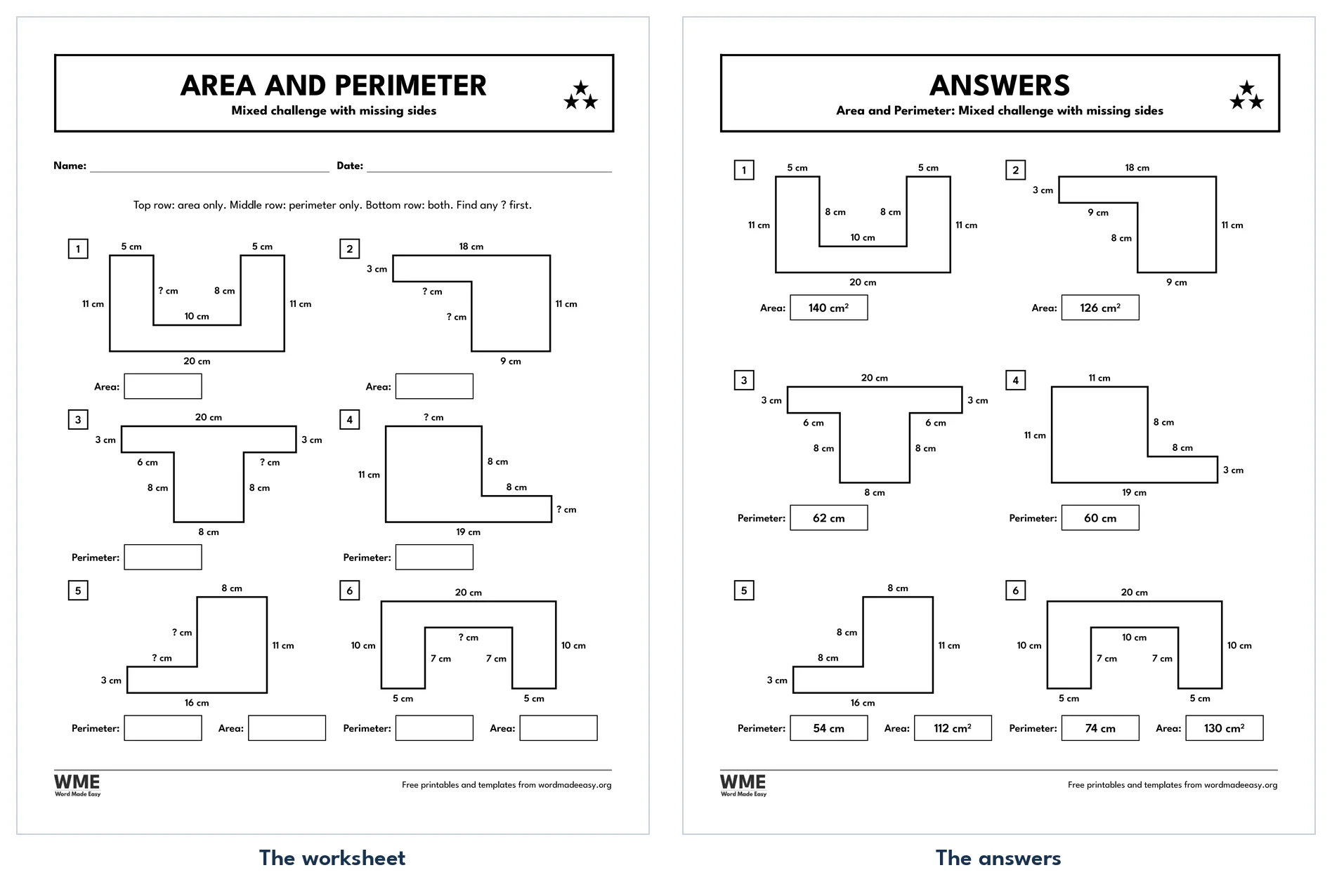
| Mixed Challenge 10 | 3 stars: Mixed area and perimeter challenge with missing sides, with answers |
👉 Every shape is a Word drawing and every length is a text box, so a teacher can retype a number or drag a shape. The Perimeter and Area boxes are table cells, and page 2 of every file is the answer page.
What Is the Difference Between Area and Perimeter?
Perimeter is the distance all the way round the outside of a shape: add the lengths of every side and the answer is in cm. Area is the amount of flat space inside the shape: count the 1 cm squares that cover it, or for a rectangle multiply the length by the width, and the answer is in square centimetres (cm²). A compound shape, such as an L, U or T, is made of rectangles joined together, so its area is the sum of the rectangles inside it. Its perimeter is still just the sides round the edge, never the lines that split it.
Which Area and Perimeter Worksheet Should You Start With?
- The gold stars in the title bar show each sheet’s level, and the pack runs in order: three one-star sheets, four two-star sheets, then three three-star sheets.
- Rectangles and L Shapes 1 (1 star): six shapes to 12 cm with every side labelled, a gentle first look at both measures.
- Count the Squares 2 and 3 (1 star): rectangles, then L, U and T shapes on a squared grid; count the edges for the perimeter and the squares for the area.
- Rectangles 4 (2 stars): nine rectangles and squares to 15 cm, so length times width replaces counting.
- Compound Shapes 5 (2 stars): L, U and T shapes split into rectangles by dashed lines, the first compound shapes area worksheet in the pack.
- Compound Shapes 6 (2 stars): the same kinds of shape to 20 cm with no split lines.
- Missing Side Lengths 7 (2 stars): L shapes with one or two sides marked ?, worked out from the opposite sides before the perimeter and area.
- Area Only 8 and Perimeter Only 9 (3 stars): compound shapes with missing sides, one measure each, so children focus on the right method.
- Mixed Challenge 10 (3 stars): a row of area questions, a row of perimeter questions and a row asking for both.
- Area links straight to multiplication: the sister page of multiplication arrays worksheets shows the rows and columns inside a rectangle, and the coordinates worksheets practise reading a grid.
How to Use the Area and Perimeter Worksheets
- Pick the sheet that matches the stars your class is ready for, choose A4 or US Letter, and print only page 1.
- Read the instruction line: the grid sheets say each square is 1 cm long; the others say all lengths are in cm.
- For the perimeter, tick each side as it is added so none is missed or counted twice.
- For the area of a compound shape, split it into rectangles, find each area and add them.
- Mark with page 2, where any side marked ? also shows its length in blue.
The most common mistake on compound shapes is adding the split line into the perimeter: it is inside the shape, so it never counts. The next is leaving out a side that has no number; on the missing side sheets, opposite sides of an L add up, so the two short sides on one edge equal the long side facing them. Children also mix up the units, so ask for cm on every perimeter and cm² on every area. For more counting practice on a grid, print the graph paper and draw shapes with a given area, and for quick multiplying try the multiplication worksheets.
Black and White Versions
Every area and perimeter worksheet also comes in black and white: black lines, text and answer boxes on white, so the shapes print sharply on any printer. Choose Black and white in the download box, or All to get both.
How to Print the Area and Perimeter Worksheets
Want to print without editing? Every download has three folders: the editable Word files, the same sheets as PDFs, and every page as a print-ready image (JPEG), so you can print straight away without opening Word.
Print at 100% (Actual size) on the paper the file was made for, A4 or US Letter, so the shapes keep their scale and the grid squares stay even. Page 1 is the worksheet and page 2 the answers: print page 1 for the class.
FAQs
Are these area and perimeter worksheets free?
Yes. All ten area and perimeter worksheets are free: choose A4 or US Letter, colour or black and white, and download them in one ZIP file.
Is there an answer key?
Yes. Page 2 of every Word file is the answer page, with each perimeter in cm, each area in cm² and every missing side filled in blue.
How do you find the area of a compound shape?
Split the shape into rectangles with a straight line, find the area of each rectangle (length times width) and add the areas together. Compound Shapes 5 draws the split lines for you.
How do you find a missing side length?
On a shape with square corners, the sides that face one way add up to the sides that face the other way. Take the shorter known side from the longer opposite side to find the missing one.
What grade are these area and perimeter worksheets for?
The counting sheets suit grade 2 and 3 in the US, or Year 3 in the UK. The compound shapes and missing side sheets suit grade 3 to 5, or Year 4 to Year 6.
Are the shapes drawn to scale?
Yes. All the shapes on one sheet use the same scale, so longer sides look longer, but children should use the numbers, not a ruler, to find the answers.
Conclusion
Ten area and perimeter worksheets, from counting squares to compound shapes with missing sides, each with an answer page and editable in Microsoft Word.
Download your paper size above, and for a grid to draw your own shapes on, open the graph paper.
Related Tutorials
Maths Resources
Recently Added Maths Resources
Browse all free maths resources for home and school, all made by a teacher.
Leave a comment
Have a question about these resources, or an idea for a new one? Ask below.