
Translation Worksheets: 10 Free Printables with Answers
Preview every worksheet, choose colour or black and white and your paper size, then download your translation worksheets in one small ZIP file.
A4 and US Letter10 worksheetsFree
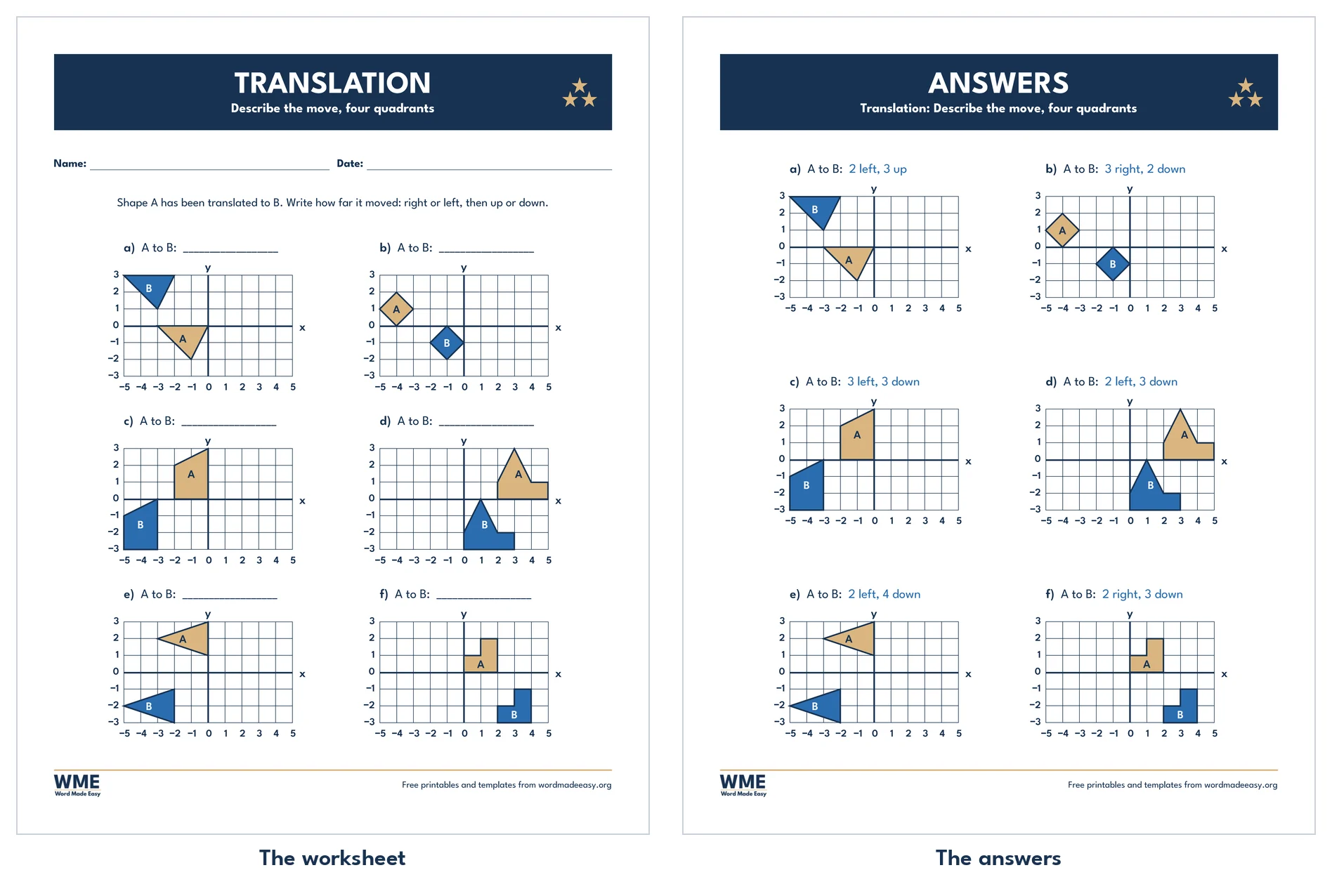
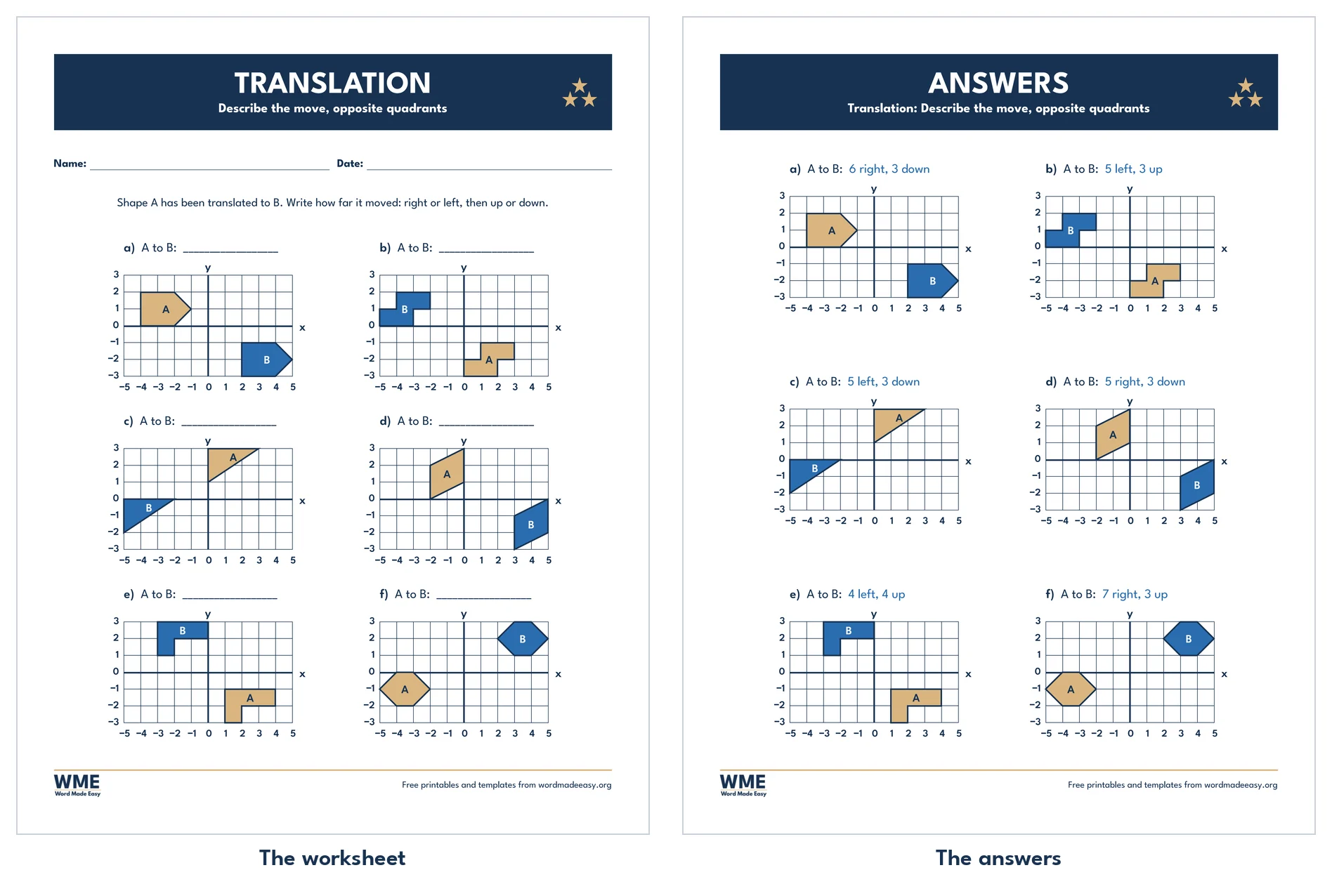
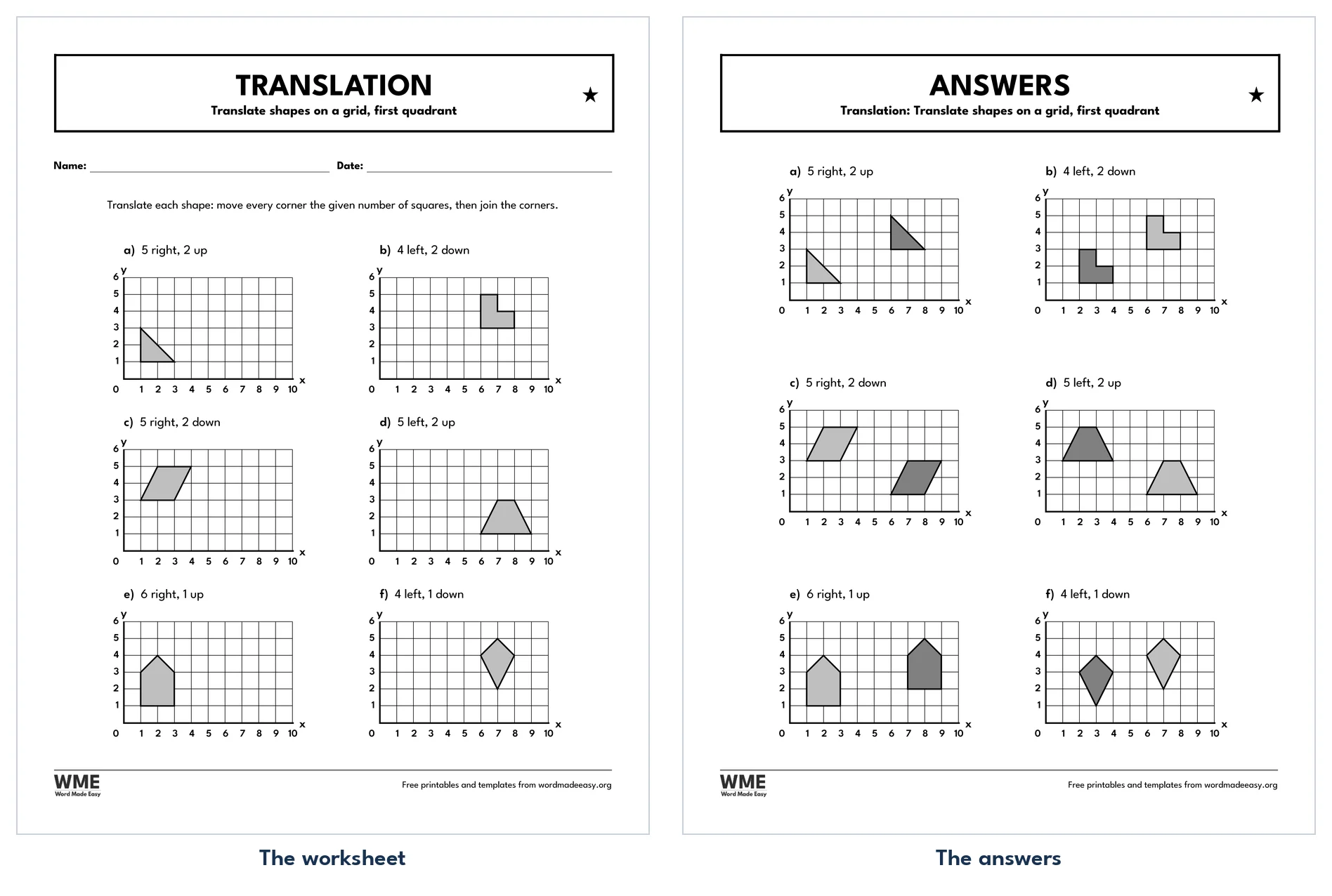
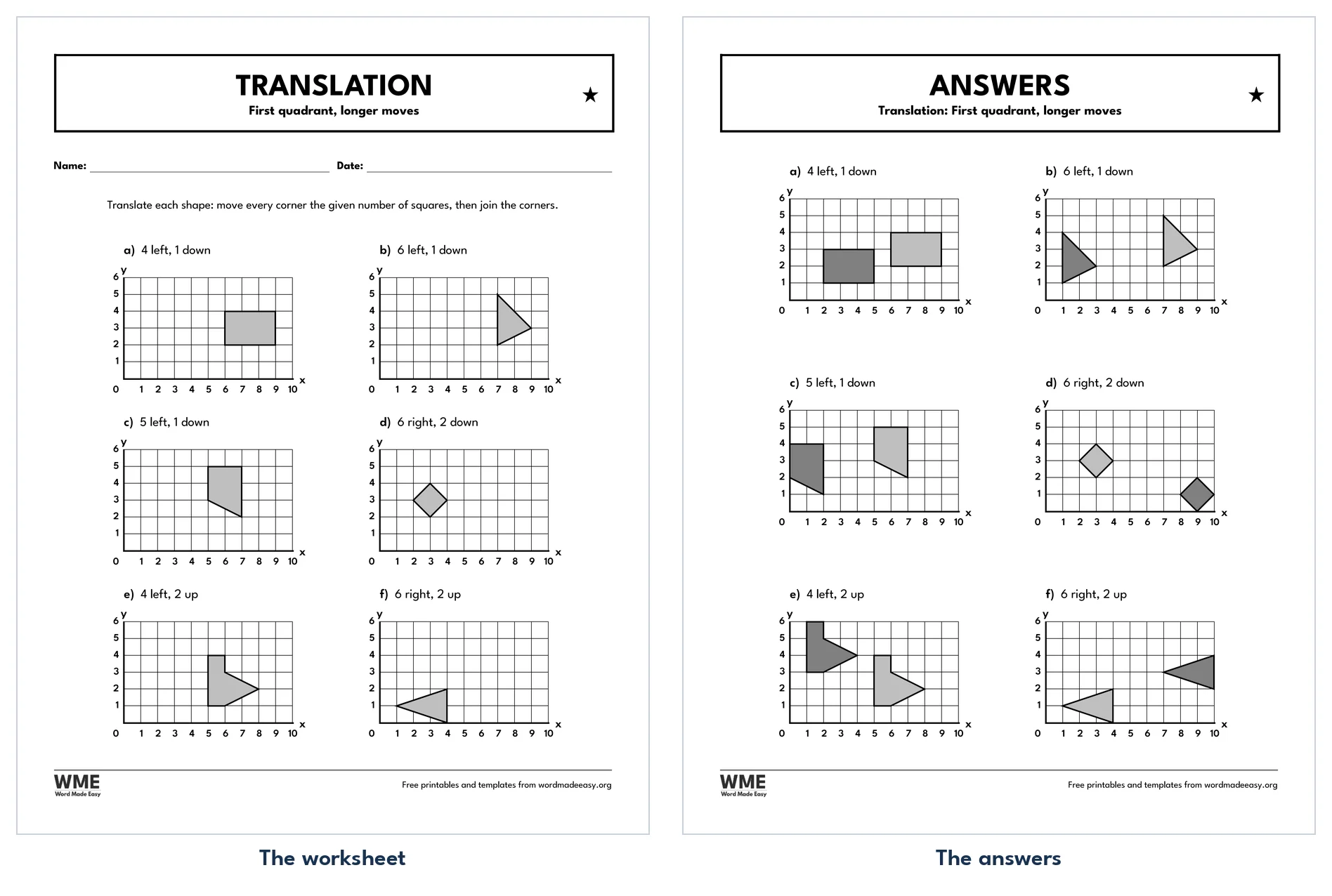
Can’t find the template you need? Request a template and I’ll make it in Word, free.
Get new free printables first: follow Word Made Easy on Pinterest
These free translation worksheets teach translating shapes one corner at a time. Every sheet has six numbered coordinate grids, each with a shape whose corners sit exactly on grid points and a move written above it, such as “4 left, 2 down”. Children count the squares from each corner, mark the new corner and join them up, so the shape slides without turning or changing size. The pack starts in the first quadrant, moves on to grids where the axes cross in the middle and the shape travels into another quadrant, and ends with reverse sheets where both shapes are drawn and the child writes the move. Every shape and every answer has been checked, and each corner sits exactly on a grid point.
Below you’ll find what a translation is, the order to use the sheets in, and the counting slip that catches most children out.
What’s in the Translation Worksheets Pack
| Worksheet | What is on it |
|---|---|
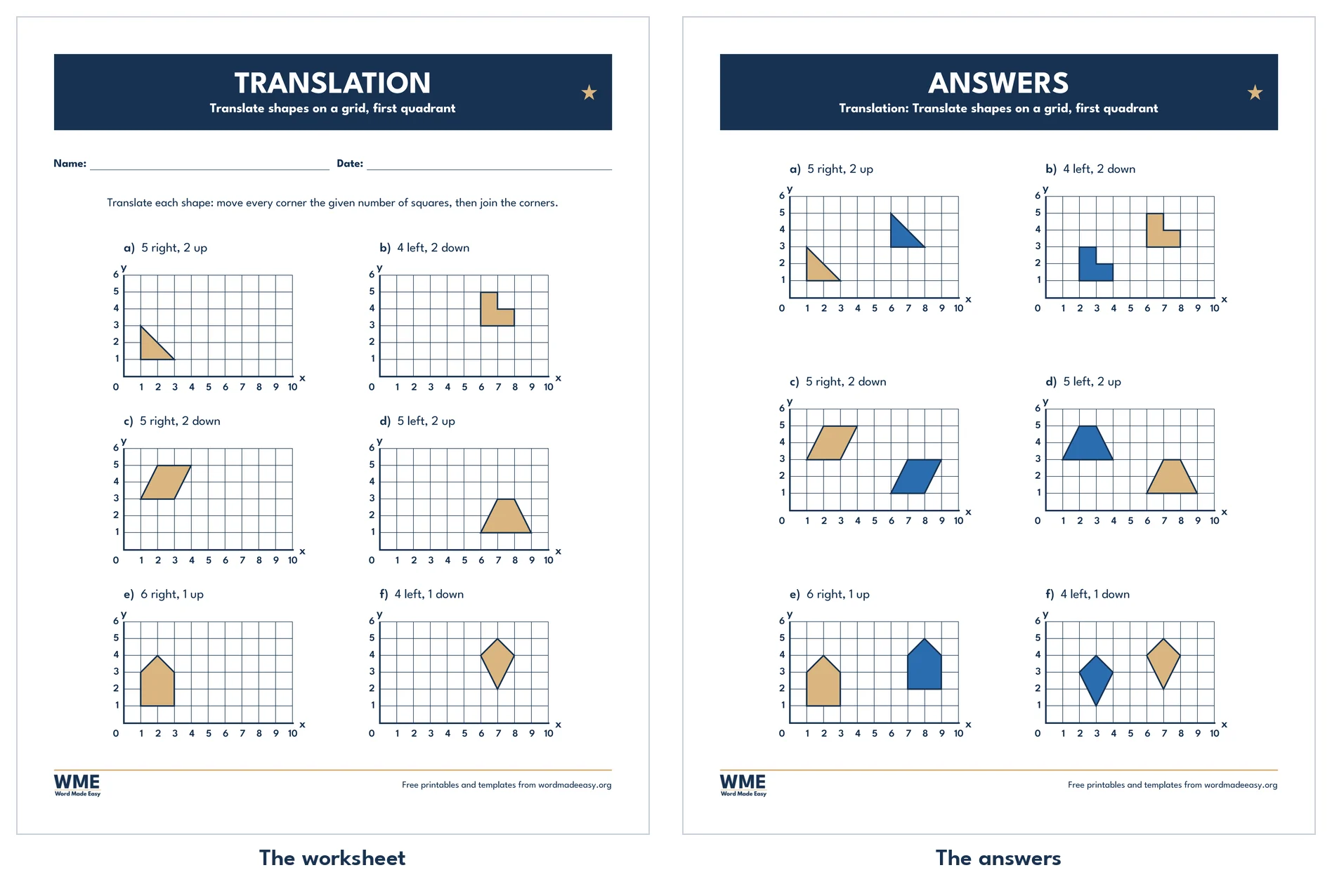
| Translation 1 | 1 star: Translate shapes in the first quadrant, with answers |
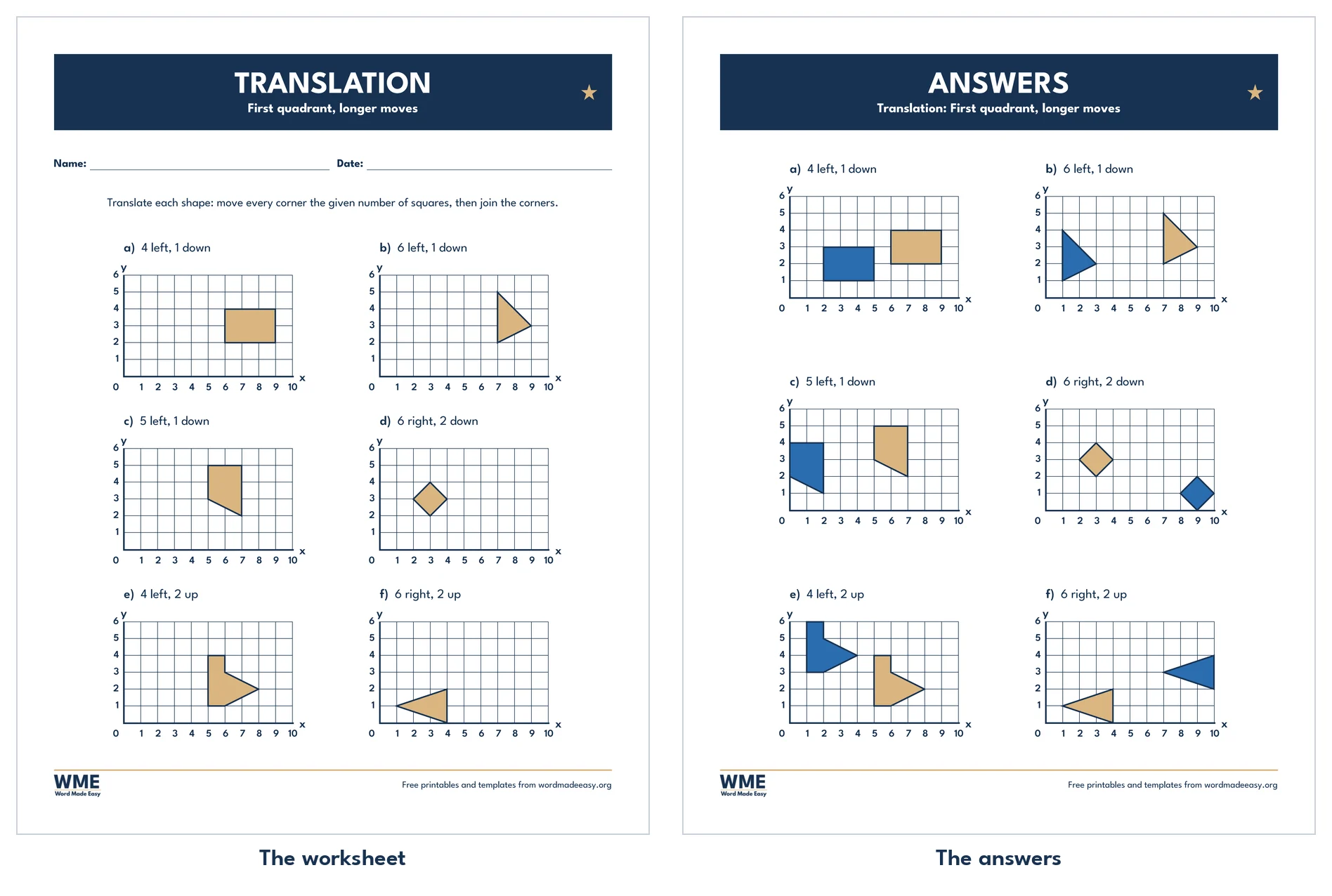
| Translation 2 | 1 star: Translate shapes in the first quadrant, longer moves, with answers |
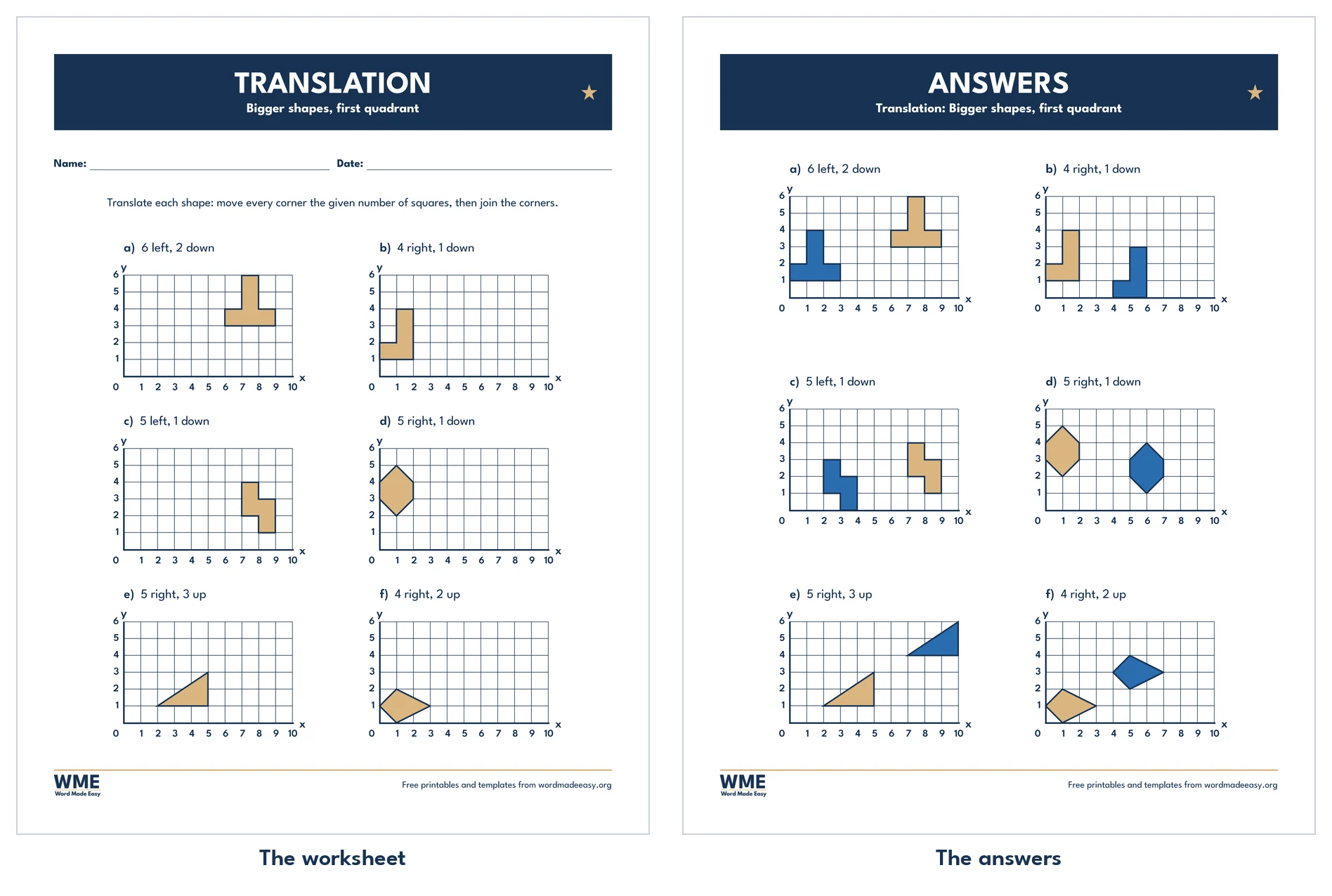
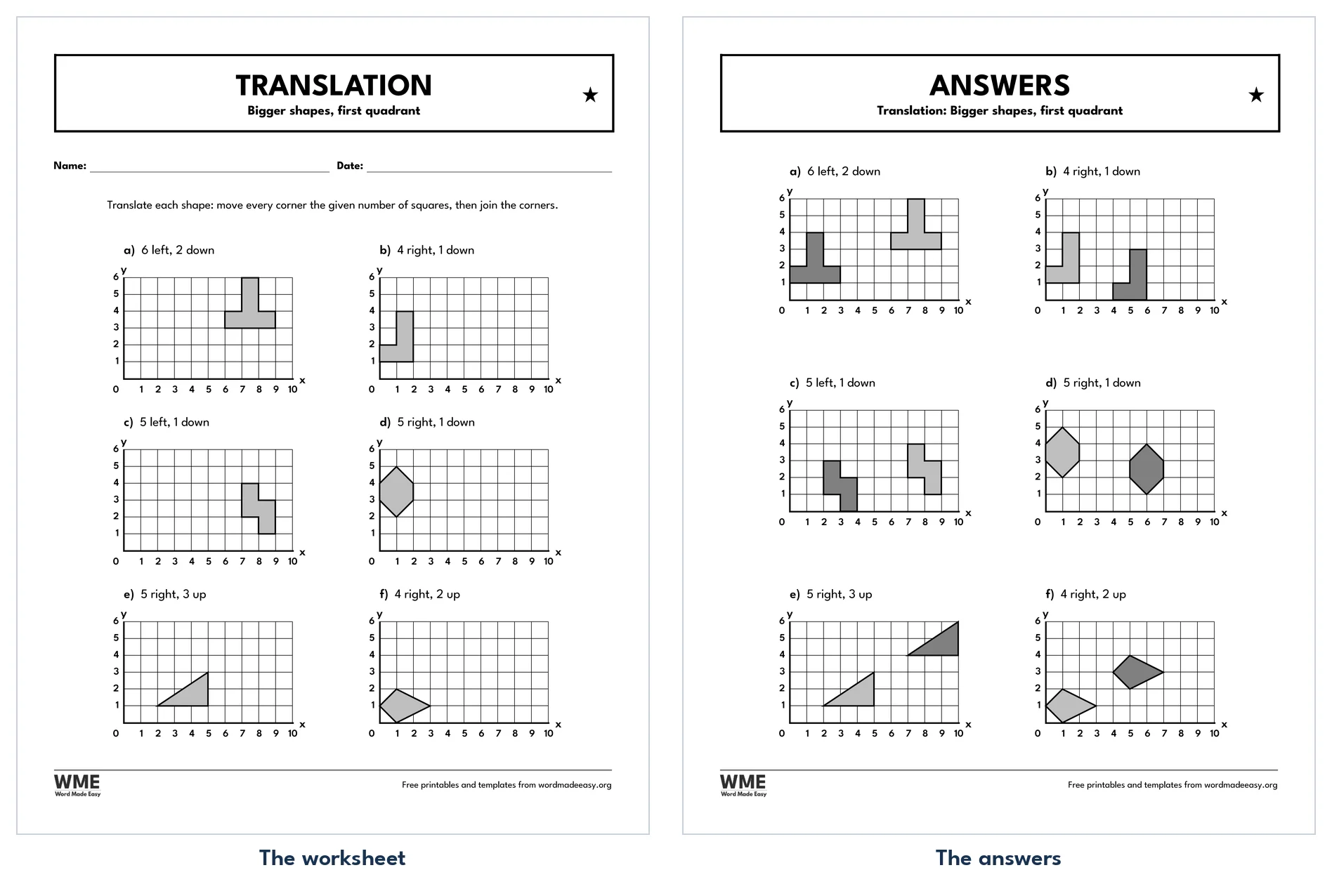
| Translation 3 | 1 star: Translate bigger shapes in the first quadrant, with answers |
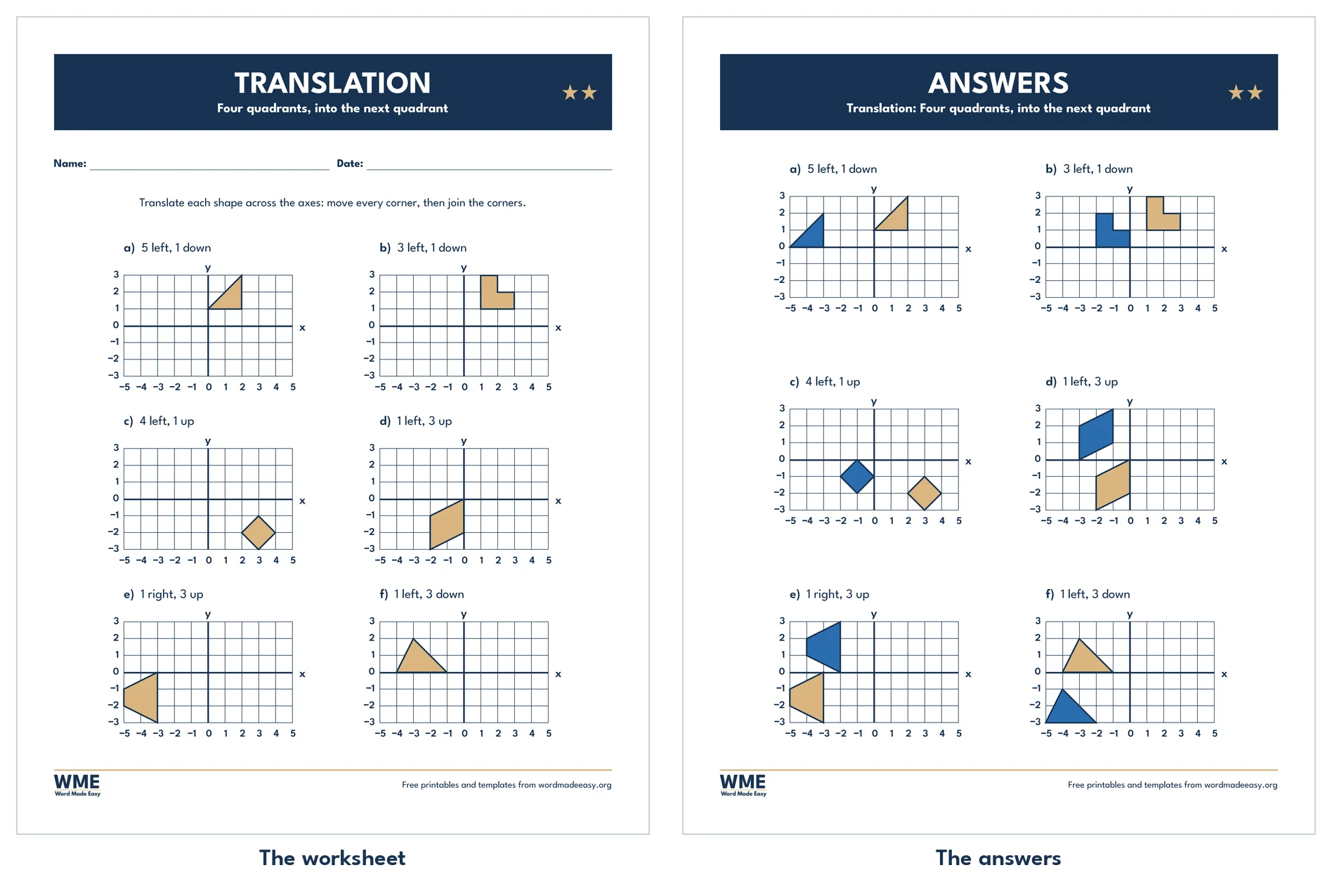
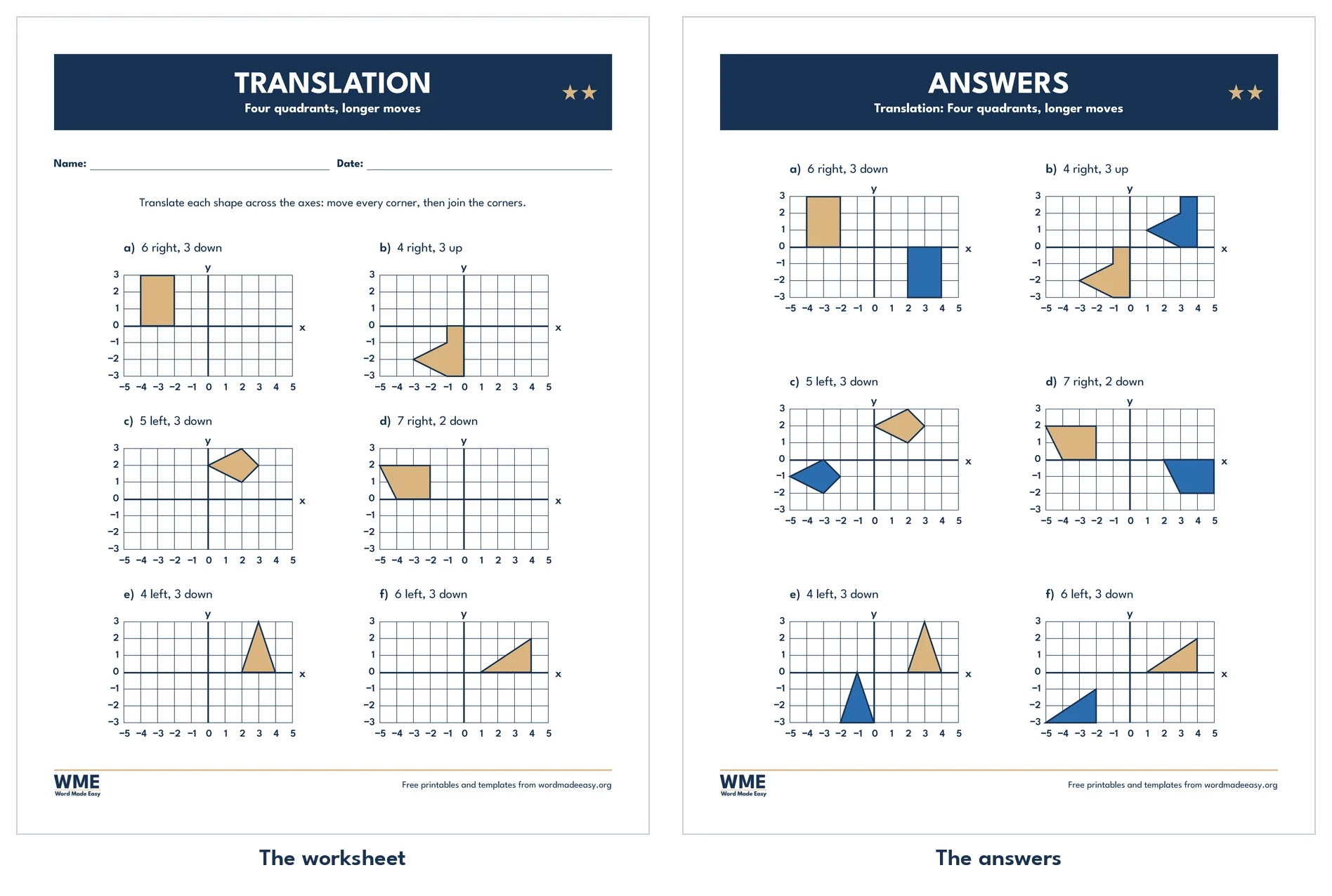
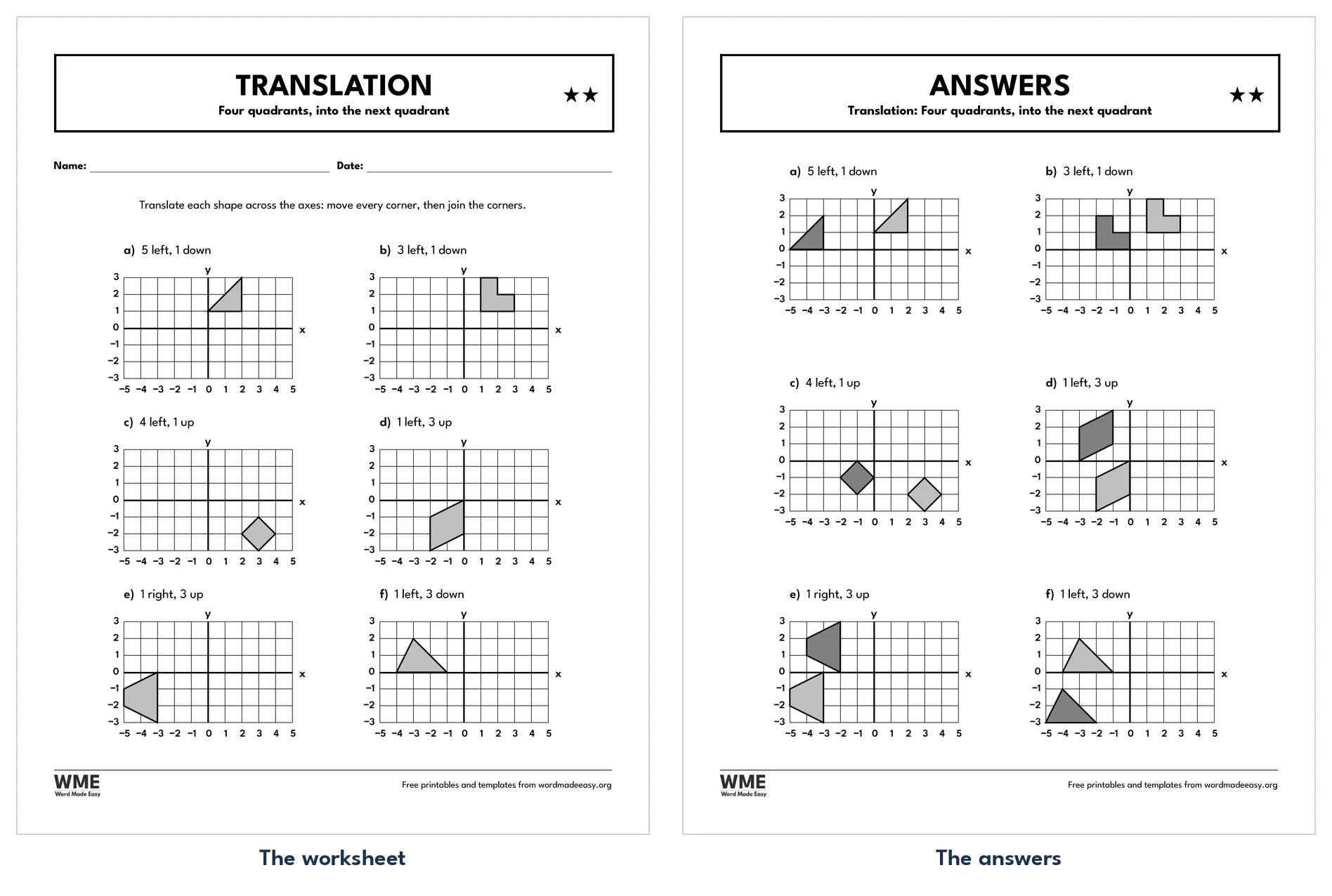
| Translation 4 | 2 stars: Translate shapes into the next quadrant, with answers |
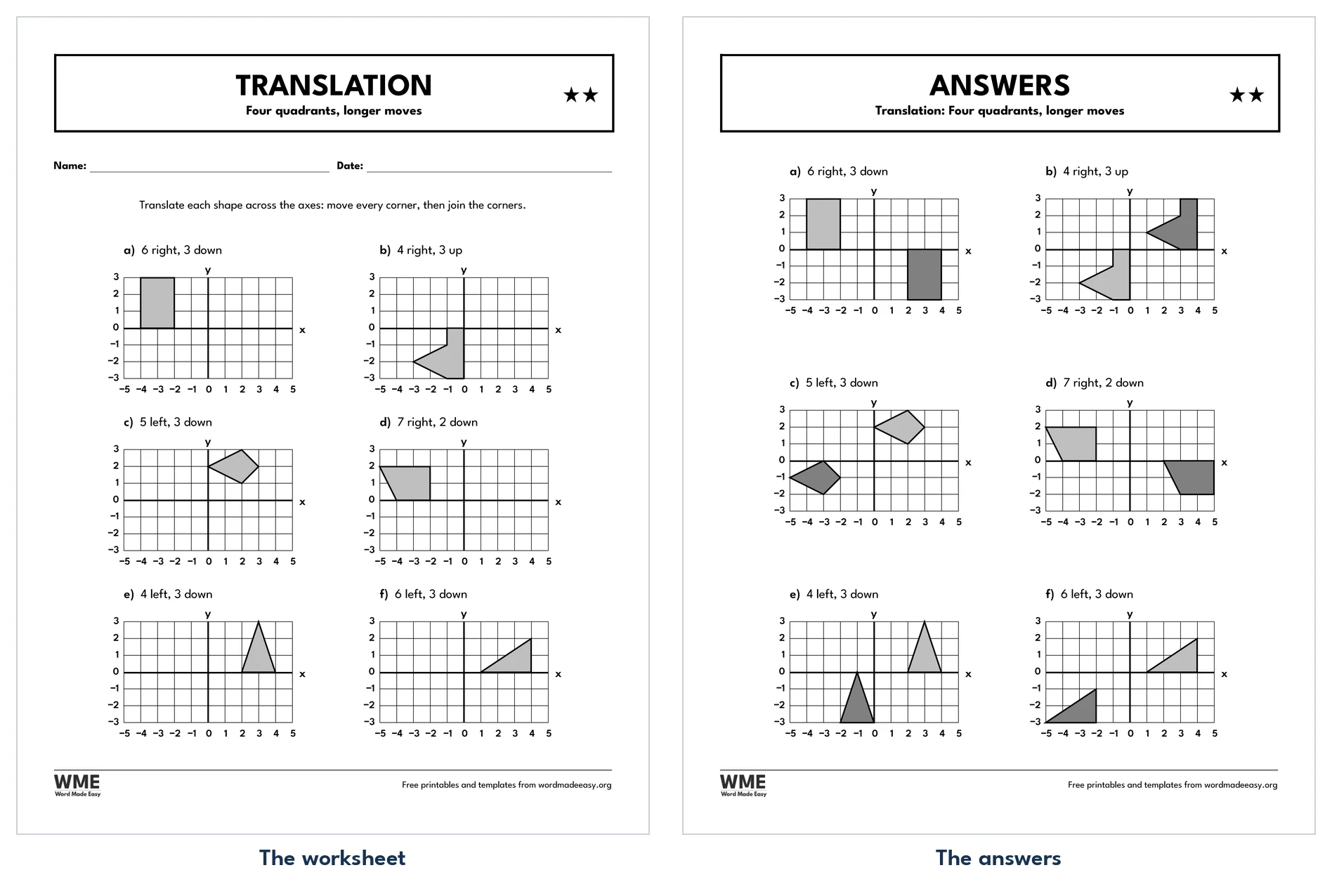
| Translation 5 | 2 stars: Translate shapes into the next quadrant, longer moves, with answers |
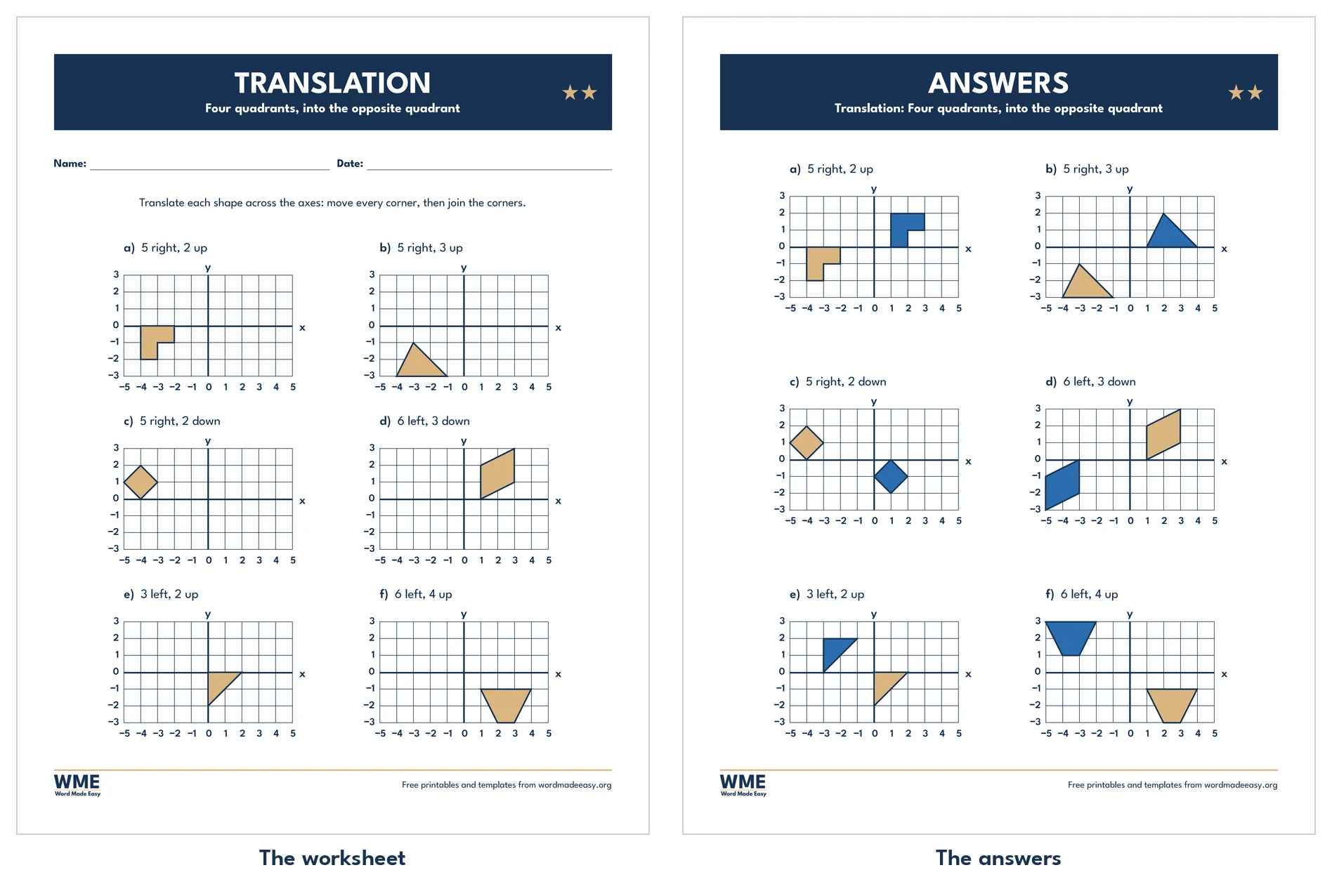
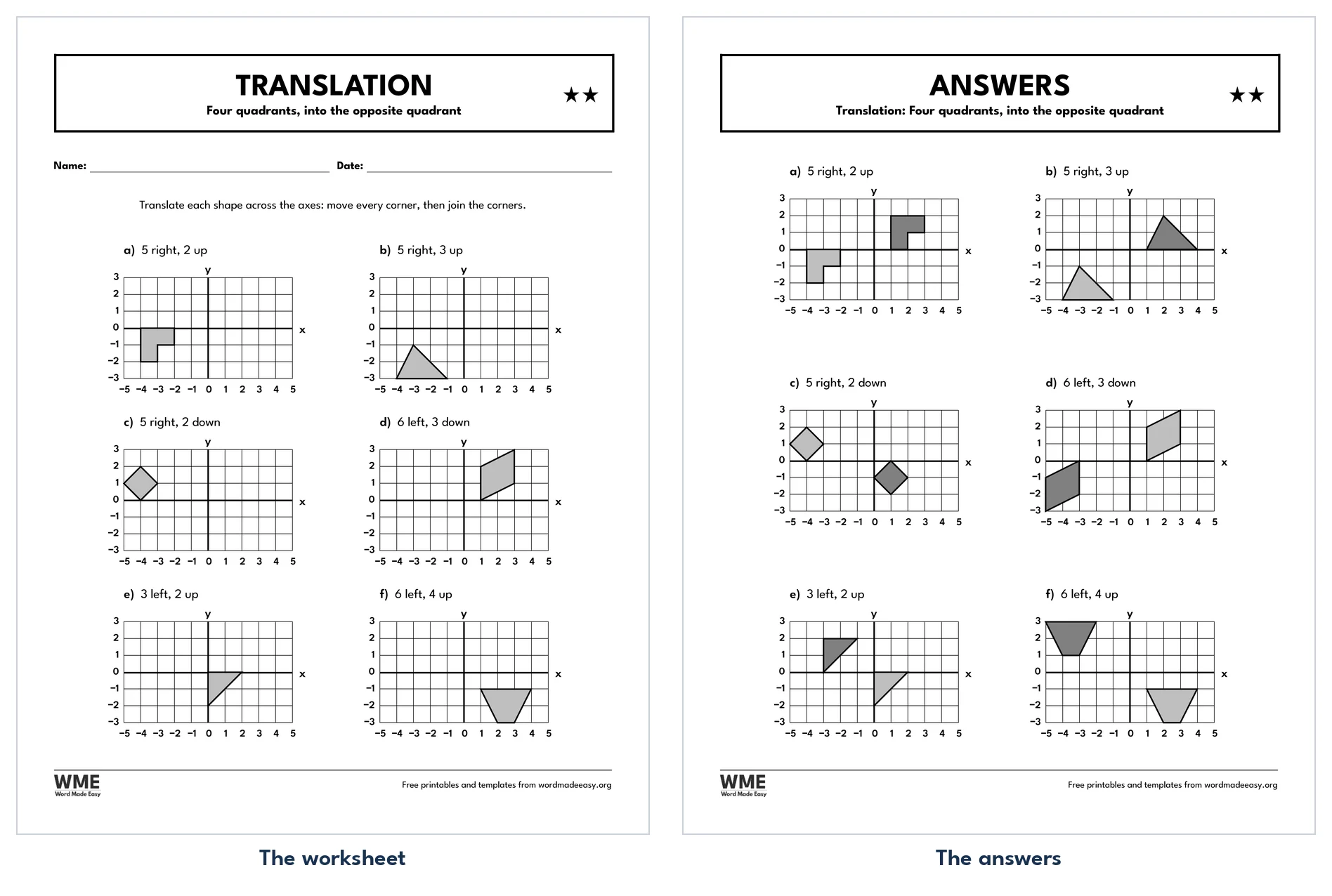
| Translation 6 | 2 stars: Translate shapes into the opposite quadrant, with answers |
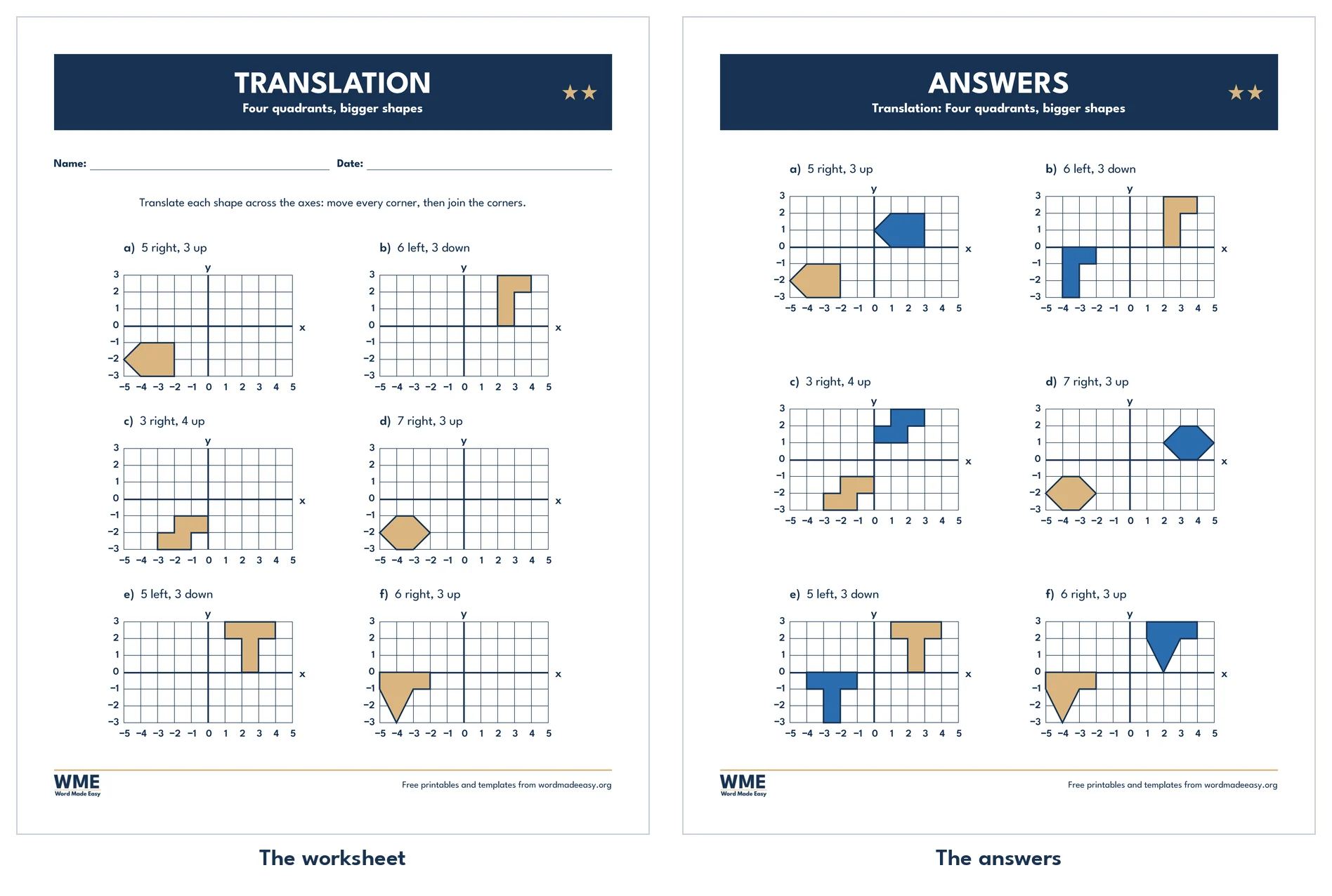
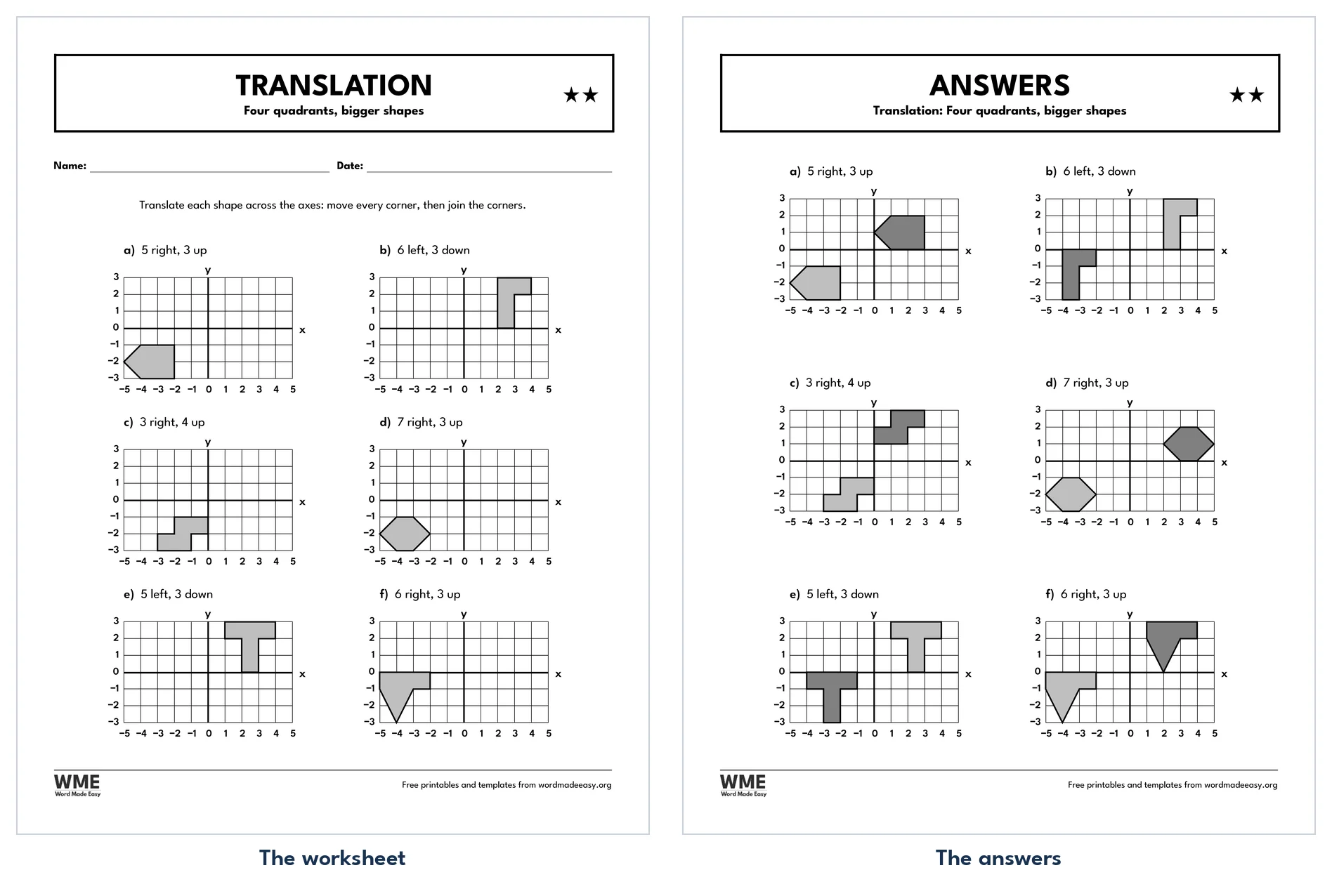
| Translation 7 | 2 stars: Translate bigger shapes across the axes, with answers |
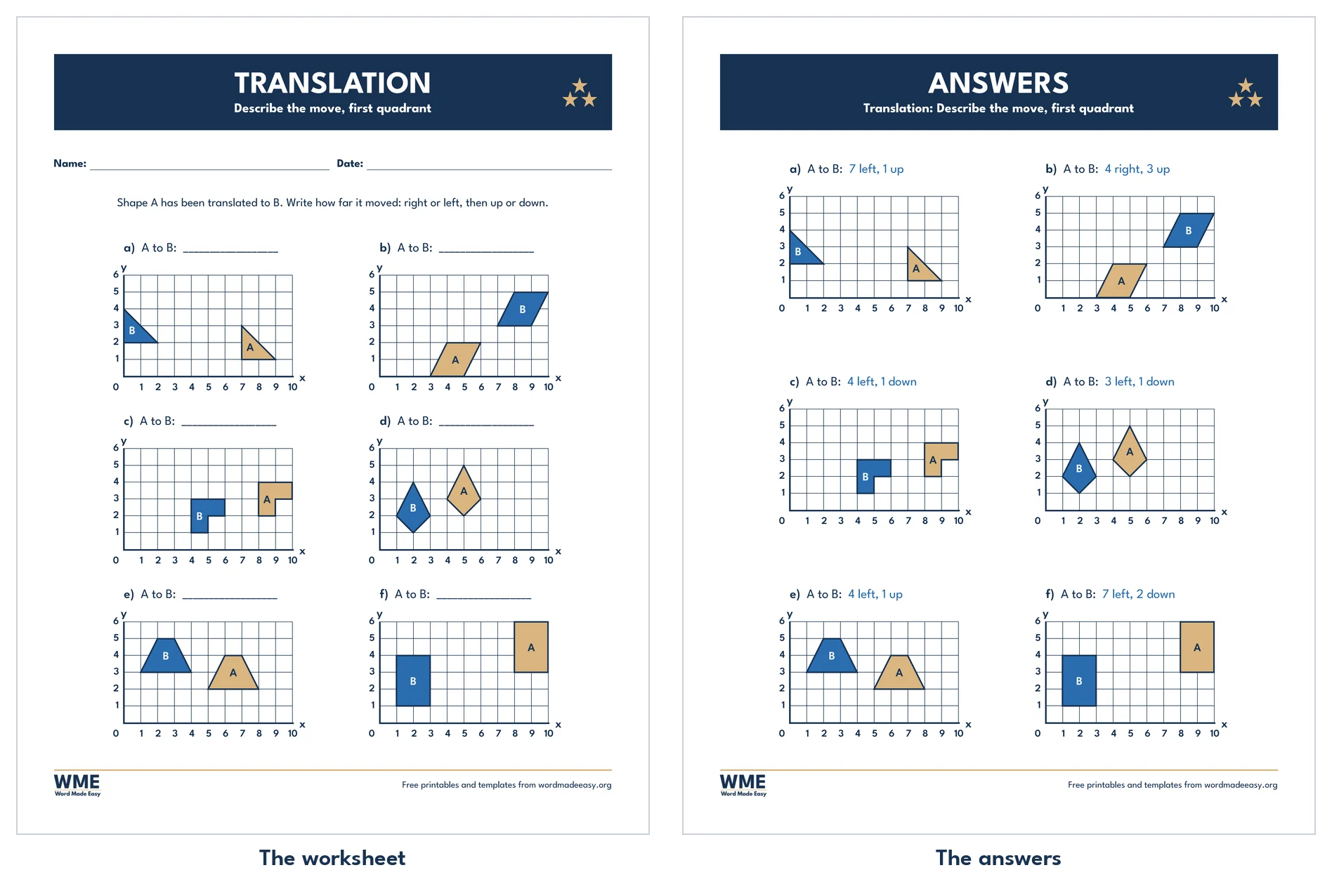
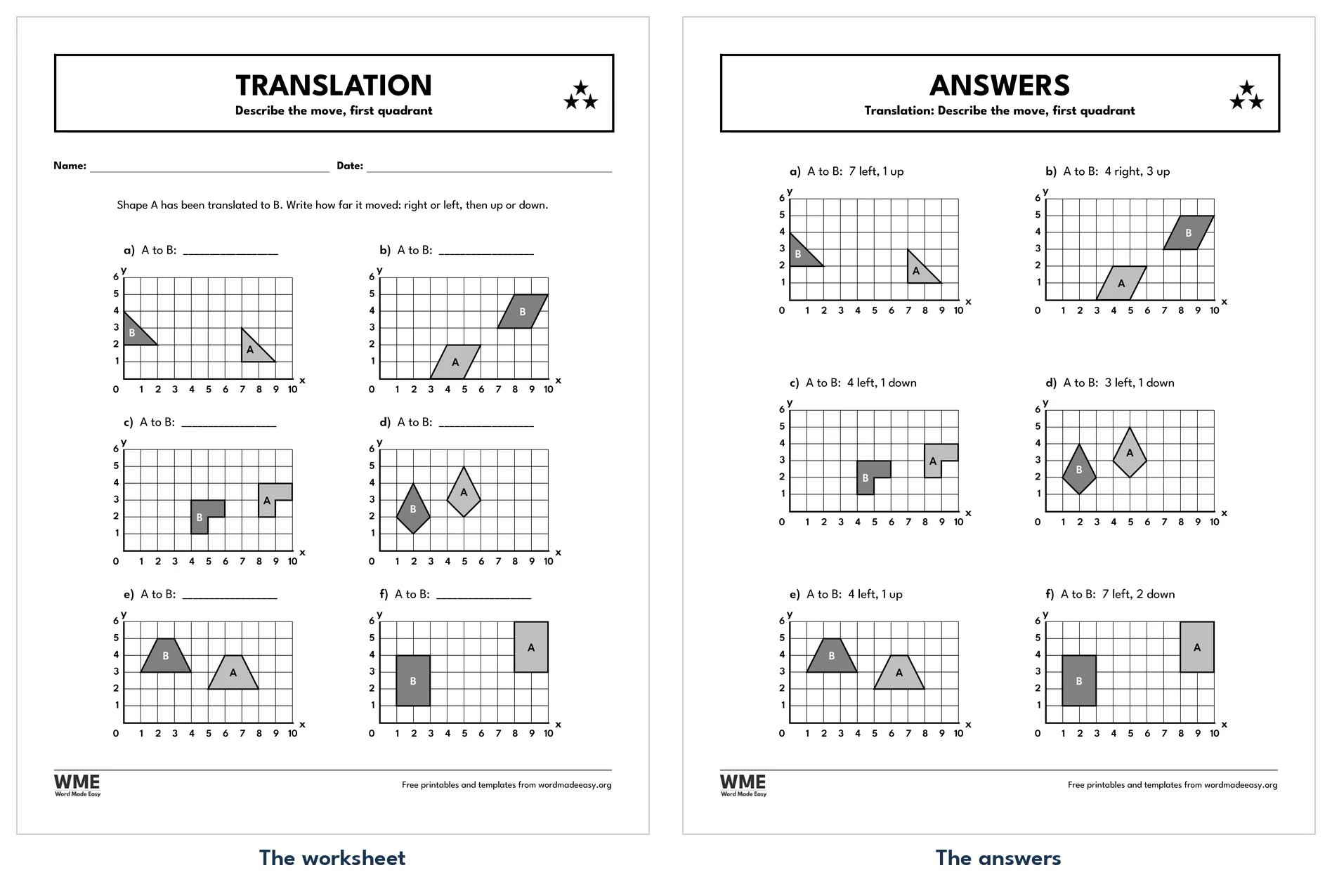
| Describe the Translation 8 | 3 stars: Describe the translation from A to B, first quadrant, with answers |
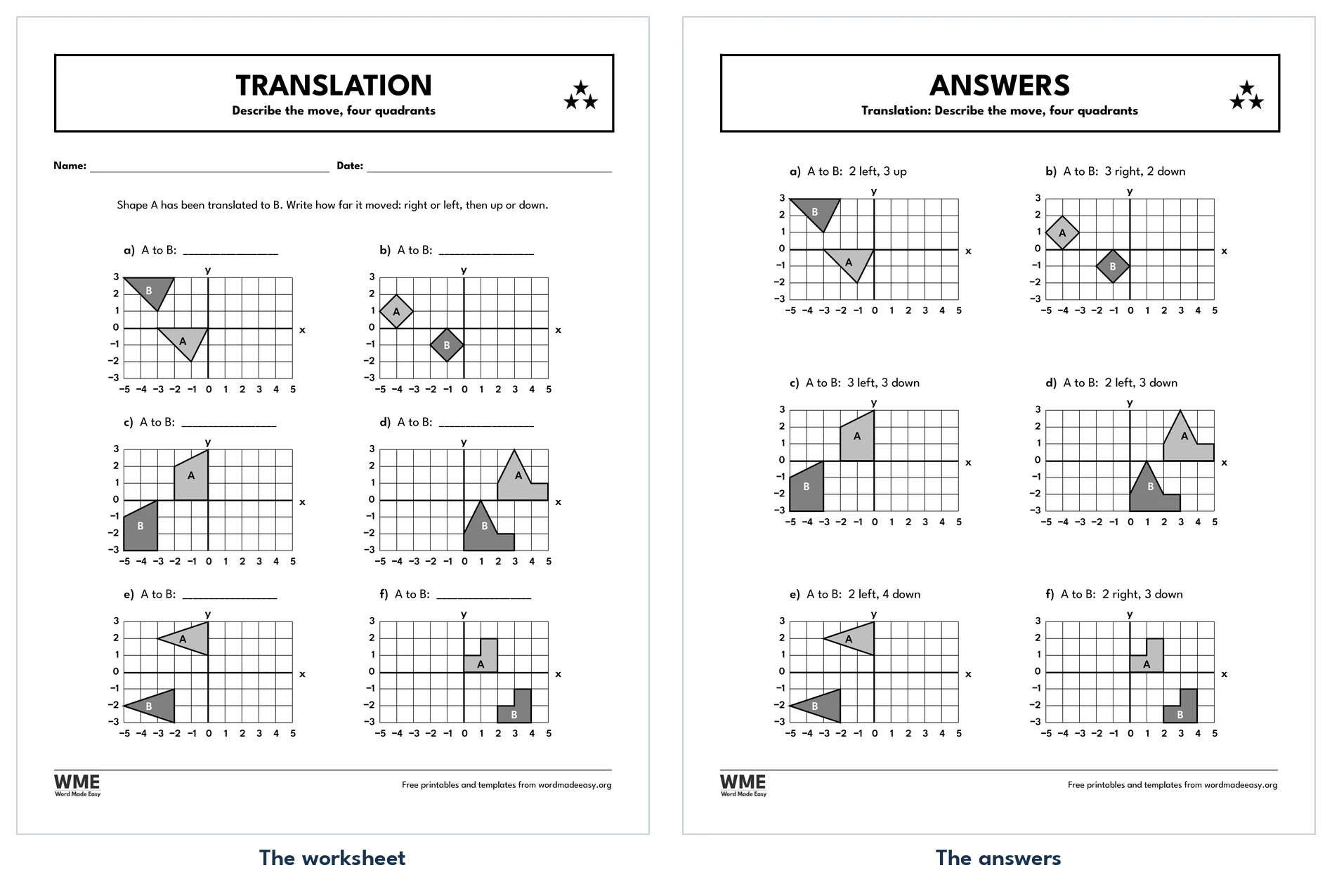
| Describe the Translation 9 | 3 stars: Describe the translation from A to B, four quadrants, with answers |
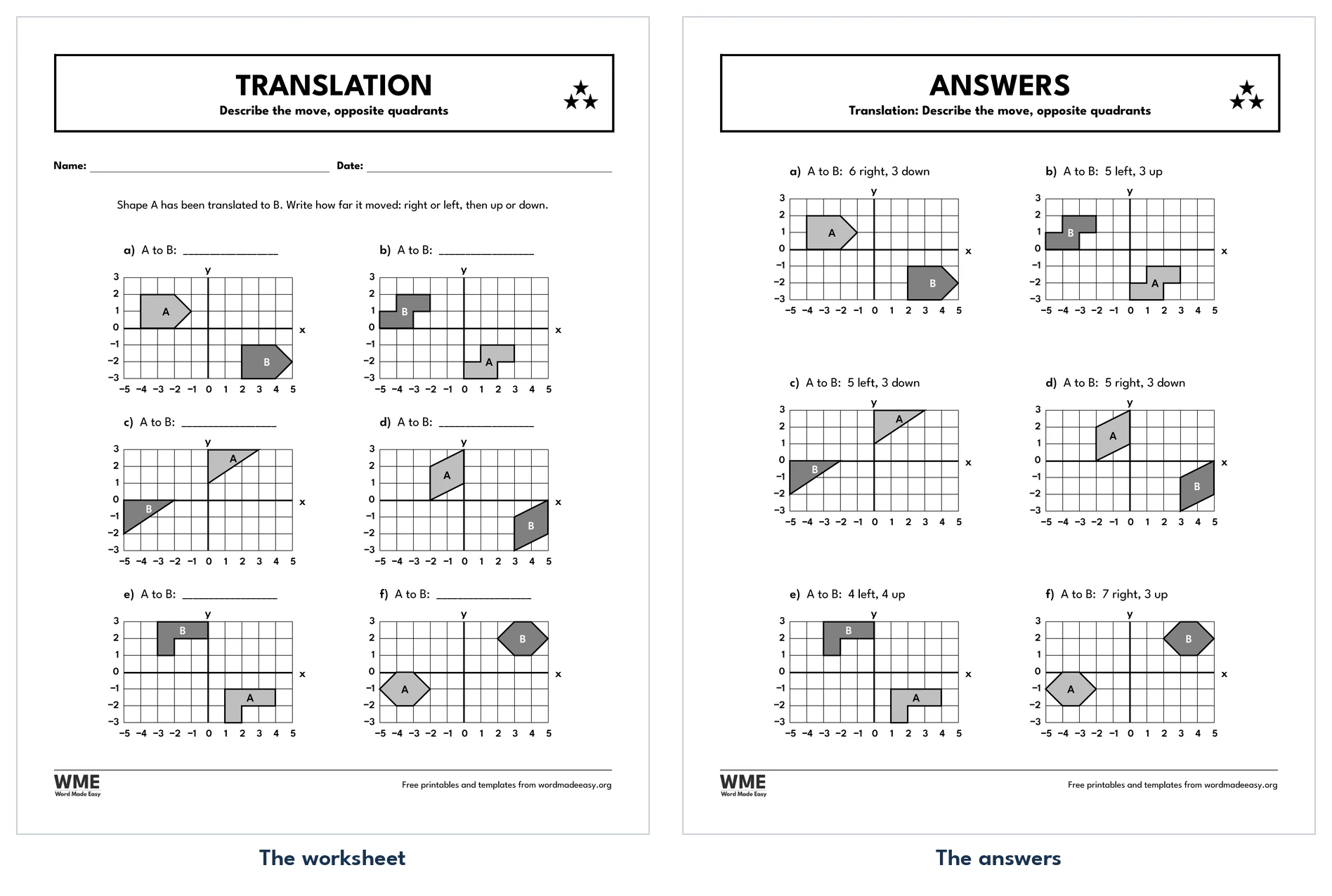
| Describe the Translation 10 | 3 stars: Describe the translation from A to B, opposite quadrants, with answers |
👉 Each grid is a Word table, the axis numbers and moves are typed text, and every shape is a Word drawing shape, so a teacher can change a move or drag a shape to a new spot. Page 2 of every file is the answer page.
What Is a Translation in Maths?
A translation slides a shape to a new position. Every corner moves the same distance in the same direction, so the shape keeps its size, its angles and the way it faces; only its position changes. A translation is usually given as a number of squares right or left, then up or down: “3 right, 2 up” moves every corner 3 squares across and 2 squares up. The moved shape is called the image. On a coordinate grid, a translation adds the same amount to every x coordinate and the same amount to every y coordinate, which is why counting from the corners always works.
Which Translation Worksheet Should You Start With?
- The gold stars in the title bar show the level, and the sheets are in order: three one-star sheets, four two-star sheets and three three-star sheets.
- Translation 1 to 3 (1 star): first-quadrant grids numbered 0 to 10 across and 0 to 6 up. Sheet 1 uses short moves, sheet 2 longer ones, and sheet 3 bigger shapes such as a T shape and a hexagon.
- Translation 4 and 5 (2 stars): four-quadrant grids from −5 to 5 and −3 to 3. Each shape crosses an axis into the next quadrant, so children meet negative coordinates.
- Translation 6 and 7 (2 stars): moves that take a shape into the opposite quadrant, then bigger shapes with longer moves in both directions.
- Describe the Translation 8 to 10 (3 stars): shape A and its image B are both drawn. Children write how far A moved, right or left, then up or down: first quadrant, then four quadrants.
- To practise reading and plotting points first, the coordinates worksheets work on the same kind of grid. The sister page of reflection worksheets flips shapes in a mirror line instead of sliding them, and the symmetry drawing worksheets have children finish pictures across a line of symmetry.
How to Use the Translation Worksheets
- Pick the translation sheet that matches the star level you want, save it in your paper size and print only its first page.
- Read the move above the first grid aloud and point to one corner of the shape.
- Count the squares across first, then up or down, and mark the new corner with a small dot.
- Do the same for every corner, then join the dots with a ruler and check the image is the same shape facing the same way.
- Mark with page 2, where each image is drawn in blue.
The slip that catches most children is counting the grid lines they start on, so a move of 3 lands only 2 squares away. Ask them to count the jumps between lines, not the lines themselves, and to say “one, two, three” as their finger moves. Another common mistake is moving the shape as a whole by eye: insist on moving one corner at a time and checking that the image faces the same way as the shape. On the describe sheets, pick one corner of A, find the matching corner of B and count from one to the other. For a blank grid to make up your own moves, the graph paper prints a full page of squares.
Black and White Versions
Every translation worksheet also comes in black and white: black grid lines and numbers, a light grey shape and a darker grey image, so the corners stay clear on a home printer. Choose Black and white in the download box, or All to get both.
How to Print the Translation Worksheets
Want to print without editing? Every download has three folders: the editable Word files, the same sheets as PDFs, and every page as a print-ready image (JPEG), so you can print straight away without opening Word.
Print at 100% (Actual size) on the paper the file was made for, A4 or US Letter, so the squares stay big enough to count and draw in. Page 1 is the worksheet and page 2 the answers: print page 1 for the class.
FAQs
Are these translation worksheets free?
Yes. All ten translation worksheets are free: choose A4 or US Letter, colour or black and white, and download them in one ZIP file.
Is there an answer key?
Yes. Page 2 of every Word file is the answer page: each translated shape is drawn in blue, and on the describe sheets each move is written in blue.
How do you describe a translation?
Pick one corner of the shape and the matching corner of its image. Count how many squares it moved right or left, then how many up or down, and write both, for example 4 left, 3 up.
Does a translated shape change size?
No. A translation only slides a shape. The image is the same size and shape and faces the same way; only its position on the grid changes.
What grade are these translation worksheets for?
The first-quadrant sheets suit grade 4 and 5 in the US or Year 5 in the UK. The four-quadrant and describe sheets suit grade 5 to 6 or Year 6, where translating shapes on a coordinate grid with negative numbers is taught.
Can I change the moves or the shapes?
Yes. The moves are typed text in Word, so you can retype them, and each shape is a Word drawing shape that you can drag to new grid points.
Conclusion
Ten translation worksheets, from short slides in the first quadrant to describing moves across the axes, each with an answer page and editable in Microsoft Word.
Download your paper size above, and for a blank grid to set your own moves, open the graph paper.
Related Tutorials
- Free Graph Paper for Word
- Skip Counting Worksheets
- Free Addition and Subtraction Worksheets for Word
Maths Resources
Recently Added Maths Resources
Browse all free maths resources for home and school, all made by a teacher.
Leave a comment
Have a question about these resources, or an idea for a new one? Ask below.