
Hidden Picture Math Worksheets: 10 Free Solve and Join the Dots Sheets
Preview every worksheet, choose colour or black and white and your paper size, then download your hidden picture math worksheets in one small ZIP file.
A4 and US Letter10 worksheetsFree


Can’t find the template you need? Request a template and I’ll make it in Word, free.
Get new free printables first: follow Word Made Easy on Pinterest
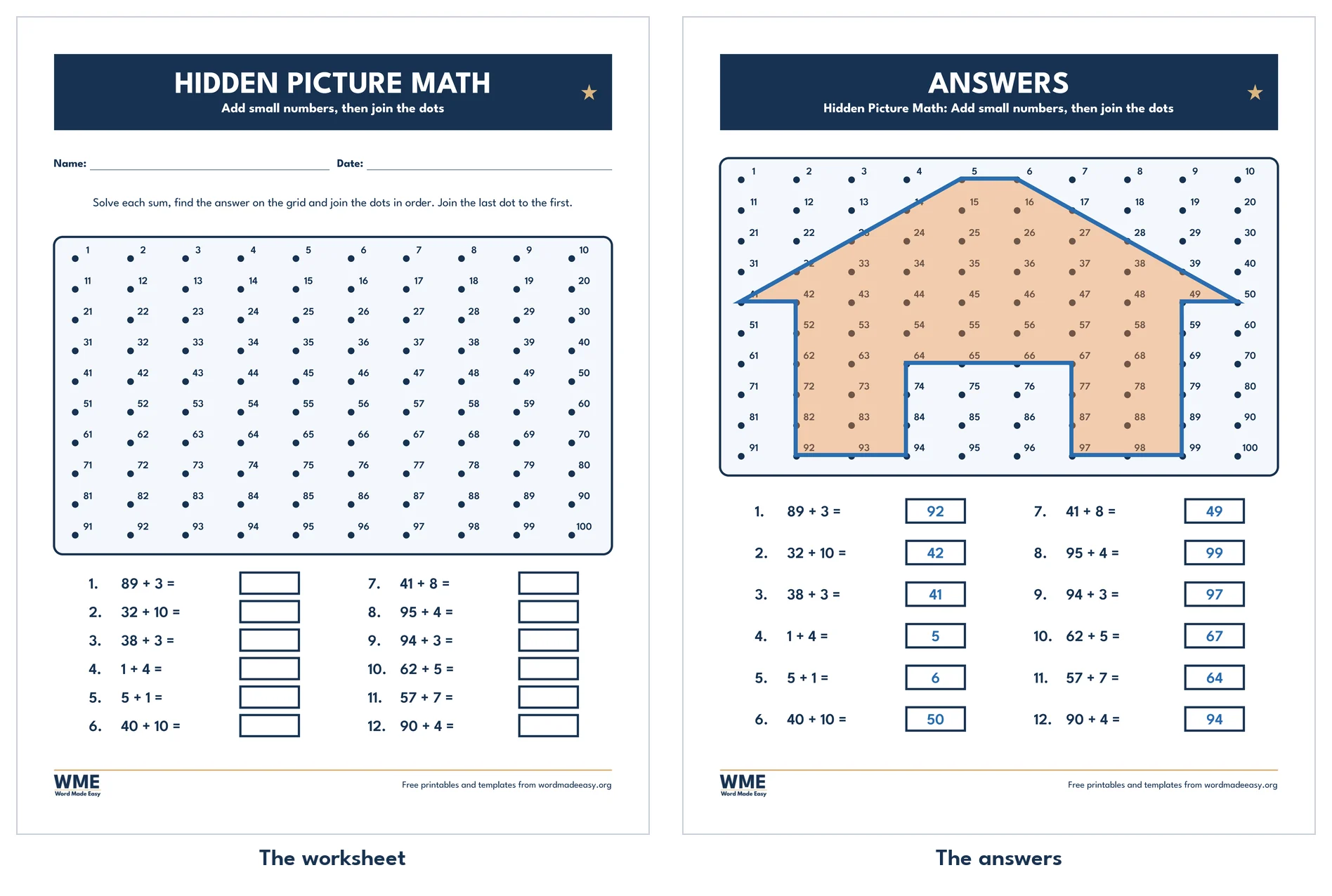
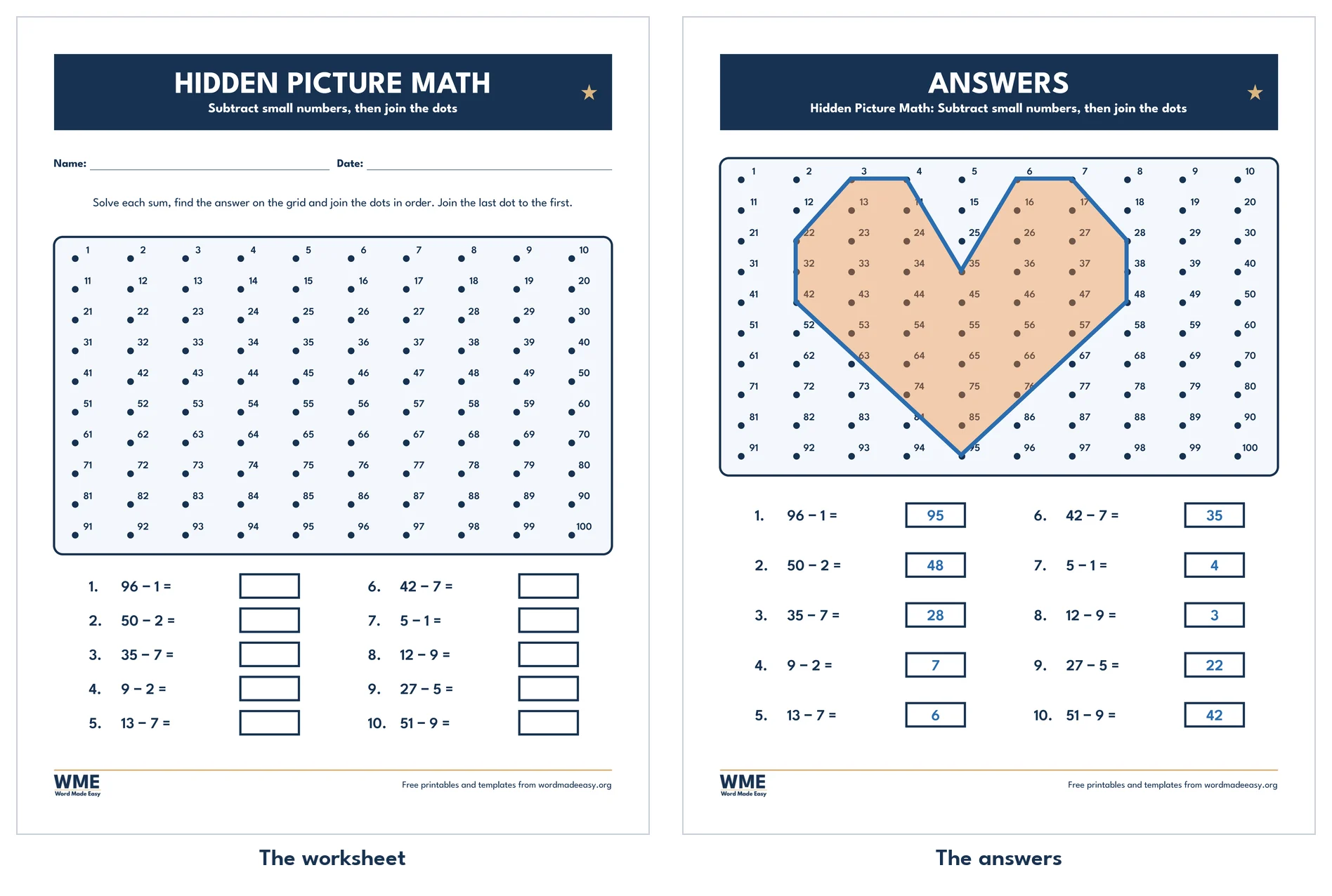
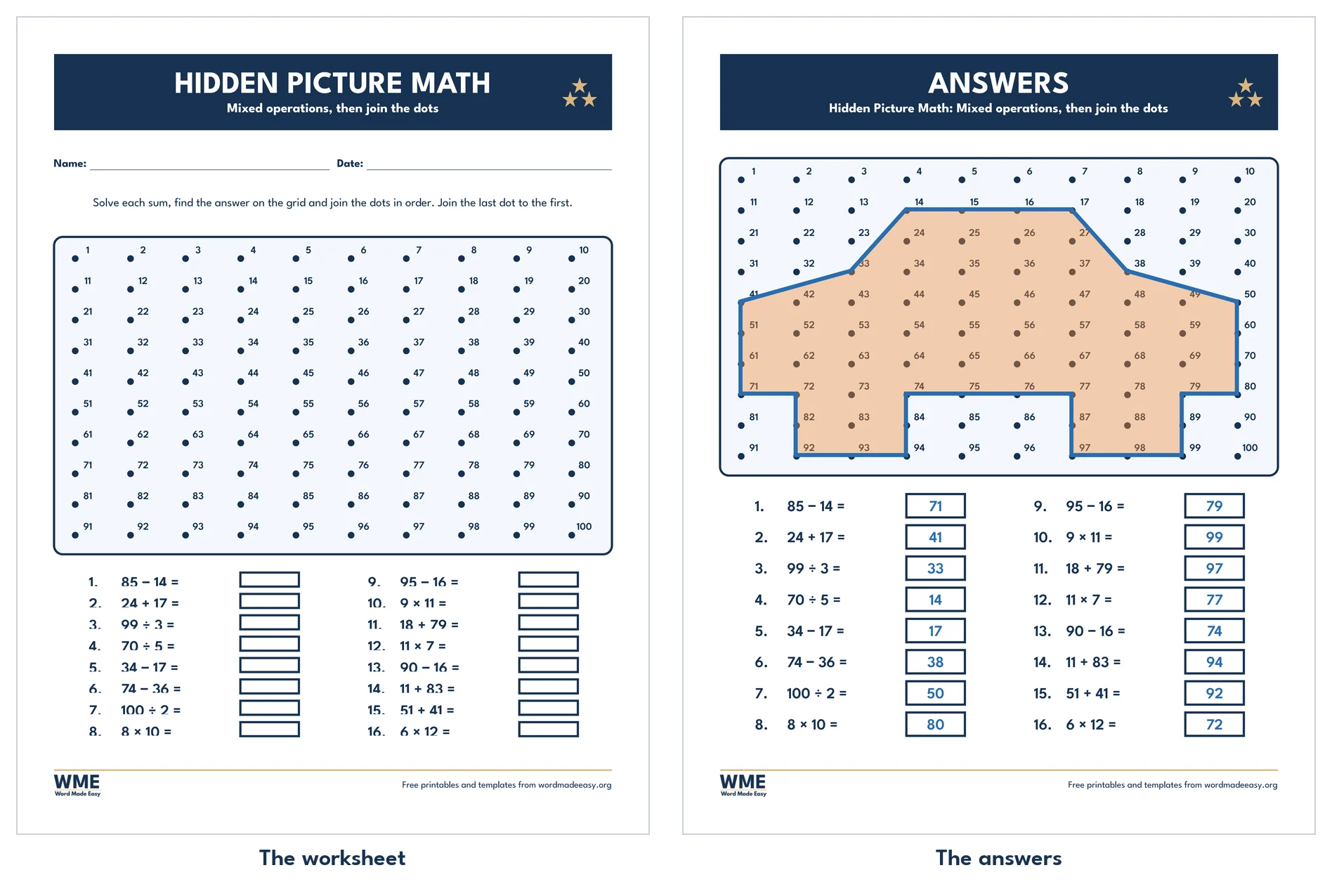
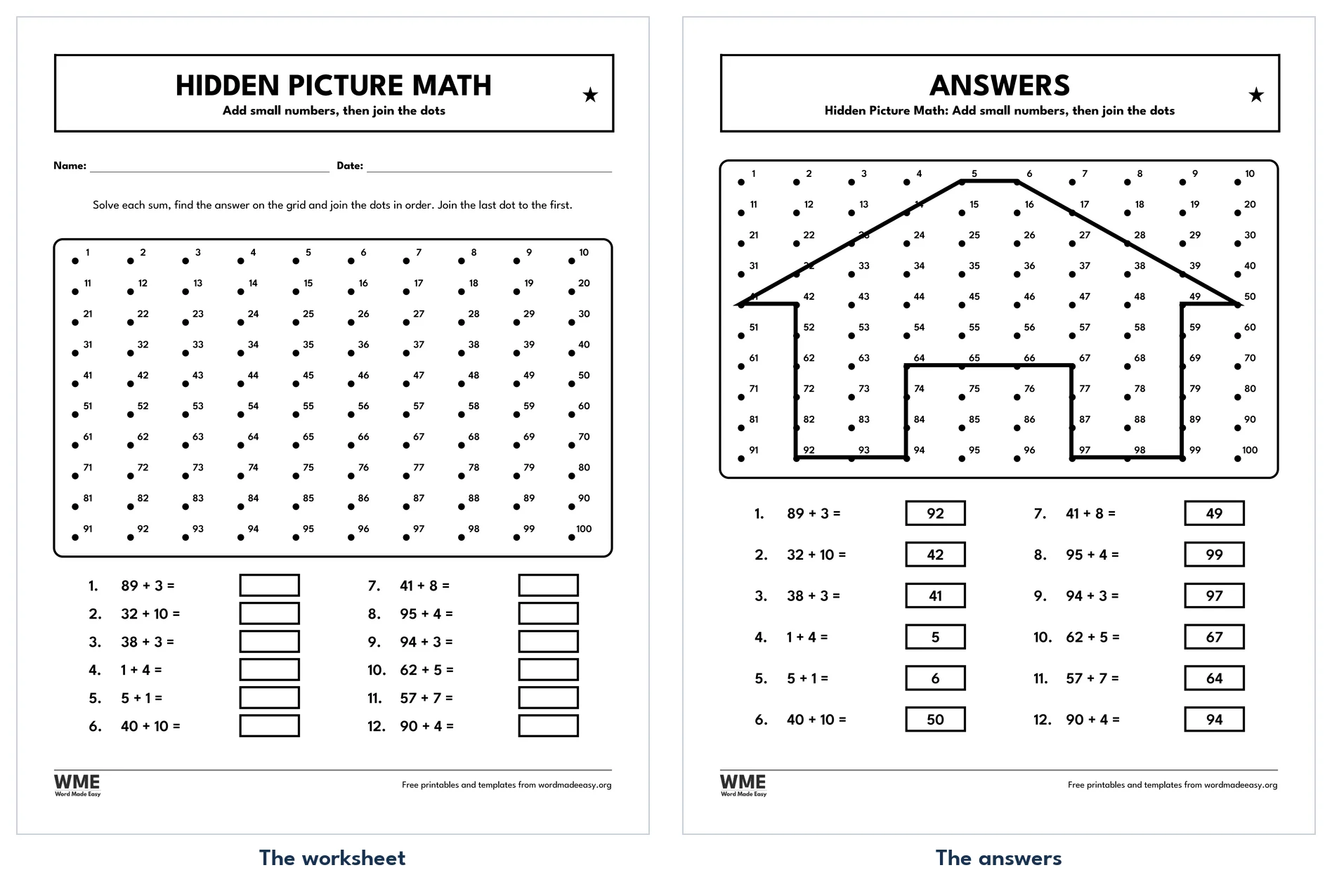
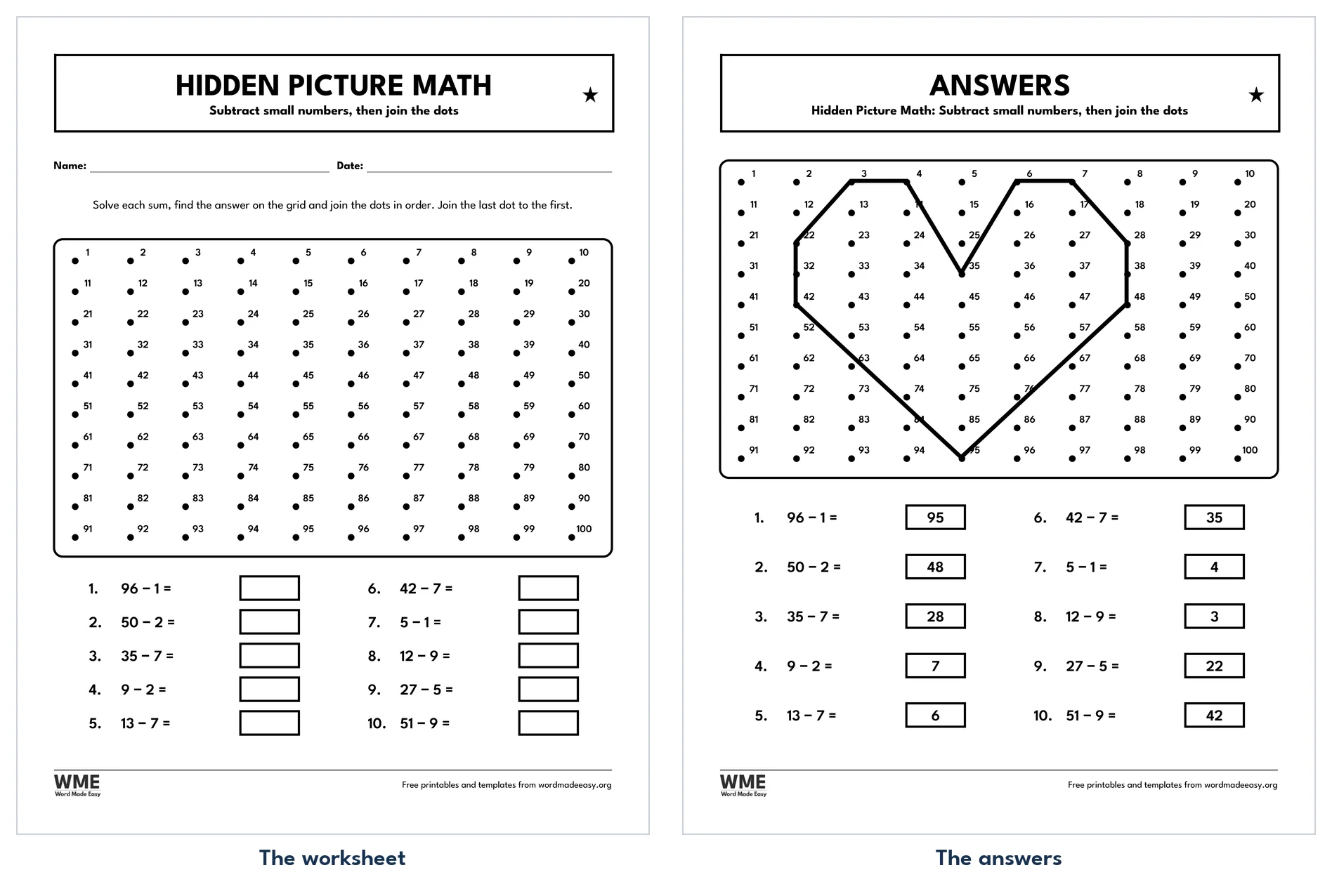
These ten free hidden picture math worksheets hide a picture behind a set of sums. Children solve each sum, find the answer on a grid of 100 numbered dots, and join the dots in order. When the last dot is joined back to the first, a house, a heart or a car appears. The sheets start with small additions and subtractions, move on to numbers within 100 and three-number sums, and end with multiplying, dividing and a mixed sheet. Each sheet was checked so that every answer equals the dot it points to, and every picture is one closed outline.
Below you will see what each sheet practises, which picture it hides, and how to support children who lose track of the order of the dots.
What’s in the Hidden Picture Math Worksheets
| Level | Worksheets |
|---|---|
| 1 star | Adding Small Numbers, Subtracting Small Numbers, Add and Subtract Small Numbers |
| 2 stars | Adding Within 100, Subtracting Within 100, Add and Subtract Within 100, Three Number Sums |
| 3 stars | Multiply and Divide, Division, Mixed Operations |
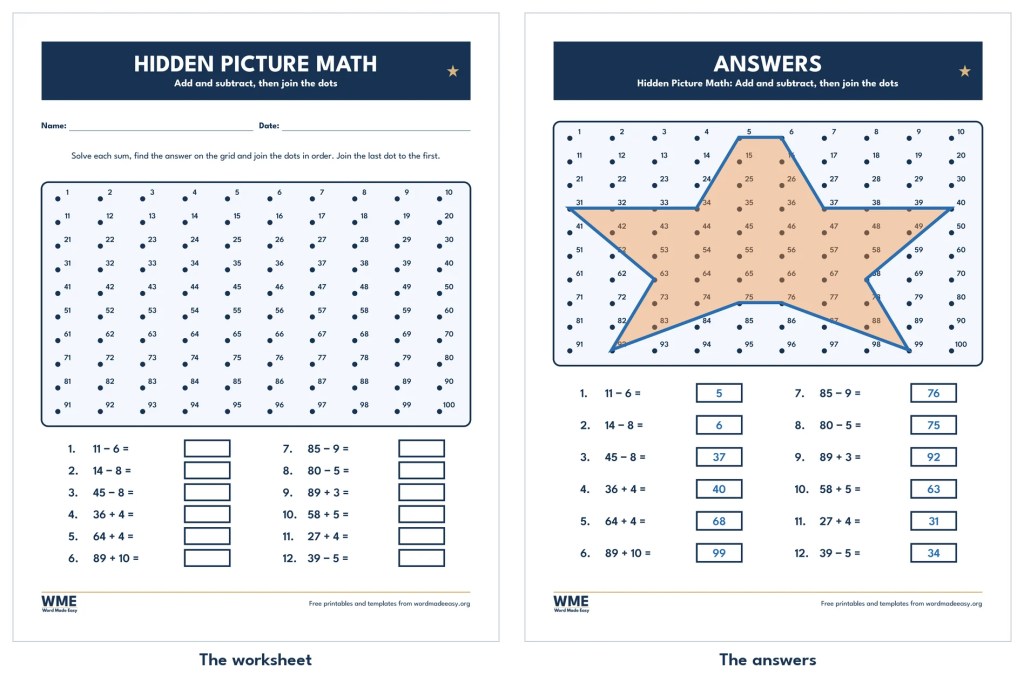
👉 Each sum, answer box and dot number is typed Word text, so you can change a sum or reorder them before printing. Page 2 shows the answers filled in and the picture joined.
What Is a Hidden Picture Math Worksheet?
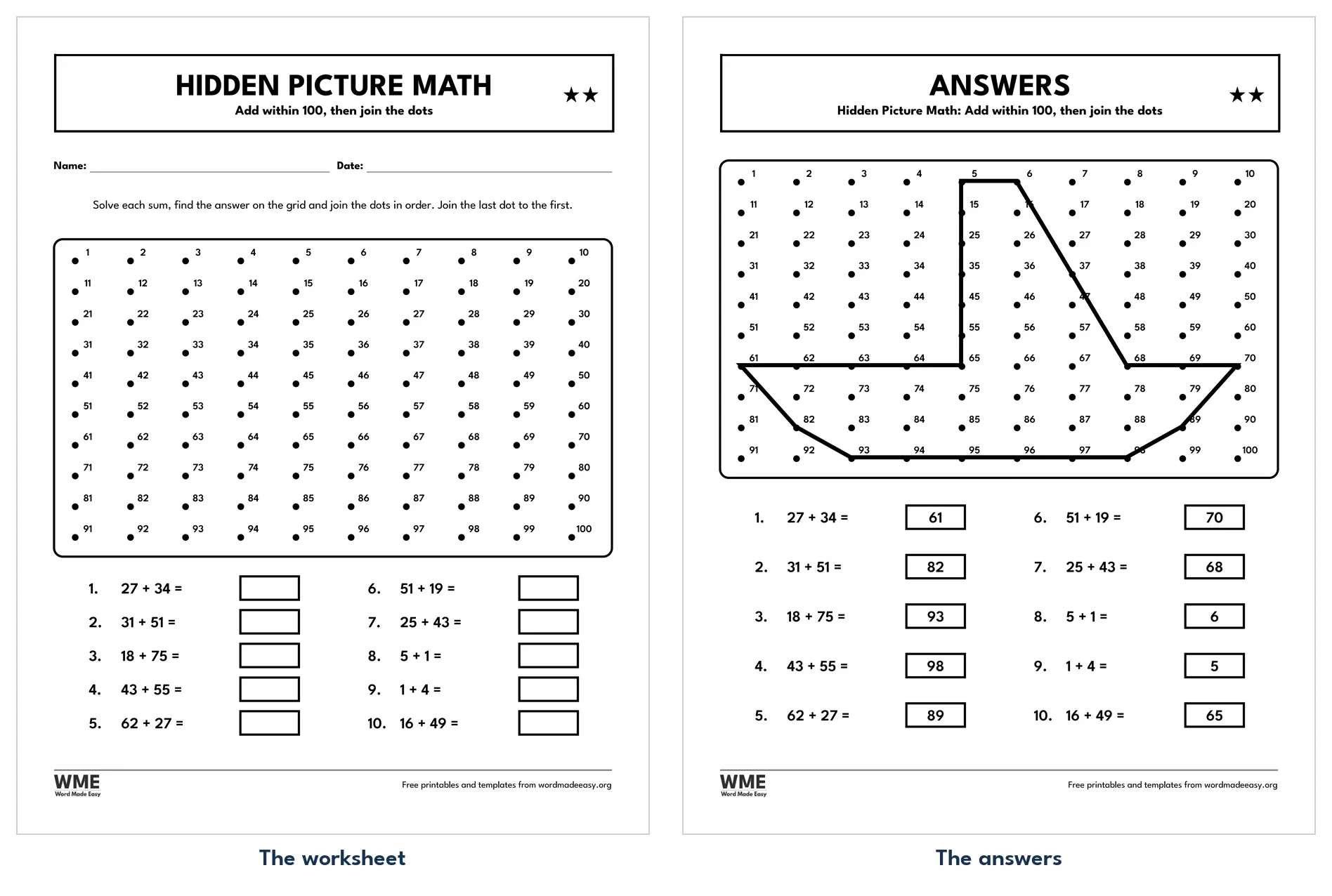
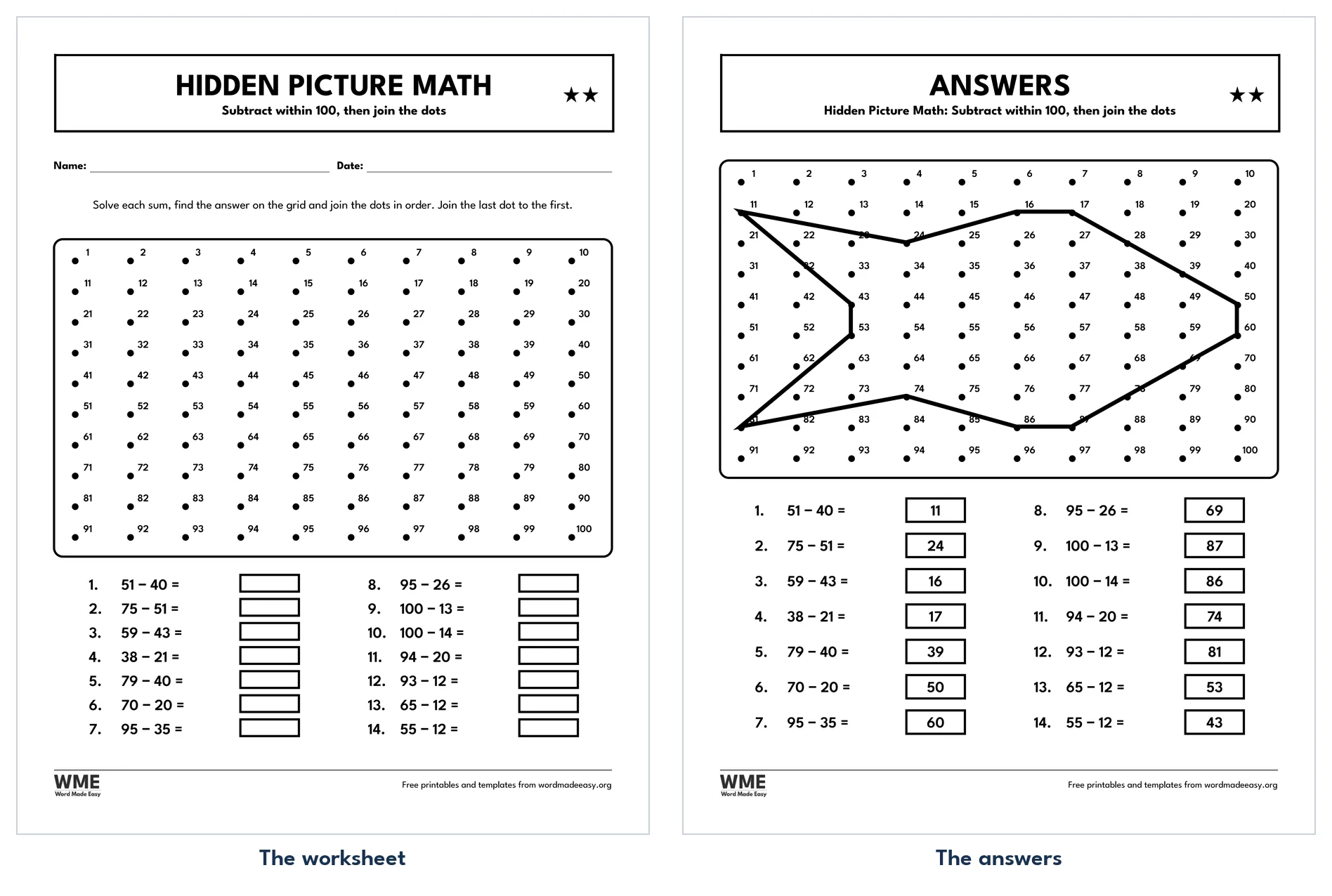
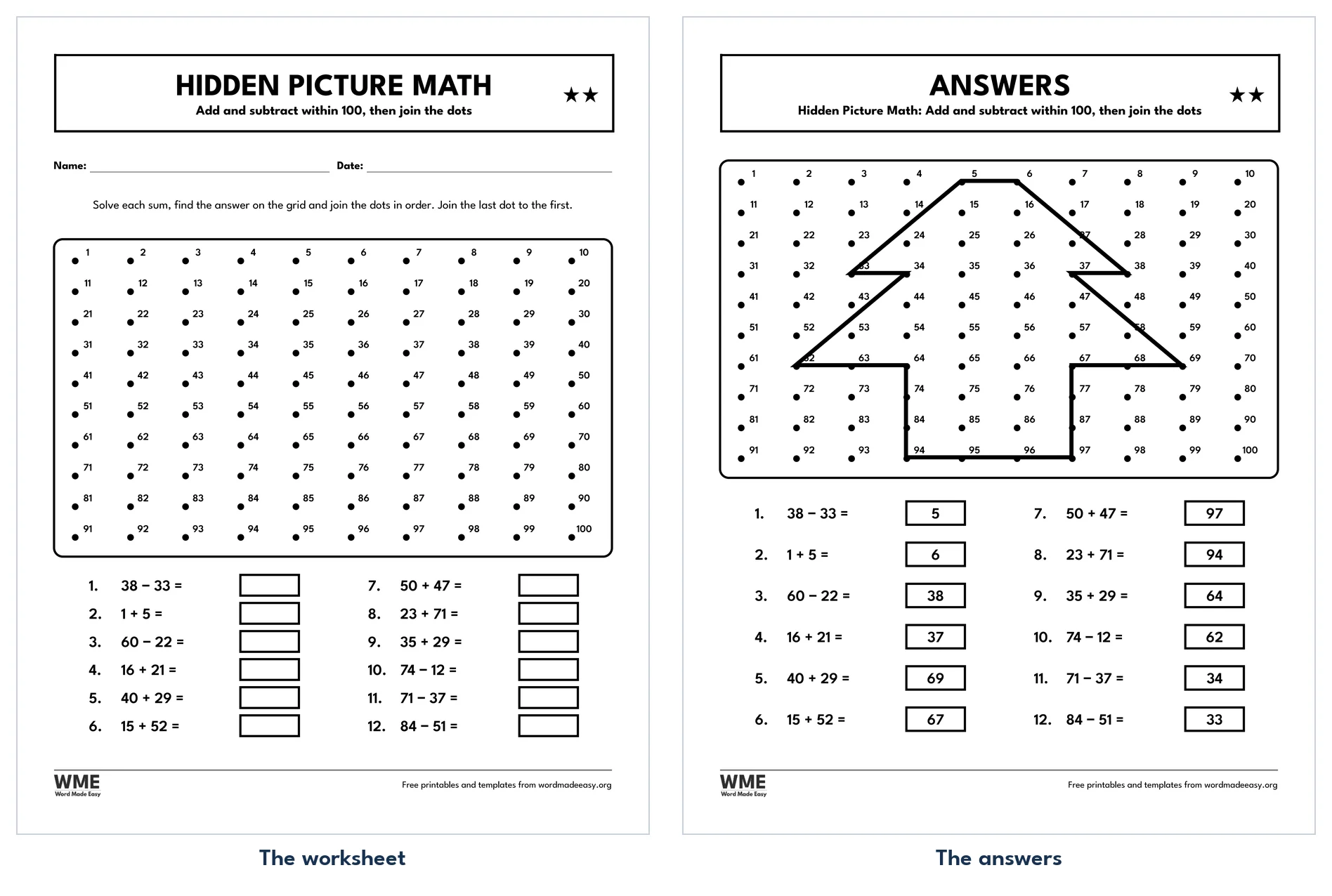
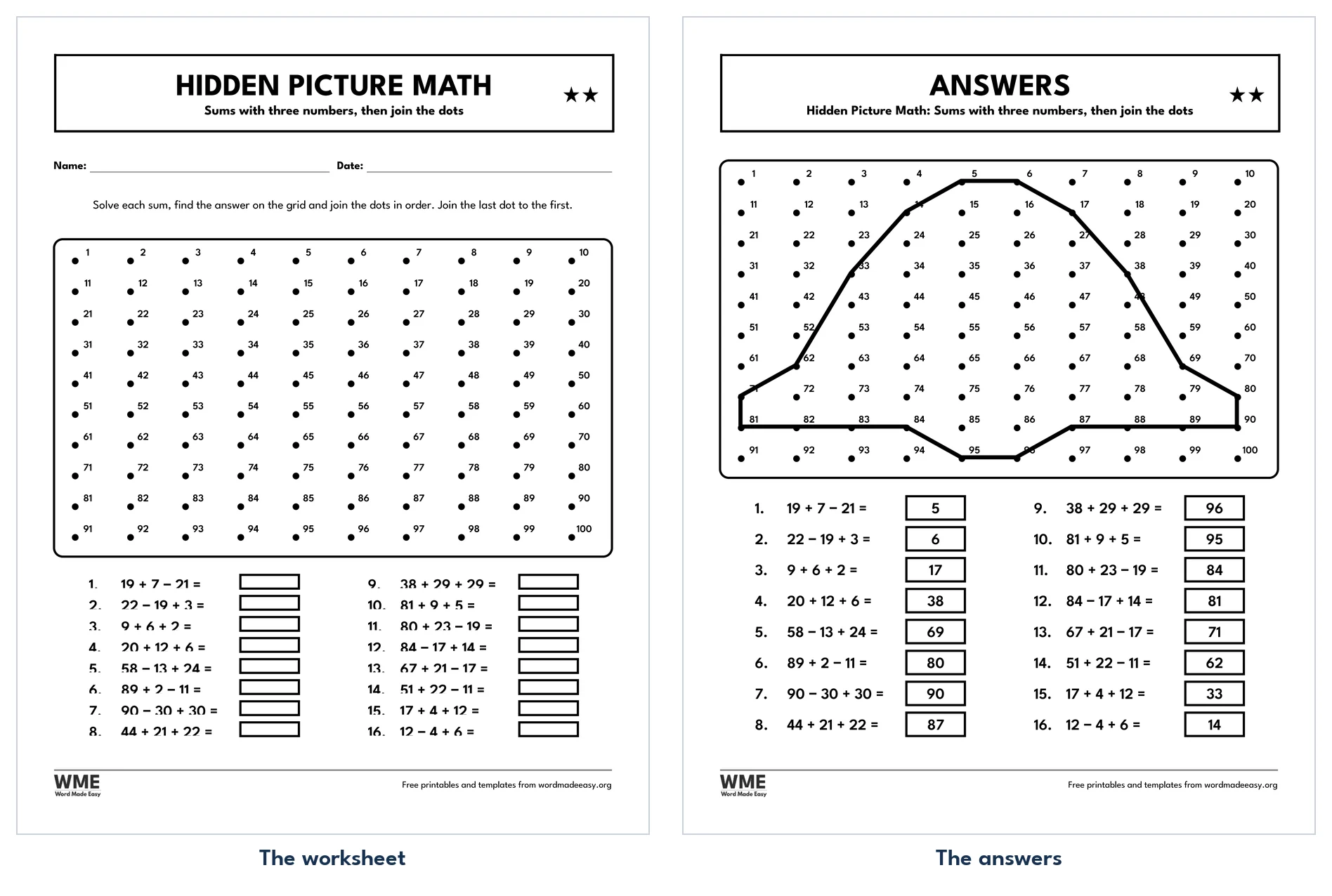
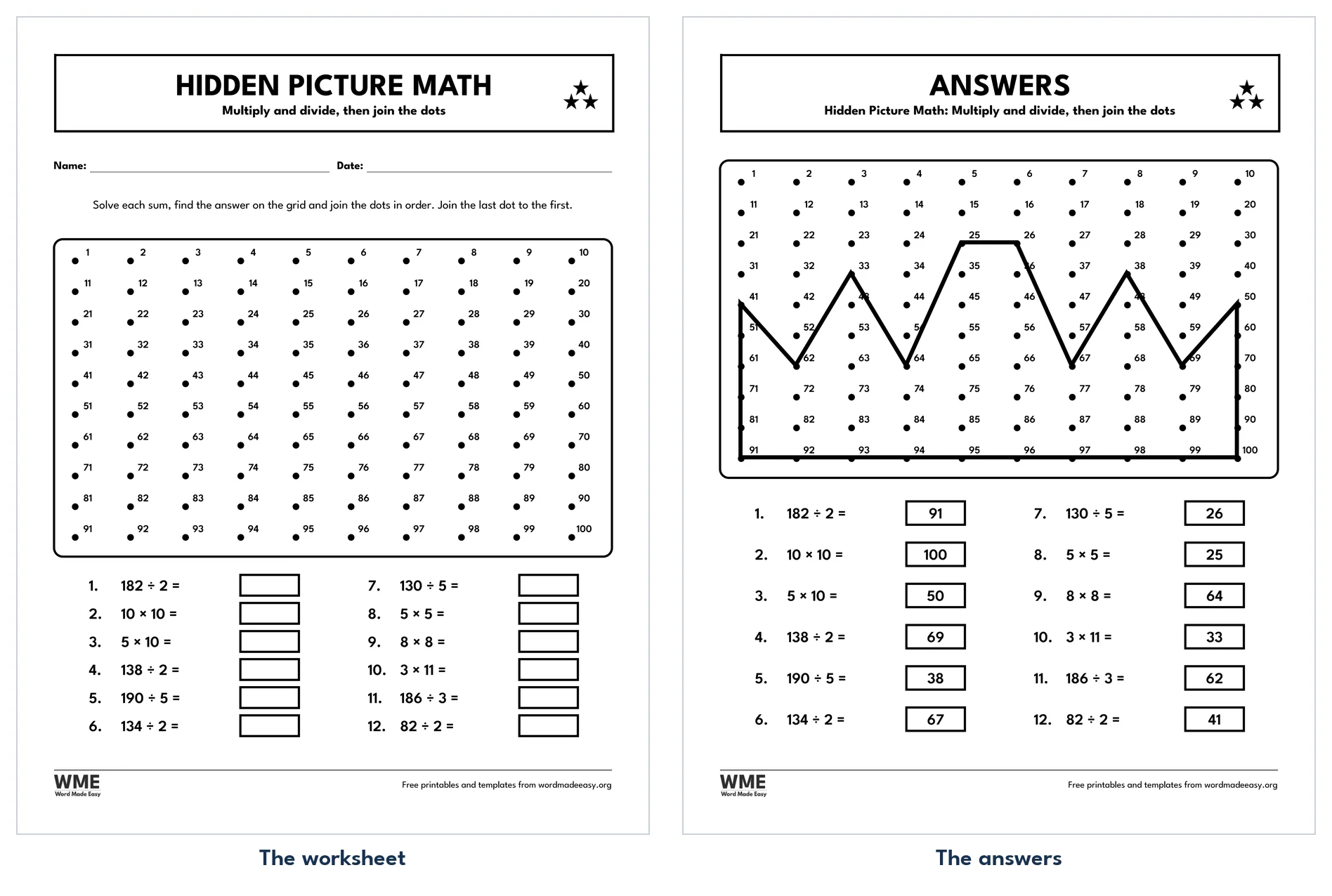
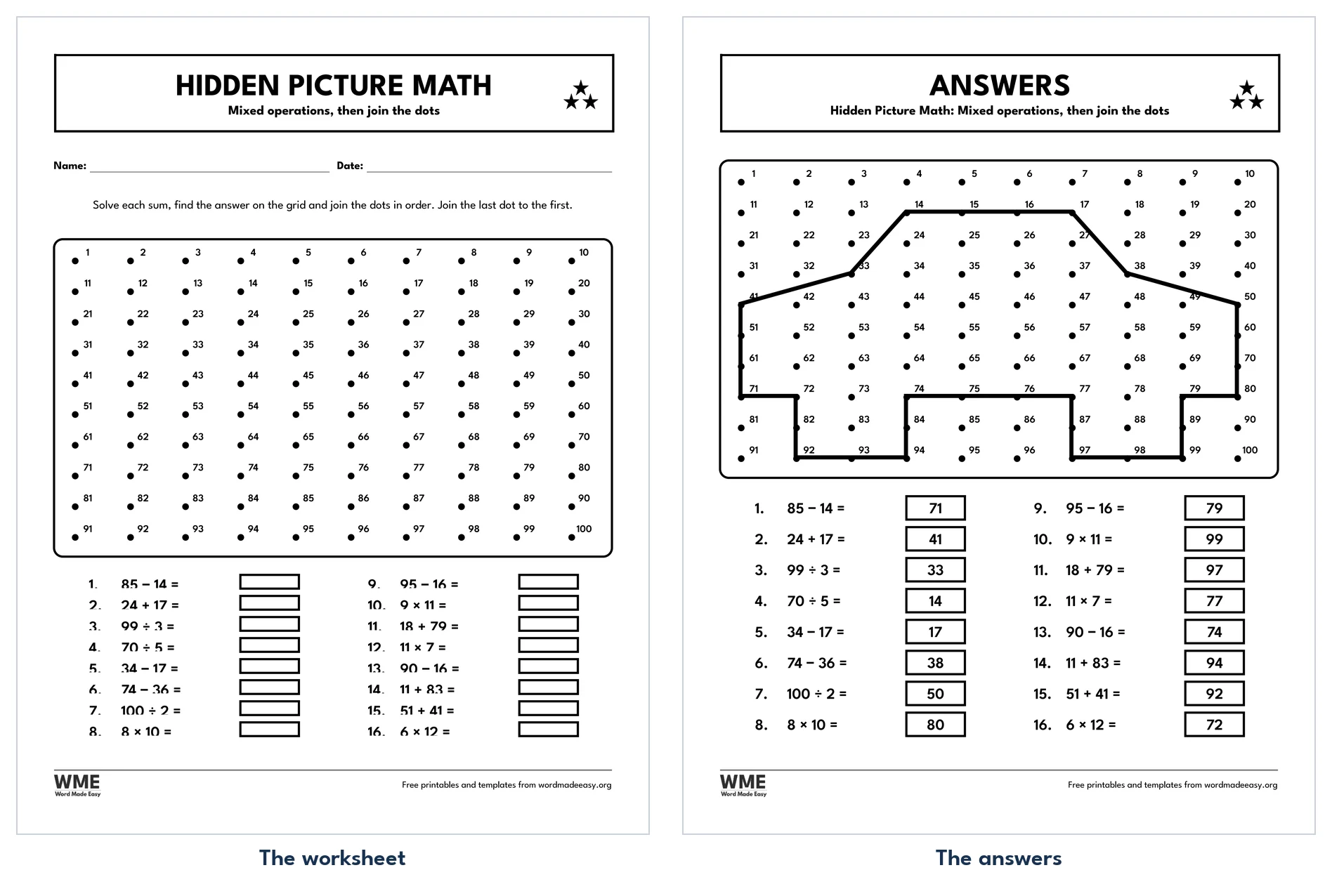
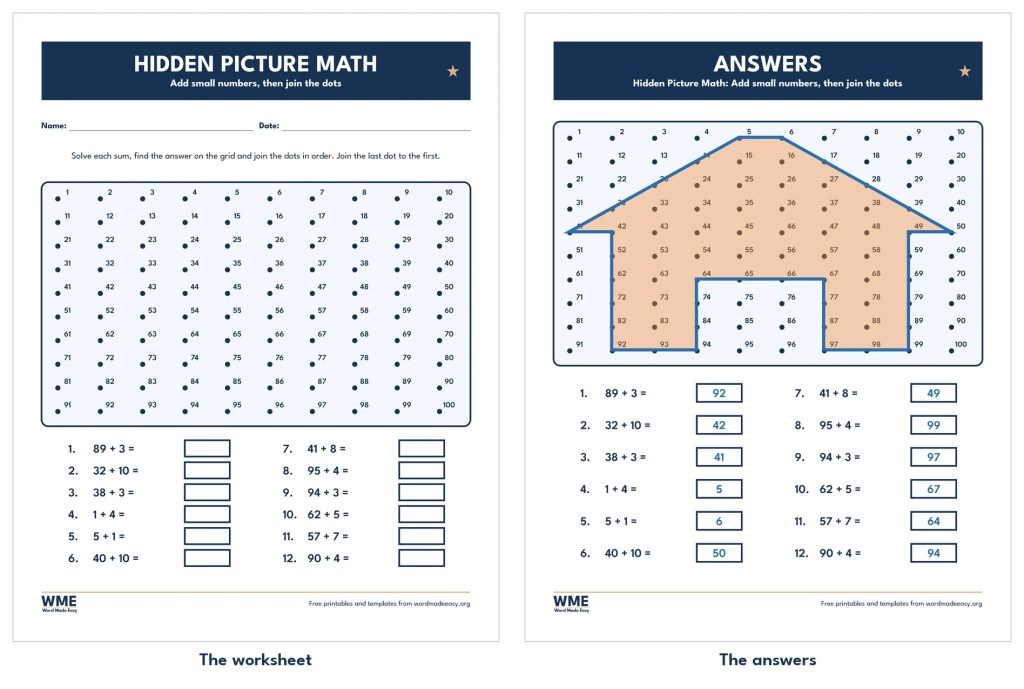
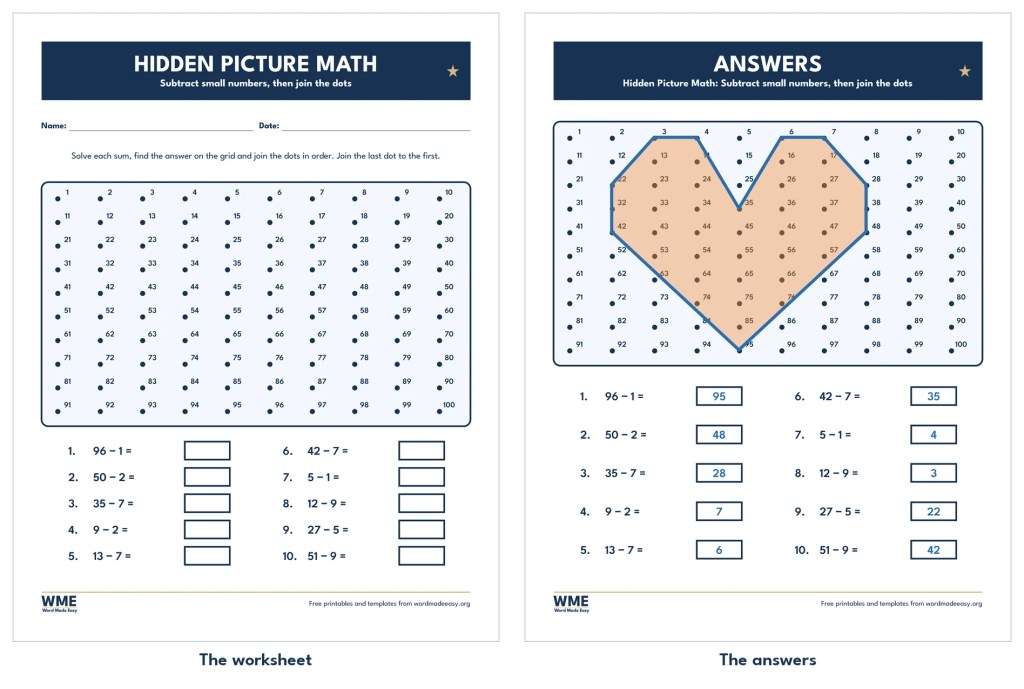
A hidden picture math worksheet turns answers into a drawing. Every sum has an answer between 1 and 100, and every answer is a number on the dot grid. The first answer is the first dot, the second answer is the second dot, and so on, so the picture only appears when every sum is right. A wrong answer sends the line to the wrong dot, which gives children a reason to go back and check, with no marks from an adult needed.
Which Hidden Picture Worksheet Should You Start With?
- The star in the corner tells you the sums: one star for small additions and subtractions, two for work within 100 and three-number sums, three for multiplying and dividing.
- Adding Small Numbers (1 star): twelve additions that reveal a house.
- Subtracting Small Numbers (1 star): ten subtractions that reveal a heart.
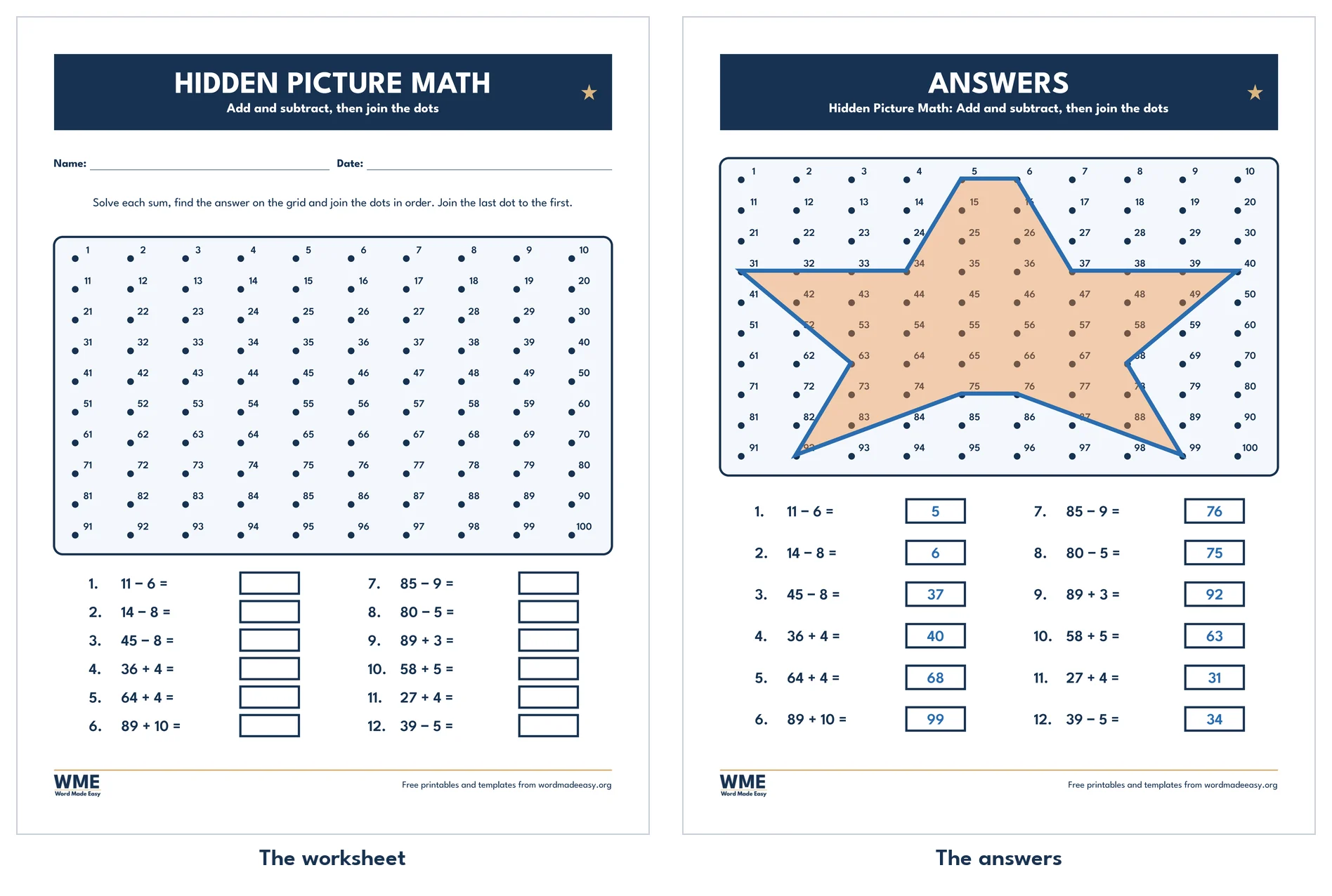
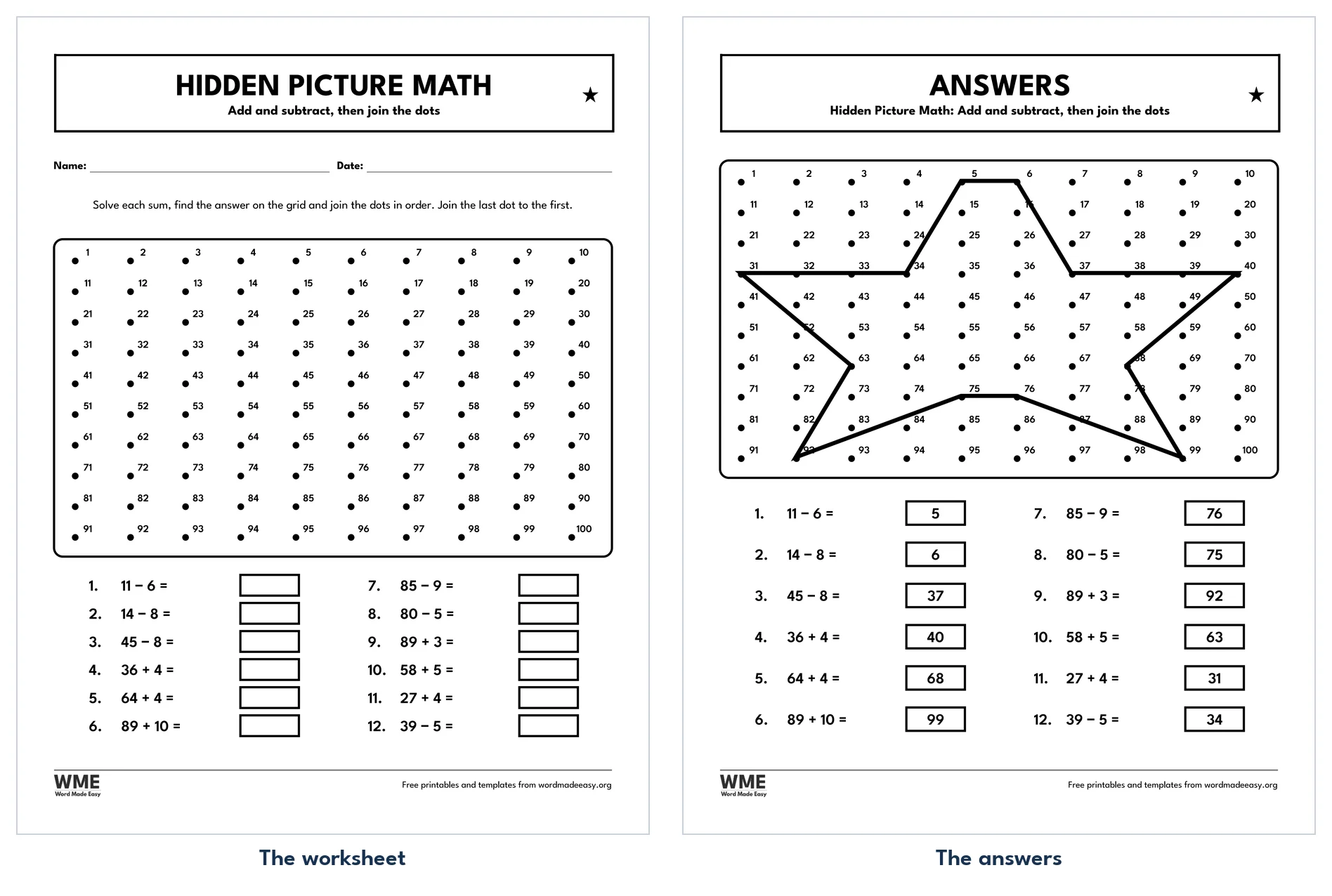
- Add and Subtract Small Numbers (1 star): twelve sums of both kinds that reveal a star.
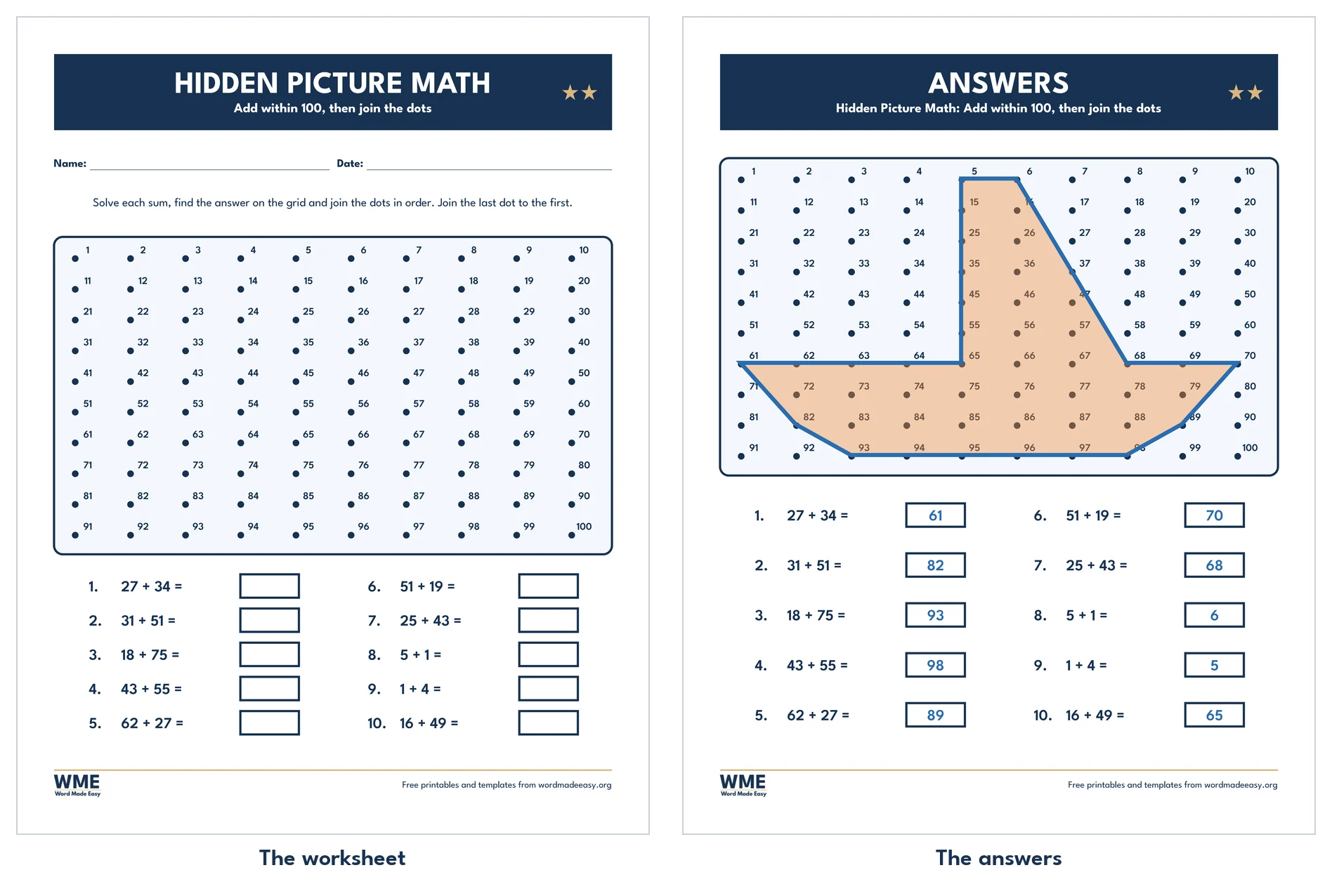
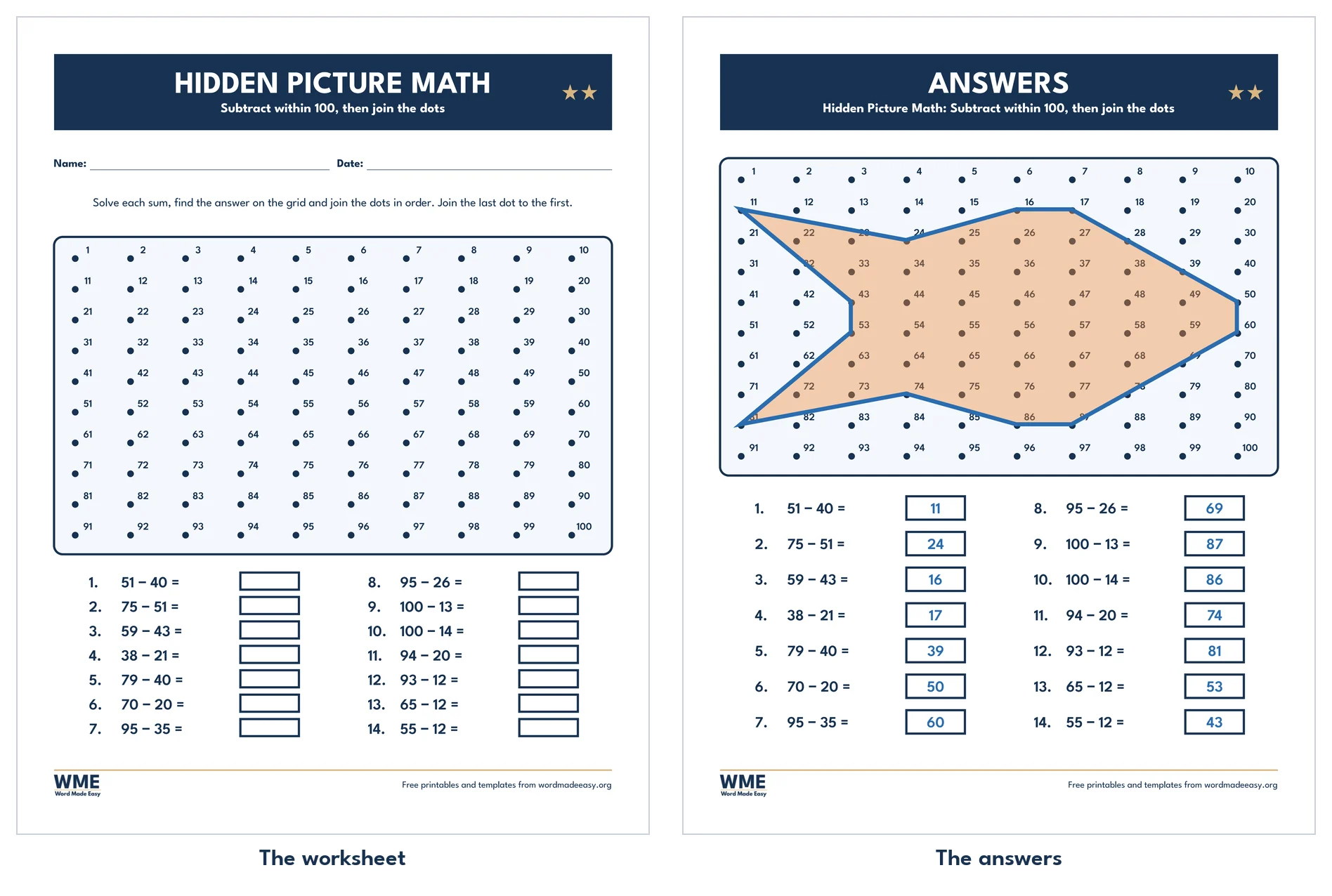
- Adding, Subtracting and Mixed Within 100 (2 stars): a sailing boat from ten additions, a fish from fourteen subtractions and a tree from twelve mixed sums.
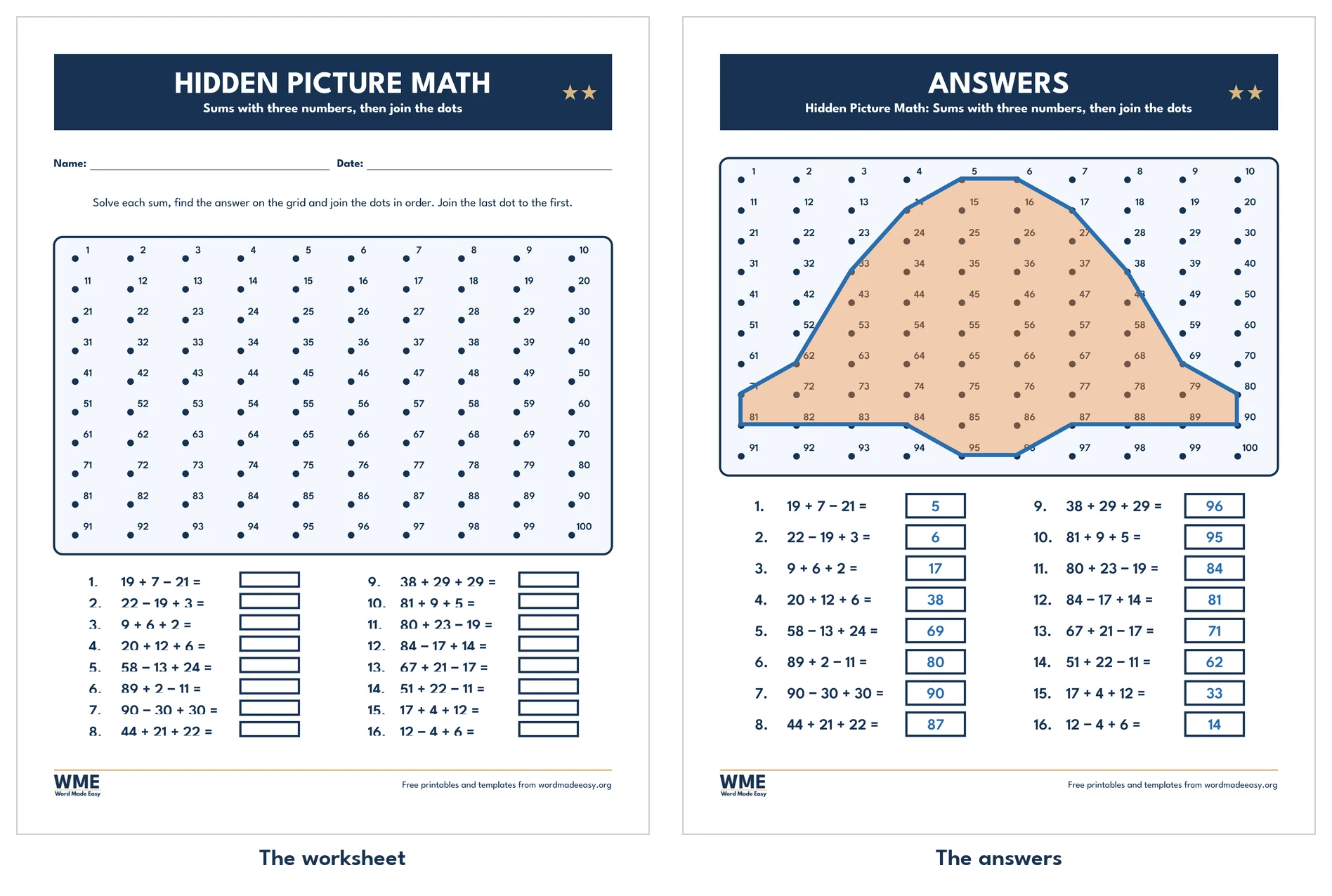
- Three Number Sums (2 stars): sixteen sums with three numbers, such as 12 + 7 – 5, that reveal a bell.
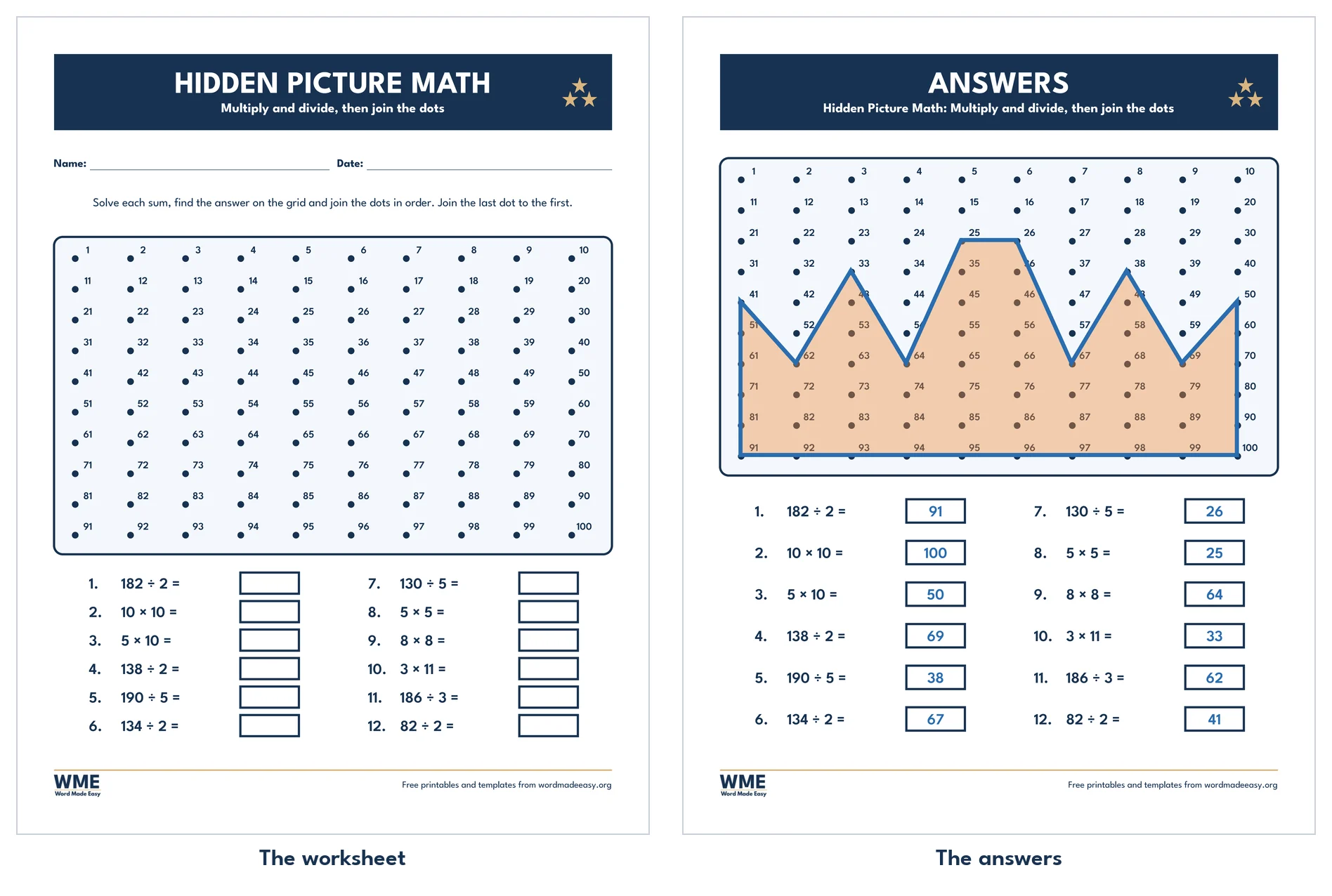
- Multiply and Divide (3 stars): twelve facts that reveal a crown. Where a dot is not a product of the tables, a division is used instead.
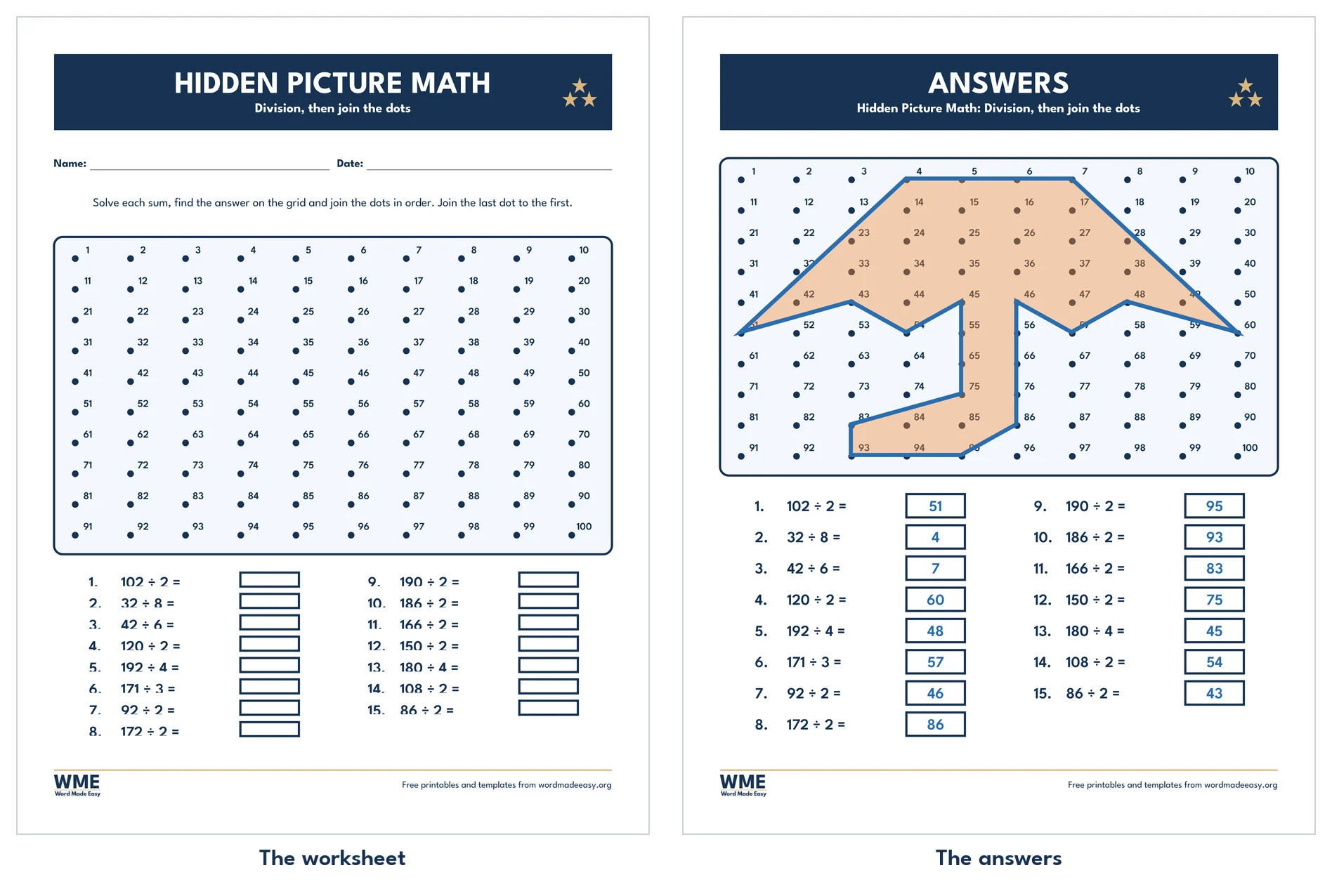
- Division (3 stars): fifteen divisions that reveal an umbrella.
- Mixed Operations (3 stars): sixteen sums of every kind that reveal a car.
- For dot pictures with no sums, see the Christmas dot to dot printables, and to plot a picture from coordinates try the coordinates worksheets.
How to Use the Hidden Picture Worksheets
- Choose US Letter or A4 above, then print page 1 of the sheet you want.
- Ask children to solve every sum first and write each answer in its box.
- Show them how to find a dot: dot 1 is top left, and the numbers run across each row like a page.
- Join the dots in order with a ruler, from the first answer to the last, then join the last dot back to the first.
- Check against page 2, and talk about any dot that went wrong.
Encourage children to mark each dot lightly with a pencil dot of their own as they find it, so they can see how the shape is growing. If the lines go somewhere odd, that is a clue that one of the sums was wrong. Check the sums rather than rubbing out the lines. Skip the harder sheets until the earlier ones feel easy, because the picture is more rewarding when nearly every sum is right.
Black and White Versions
Every hidden picture worksheet also comes in black and white, with the dots, numbers and the joined outline in black on white. Choose Black and white in the download box, or All to get both.
How to Print the Hidden Picture Math Worksheets
Want to print without editing? Every download has three folders: the editable Word files, the same sheets as PDFs, and every page as a print-ready image (JPEG), so you can print straight away without opening Word.
Print at 100% (Actual size) on the paper the file was made for, A4 or US Letter. Print page 1 for children and keep page 2, which shows the joined picture, as your marking key.
FAQs
Are these hidden picture math worksheets free?
Yes, they cost nothing. Choose a paper size and colour or black and white, and the ten sheets download as one ZIP.
How do the dots work?
The grid has 100 dots numbered 1 to 100, starting top left and reading across like a page. The first sum gives the first dot, the second sum gives the second, and so on.
What if a child gets a sum wrong?
The line goes to the wrong dot and the picture looks odd. That is the cue to recheck the sums, and page 2 shows the answer for each one.
What ages are they for?
The one-star sheets suit ages 6 to 8 (Year 2 to 3, Grade 1 to 2), the two-star sheets ages 7 to 9, and the three-star multiplication and division sheets ages 8 to 10.
Do the worksheets have answers?
Yes. Page 2 fills in every answer box and shows the finished outline joined through the dots.
Is there a black and white version?
Yes. The grid, numbers and answer outline print in black and white, so the picture reads well on a photocopy.
Conclusion
Ten hidden picture math worksheets, from small sums to division, each ending in a picture to join, ready to print.
Choose your paper size above, and for dot pictures with no sums, open the christmas dot to dot printables.
Related Tutorials
Maths Resources
Recently Added Maths Resources
Browse all free maths resources for home and school, all made by a teacher.
Leave a comment
Have a question about these resources, or an idea for a new one? Ask below.