
Free printable maths resource
These free addition facts to 20 worksheets give children systematic practice with every ordered addition fact using addends from 1 to 10. The four uncluttered worksheets contain 100 unique calculations with generous answer lines.
Preview what is inside
1 of 3
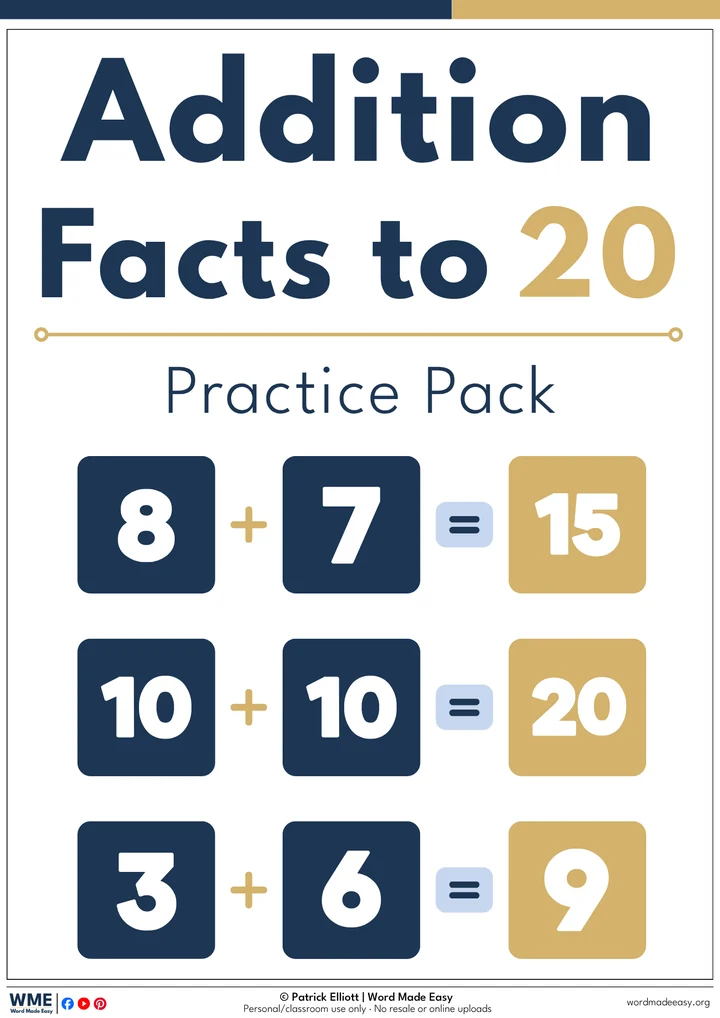
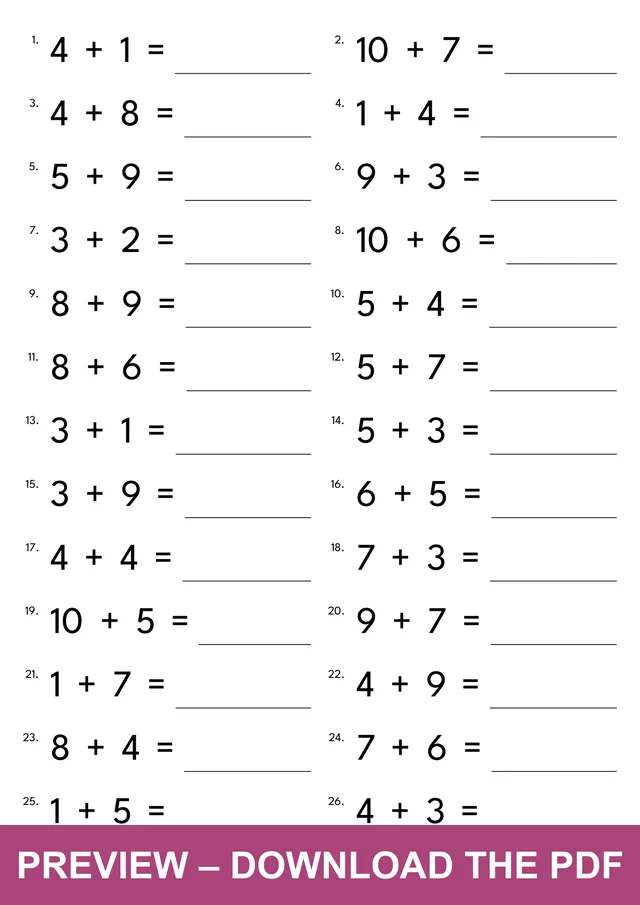
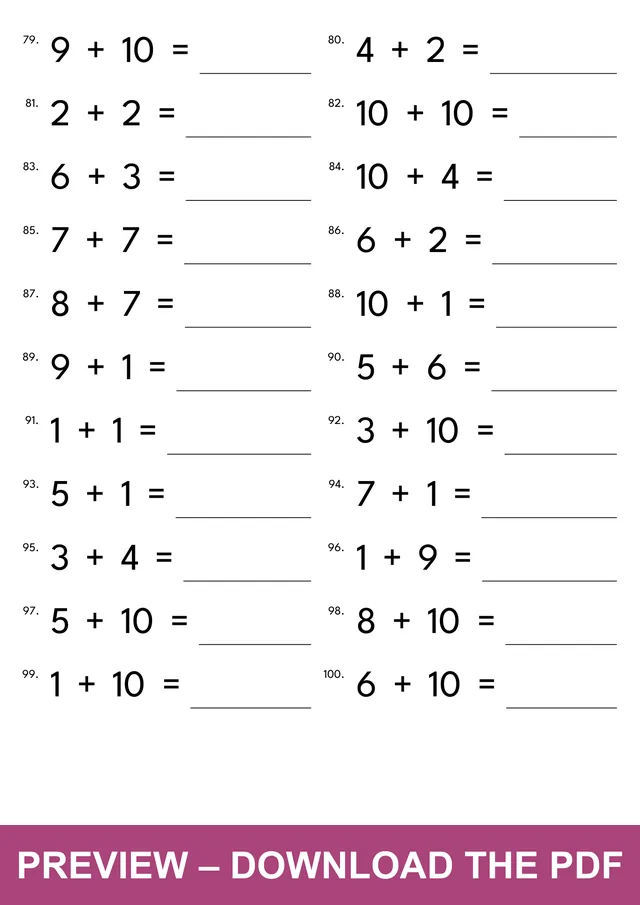
Use the arrows or dots to view the clean cover and two inside pages. The inside pages are reduced-resolution, watermarked previews; the PDF contains clean printable worksheets.
Build from secure pairs with the Number Bonds to 10 Booklet, then connect known facts to the representations in the Number Facts Part-Whole Booklet.
About these addition facts to 20 worksheets
This addition facts to 20 practice pack contains a clean cover and four worksheets with 100 calculations altogether. Every ordered pair of addends from 1 to 10 appears exactly once, so children meet both forms of a commutative pair, such as 3 + 7 and 7 + 3, without repeating an identical question. Answers range from 2 to 20.
Each A4 worksheet uses a clear two-column layout, large numerals and a generous horizontal answer line. The uncluttered black-and-white design prints economically and keeps attention on mental calculation and accurate recording.
What is included?
Four practice worksheets: The addition facts to 20 questions are divided across four printable pages, with 26 questions on each of the first three pages and 22 on the final page.
Complete ordered coverage: All 100 additions formed from addends 1 to 10 are included once. This makes the pack useful for broad practice and for spotting facts that still need teaching.
Sums up to 20: Children practise small totals alongside calculations such as 9 + 10 and 10 + 10.
A seven-page PDF package: The five resource pages – the cover and four worksheets – are followed by the two standard Word Made Easy thank-you and terms-of-use pages. An answer key is not included.
What children can practise
- recalling addition facts with addends from 1 to 10;
- using counting on when one addend is already known;
- recognising doubles and near doubles;
- partitioning an addend to make 10 before adding the remainder;
- using commutativity to connect facts such as 4 + 9 and 9 + 4;
- recording answers accurately and checking whether a total is reasonable.
How to use the practice pack
Introduce: Before independent work on addition facts to 20, model two or three useful strategies with counters, a ten frame or a number line. For 8 + 7, for example, move 2 from the 7 to make 10, then add the remaining 5.
Practise: Give one worksheet at a time and ask children to mark the facts they knew immediately and those they solved with a strategy. The pages can be used for a short lesson task, morning work, homework or retrieval practice.
Review: Discuss selected answers and invite pupils to explain their method. Look for efficient connections between related facts rather than treating speed as the only sign of fluency.
Teaching and follow-up ideas
- Ask pupils to colour-code addition facts to 20 that are doubles, make 10 or have a total greater than 10.
- Choose several commutative pairs and discuss what changes – and what stays the same – when the addends swap places.
- Cut one worksheet into strips for a small-group sorting activity based on strategy or total.
- Let pupils select five calculations and represent each one with counters, a bar model or a part-whole model.
- Use errors diagnostically: an answer that is one too high may reveal a counting-on slip, while difficulty around 10 may suggest more work on number bonds.
- Revisit only the uncertain facts in a later session rather than repeatedly completing the entire pack.
Support and challenge
Support: Reduce the number of questions shown at once, allow counters or a number line and begin with facts whose total is 10 or less. Encourage children to circle the larger addend and count on from it. Pair each written calculation with a concrete or pictorial representation when needed.
Challenge: Ask pupils to justify two different strategies for the same fact, group calculations that share a total or write the related subtraction facts. They can also predict how changing one addend by 1 changes the total, then test the prediction with examples from the page.
Where this resource fits in learning
Use the addition facts to 20 worksheets after children have explored addition with practical equipment and images. Secure number bonds, doubles and the make-10 strategy first; the mixed sequence then helps pupils choose a method independently. This supports the national curriculum mathematics programme of study, which includes number bonds within 20 and mental fluency. The pack is also useful as a low-stakes check of which facts are fluent and which require focused teaching.
For a narrower starting point, use the Number Bonds to 10 Booklet. To extend the discussion from equations to connected representations, move on to the Number Facts Part-Whole Booklet.
Resource licence
Free for personal and classroom use. You may print copies for yourself or your learners. Resale, redistribution and uploading the file to other websites are not permitted.
Questions about the addition worksheets
What addition facts are covered?
The worksheets include every ordered addition calculation formed with addends from 1 to 10 exactly once, giving 100 unique questions with answers up to 20.
How many printable pages are included?
The resource contains a clean front cover and four worksheet pages. The PDF also includes two Word Made Easy thank-you and terms-of-use pages, making seven pages in total.
Is an answer key included?
No. This practice pack contains the question pages only, with clear answer lines for pupils to record each total.
Do commutative pairs appear?
Yes. Both orders appear, so pupils meet facts such as 3 + 7 and 7 + 3. Each exact ordered calculation appears only once.
How can I support pupils who are not yet fluent?
Offer counters, a ten frame or a number line, show fewer questions at once and model strategies such as counting on, using doubles and making 10.
May I print copies for my class?
Yes. You may print copies for your own learners under the personal and classroom-use licence.
Leave a Reply