
All About Me Handwriting Workbook: 20 Words
Free printable Foundation handwriting resource
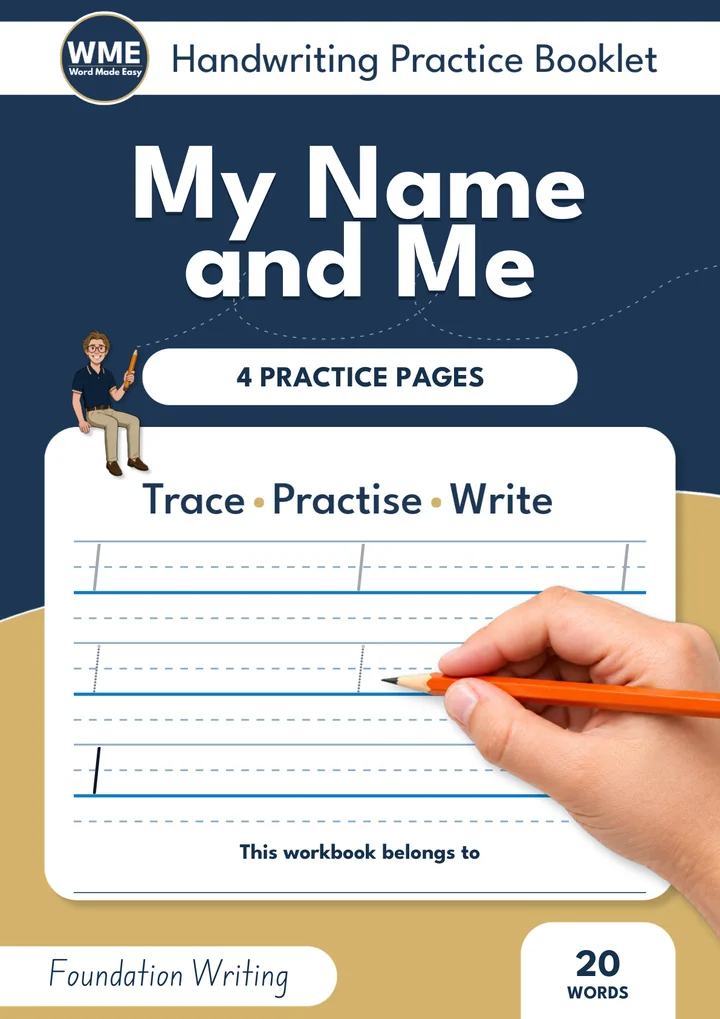
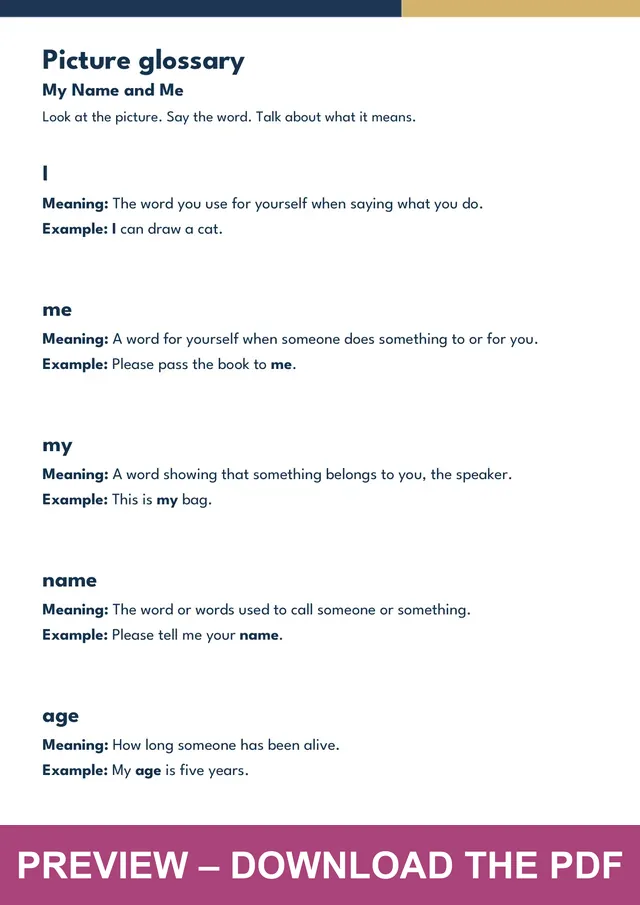
This all about me handwriting workbook introduces 20 words for talking about yourself and other people, including I, my, name, birthday and friend. A glossary explains the vocabulary before children trace, follow dotted lettering and copy the words in Foundation writing.
Preview what is inside

1 of 4
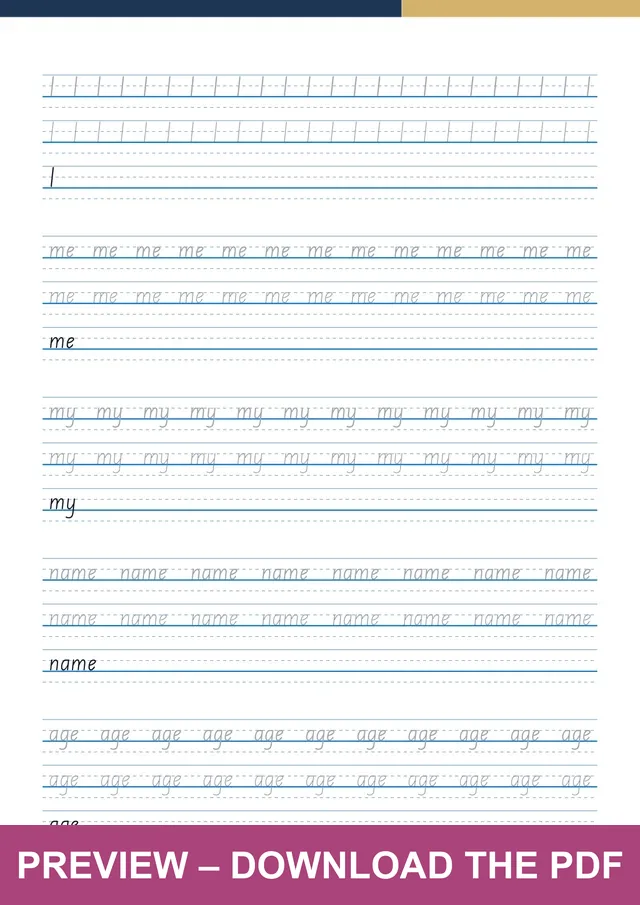
Use the arrows or dots to see the front cover, one glossary page and two handwriting sheets. The three inside-page previews are watermarked; download the PDF for clean printable pages.
Revisit letter formation with Alphabet Trace & Write A-Z Practice Workbook when a pupil needs a single-letter starting point. Use Alphabet Chart with Picture Prompts (A-Z) as a visual aid when discussing the capital I and other letter names.
About this all about me handwriting workbook
The resource is titled My Name and Me. It practises a fixed collection of useful personal and social words rather than generating a personalised name sheet. The word name appears for tracing, but the learner's own name is not printed in dotted form. You can add that separate activity after discussing how names identify people.
The vocabulary moves from I, me and my to birthday, home, myself and mine, then includes you, your, we and our. Later entries such as favourite, choose, learn and help support simple classroom conversations. Some abstract words have no picture beside their practice groups, so spoken examples are particularly valuable. Four glossary pages precede four handwriting sheets.
What is included?
- 20 words: I, me, my, name, age, birthday, home, like, myself, mine, you, your, we, our, child, friend, favourite, choose, learn, help.
- 4 picture-glossary pages with meanings and example sentences.
- 4 handwriting sheets using grey models, dotted letters and independent copying space.
- 12 PDF pages in total: front cover, instructions, glossary, handwriting sheets and two terms pages.
How to use this all about me handwriting workbook
Introduce I and my through an ordinary classroom sentence, such as talking about a drawing or a bag. Point to the glossary word while saying the sentence and clarify who is speaking. Notice that the pronoun I is a capital letter even when other practice words are lowercase.
Choose one short group and work through its three strips. When writing my, check how y extends below the baseline. For name, keep the smaller letters at a consistent height. Once a word is copied clearly, use it in a spoken sentence before moving to another entry.
Teaching and follow-up ideas
- Ask children to finish an oral sentence beginning I like, then find both words in the collection.
- Use a puppet to contrast my and your while pointing to an object belonging to the speaker or listener.
- Make a separate name card and explain the difference between the printed vocabulary word name and a person's actual name.
- Choose favourite or friend for a drawing caption, with an adult helping to record any additional words.
Support and challenge
Begin with spoken examples and gestures for words such as me, you and we. Avoid asking pupils to disclose personal details to complete a handwriting task; pretend examples work well. Cover longer entries until the learner is ready, and use I or me for a short successful practice. Extend the activity by changing a spoken sentence from my to your and discussing how its meaning changes.
Where this fits in learning
Use familiar conversation to establish the meaning of a word, connect that word to its printed form and then practise handwriting. This can support an all-about-me theme while remaining flexible for children with different experiences and language backgrounds. Later, pupils can use selected words in a self-chosen caption or a sentence dictated to an adult; the workbook does not require independent sentence composition.
Choosing pages to print
For this all about me handwriting workbook, pDF page 7 starts the practice with I, me, my, name and age, and glossary page 3 explains those entries. The final sheet, page 10, contains friend, favourite, choose, learn and help. Choose the vocabulary for the conversation you plan to have, rather than treating the cover title as a requirement to complete personal information. Print the matching glossary page for adult reference, or keep the booklet open beside a single practice sheet. Check that the capital I, pale tracing forms and guide lines reproduce clearly before printing multiple copies.
The handwriting guidance can help you model the capital I alongside the lowercase forms in my and name. NSW handwriting teaching resources.
Resource licence
Free for personal, homeschool or single-classroom use under the terms included in the PDF. Resale, redistribution and uploading the file to another website are not permitted.
Questions about this workbook
What is included in the all about me handwriting workbook?
No. It is a fixed vocabulary workbook that includes the word name. It does not generate personalised tracing text.
Why does I have a capital letter?
I is the English first-person pronoun and is written as a capital letter.
Do all entries have a picture?
No. Abstract words such as me and my rely on their explanations and spoken examples rather than a picture prompt.
How many practice pages are there?
There are four handwriting sheets and four glossary pages. With the cover, instructions and two terms pages, the PDF has twelve pages.
Can I use pretend personal details?
Yes. Children can discuss a puppet or fictional example instead of sharing private information.
What can follow the copying activity?
Use a practised word in a spoken sentence or a short caption on separate paper, with adult writing support as needed.
Leave a Reply