Skip to content
Word Made Easy
Home Word Tutorials PowerPoint Tutorials Teacher Resources YouTube Videos

Alphabet Chart with Picture Prompts (A-Z)

Teacher Resources, Phonics, Alphabet
★★★★★★★★★★No ratings yet

Free printable early phonics resource

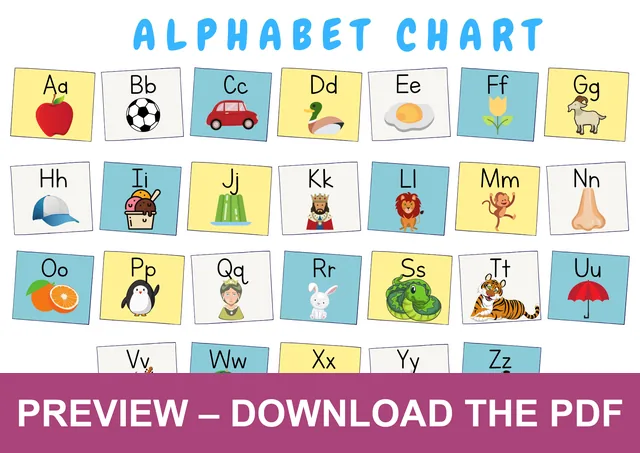
This free alphabet chart with picture prompts places uppercase and lowercase A-Z letters on one landscape page. Each letter card includes a simple illustration, giving children a compact reference for alphabet order, letter recognition and initial-sound discussion.

PDF format 1 printable page Uppercase and lowercase A-Z Picture prompts

Preview the alphabet chart

Alphabet chart with uppercase and lowercase A-Z letters and one picture prompt for each letter

This A-Z alphabet chart is shown as a reduced-resolution, watermarked preview. The downloaded PDF is the clean landscape printable.

Alphabet

Alphabet Trace & Write A-Z Practice Workbook Alphabet Letter Formation Worksheets A-Z Alphabet Flashcards with Picture Prompts (A-Z)
See More

Get the free PDF

Enter your email address, then choose whether you would also like occasional emails about new Word Made Easy Teacher Resources.

I agree that Word Made Easy may email me occasional updates about new Teacher Resources. I can unsubscribe at any time. Choose Download only if you do not want marketing emails.

Read the Privacy Policy for details about storage, retention and your rights.

Rate this resource

Your feedback helps us improve and helps other teachers find useful resources.

Choose a star rating

Use the chart as the whole-alphabet reference, then lift individual letters from the page with the Alphabet Flashcards with Picture Prompts. When pupils are ready to concentrate on the first Phase 2 set, move to the Phase 2 SATPIN Flashcards.

About this alphabet chart with picture prompts

The single landscape poster shows all 26 letters in alphabetical order. Every card pairs the capital and lowercase form, from Aa to Zz, with a colourful picture cue. The complete sequence remains visible at once, so a child can compare letter shapes, find a named letter and notice what comes before or after it.

The pictures provide conversation prompts rather than a prescribed phonics scheme. Agree the intended word and pronunciation with pupils, especially for letters whose sounds or example words vary between programmes. The chart works best as a visual reference alongside explicit teaching, not as a replacement for modelling how a grapheme represents a sound.

What is included?

Complete A-Z sequence: All 26 letters appear on one page in conventional alphabet order.

Two forms of every letter: Each card displays the uppercase and lowercase shape together.

Visual cue on every card: A simple illustration gives adults and children a starting point for naming and initial-sound talk.

Three-page PDF package: The printable chart is followed by the Word Made Easy thank-you and terms-of-use pages.

What children can practise

  • locating a named capital or lowercase letter;
  • matching the two written forms of the same letter;
  • reciting short sections of the alphabet in order;
  • using a picture name to discuss an initial phoneme;
  • checking a letter independently during reading or writing.

How to use the alphabet chart

Scan a small section: Begin with three to six adjacent cards rather than asking a new learner to search the whole page. Name each letter and compare its two forms.

Find and explain: Ask for a specific letter, then invite the child to name its picture cue and say the first sound they hear in that word.

Return to the chart: Keep the page available during a writing or sorting task so pupils learn to use a reference instead of waiting for the answer.

Teaching ideas for one-page alphabet practice

  • Cover several cards and ask pupils which letters are missing from the sequence.
  • Call out a lowercase letter and ask the learner to touch its capital partner on the same card.
  • Place a counter on a starting letter, then move forwards or backwards by one card.
  • Choose two visually similar letters and discuss the features that distinguish them.

Support and challenge

Support: Fold or mask the page so only one row is visible. Give a spoken choice between two letters and let the pupil trace the selected shape with a finger.

Challenge: Ask children to find a letter from its sound, name another word beginning with it, or identify the letters immediately before and after it without reciting from A.

Where the chart fits in early literacy

Use this alphabet chart with picture prompts while children are learning letter names and shapes, and keep phoneme teaching aligned with the sequence used by your school. The Department for Education reading framework sets out why systematic early reading instruction needs planned progression and repeated practice.

Resource licence

Free for personal and classroom use. You may print copies for yourself or your learners. Resale, redistribution and uploading the file to other websites are not permitted.


Your PDF has been downloaded

Check your Downloads folder. Before you go, we would appreciate your quick feedback.

How useful is this resource?

Would you share it?
Facebook WhatsApp Pinterest Email

Questions about the alphabet chart

What is shown on the alphabet chart?

It shows all 26 uppercase and lowercase letters in order, with one colourful picture prompt on each letter card.

Is the whole alphabet on one printable page?

Yes. The complete A-Z chart is arranged on a single landscape printable page.

How should I use the picture cues?

Name the intended picture together, listen for its first phoneme and connect that sound to the featured letter where it matches your phonics programme.

Can children use the chart during writing?

Yes. Keep it visible as a reference so pupils can locate and compare letter shapes while attempting their own writing.

What file will I download?

The download is a three-page PDF containing one alphabet chart plus the Word Made Easy thank-you and terms-of-use pages.

May I display the chart in my classroom?

Yes. You may print and display it for your own learners. Please share this resource page rather than redistributing the PDF.


Related resources

  • Free Alphabet Flashcards Printable (A–Z PDF)
  • Free Phase 2 Phonics – Flashcards 01 Printable PDF
  • Free CVC Words Poster Printable (12 Words PDF)
Browse all phonics resources

Like this:

Like Loading…
alphabet letter recognition Phonics poster
←Reference Shortcuts in Word: 28 Essential Keys
Alphabet Flashcards with Picture Prompts (A-Z)→

Meet the Author

Patrick Elliott standing outdoors holding his dog.

I’m Patrick Elliott, the creator of Word Made Easy. I’m an educator and Inclusion Lead, and I use Microsoft Word and PowerPoint daily for planning, documentation, and classroom resources.

Every guide is tested step-by-step before publishing (usually in Microsoft 365). You’ll also find practical walkthroughs on my YouTube channel.

More:About me.Contact.YouTube

Explore More

  • Word Tutorials
  • PowerPoint Tutorials
  • Teacher Resources
  • YouTube Videos

YouTube

Recent Tutorials

  • How to View Two Pages Side by Side in Word: 2 Easy Methods (Quick Guide)August 29, 2026
  • Open Two Documents Side by Side in Word: 2 Easy Steps (Quick Guide)August 29, 2026
  • How to Open Word in Safe Mode: 2 Easy Methods (Quick Guide)August 29, 2026
  • How to Replace Text in Word: 2 Easy Methods (Quick Guide)August 29, 2026
  • How to Export a Single Page in Word: 5 Easy Steps (Quick Guide)August 29, 2026

Recent Teacher Resources

  • Farm Animals Trace & Write Handwriting WorkbookSeptember 2, 2026
  • Alphabet Trace & Write A-Z Practice WorkbookSeptember 1, 2026
  • Addition Facts to 20 Practice PackAugust 31, 2026
  • Alphabet Letter Formation Worksheets A-ZAugust 30, 2026
  • Simple Present Tense WorksheetAugust 22, 2026
Word Made Easy

Explore

  • →Home
  • →Word Tutorials
  • →PowerPoint Tutorials
  • →Teacher Resources
  • →YouTube Videos

Categories

  • →Page Layout & Sections
  • →Tables, Images & Media
  • →Word Formatting Basics
  • →Word Productivity & Automation

Author

  • →About Me
  • →Contact
  • →YouTube
Privacy Policy Cookie Policy Terms of Use
© 2012–2026 Word Made Easy. Content is protected.
Your privacy choices

We use cookies and similar technologies to make this site work, understand how it is used, and show relevant content and advertising. You can accept all cookies, deny non-essential cookies, or manage your preferences. You can change your choice at any time.

Functional Always active
The technical storage or access is strictly necessary for the legitimate purpose of enabling the use of a specific service explicitly requested by the subscriber or user, or for the sole purpose of carrying out the transmission of a communication over an electronic communications network.
Preferences
The technical storage or access is necessary for the legitimate purpose of storing preferences that are not requested by the subscriber or user.
Statistics
The technical storage or access that is used exclusively for statistical purposes. The technical storage or access that is used exclusively for anonymous statistical purposes. Without a subpoena, voluntary compliance on the part of your Internet Service Provider, or additional records from a third party, information stored or retrieved for this purpose alone cannot usually be used to identify you.
Marketing
The technical storage or access is required to create user profiles to send advertising, or to track the user on a website or across several websites for similar marketing purposes.
  • Manage options
  • Manage services
  • Manage {vendor_count} vendors
  • Read more about these purposes
Manage preferences
  • {title}
  • {title}
  • {title}

Discover more from Word Made Easy

Subscribe now to keep reading and get access to the full archive.

Continue reading

%d