
Free printable Foundation handwriting resource
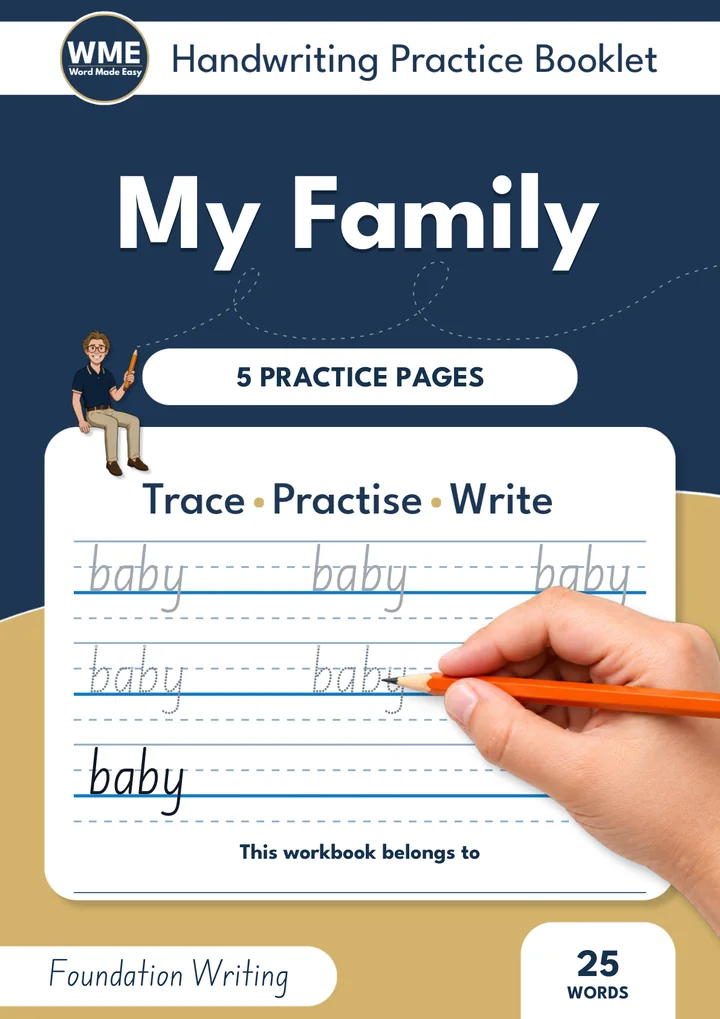
This family words handwriting workbook explores 25 relationship names through glossary explanations and Foundation writing practice. Children hear and discuss words such as parent, sister, grandparent and guardian before tracing pale models, following dotted letters and making independent copies.
Preview what is inside

1 of 4
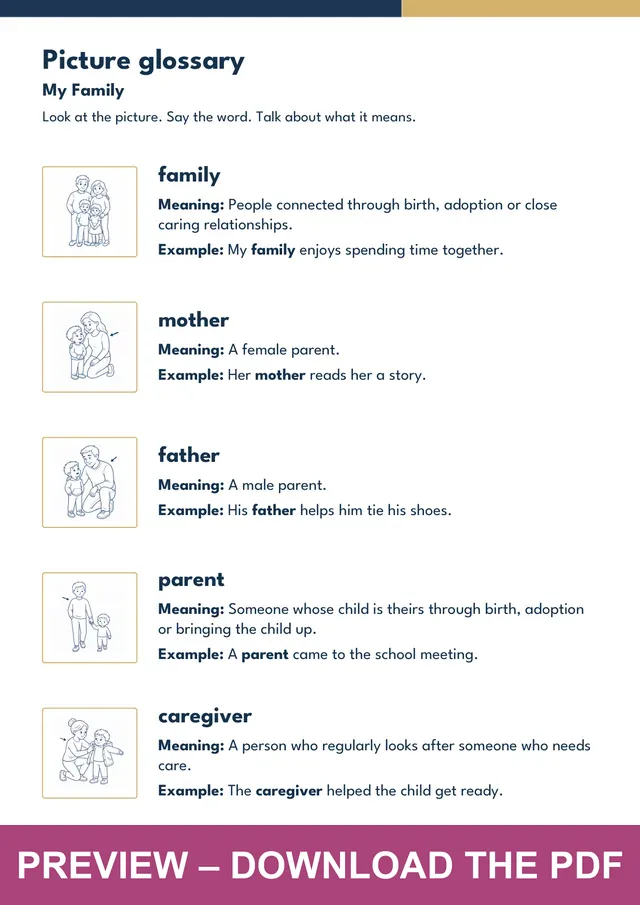
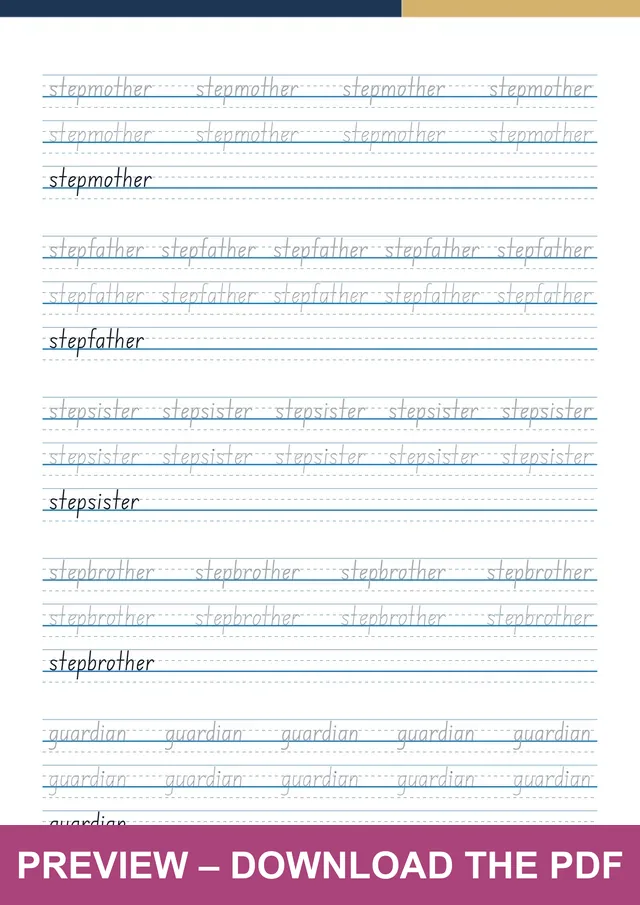
Use the arrows or dots to see the front cover, one glossary page and two handwriting sheets. The three inside-page previews are watermarked; download the PDF for clean printable pages.
Practise isolated letter shapes with Alphabet Trace & Write A-Z Practice Workbook before attempting longer relationship names. Keep Alphabet Chart with Picture Prompts (A-Z) available when pupils need a visual reminder of letter forms.
About this family words handwriting workbook
The collection begins with family, mother, father, parent and caregiver, then widens to siblings, grandparents, cousins and stepfamily vocabulary. Definitions and example sentences help explain relationships that cannot always be understood from a single picture. Illustrations support many entries, while the later stepfamily words are presented without a picture beside every practice group.
Five glossary pages lead into five handwriting sheets, each with up to five word groups. Within a group, the first strip supplies grey models, the second gives dotted lettering and the last begins with a solid model followed by blank lines. Long terms such as grandmother and stepbrother provide a different writing demand from short words such as aunt or son.
What is included?
- 25 words: family, mother, father, parent, caregiver, sister, brother, baby, grandmother, grandfather, aunt, uncle, cousin, son, daughter, sibling, grandparent, grandchild, twins, relative, stepmother, stepfather, stepsister, stepbrother, guardian.
- 5 picture-glossary pages with meanings and example sentences.
- 5 handwriting sheets using grey models, dotted letters and independent copying space.
- 14 PDF pages in total: front cover, instructions, glossary, handwriting sheets and two terms pages.
How to use this family words handwriting workbook
Introduce a fictional family through puppets or a story and choose two relationship words to discuss. Read the glossary explanations aloud, checking that children understand how the words relate to one another. Use parent and caregiver inclusively and let pupils choose examples that make sense to them.
Model one word slowly on the guided lines. In sister, compare the repeated s letters; in grandmother, pause to check letter order and spacing instead of trying to finish the entire strip without looking back. Ask the learner to point to the black model before making an independent copy, then explain the word through the fictional example.
Teaching and follow-up ideas
- Use story characters to make spoken sentences containing sibling, cousin or grandparent.
- Compare mother and grandmother on separate word cards and notice the shared spelling without assuming that every long word can be decoded that way.
- Choose two practised labels for a drawing of a fictional household.
- Match an adult-read glossary explanation to a word, using a small selection rather than the full list of 25.
Support and challenge
A personal family tree is optional and is not required by the PDF. Offer fictional examples so no learner has to explain private family circumstances. Begin with a familiar shorter label such as baby and use an adult-read model for longer relationships. Challenge confident pupils to distinguish sibling from sister or brother in conversation, then copy the more general term carefully.
Where this fits in learning
Establish relationship meanings through conversation and stories, introduce the printed labels, then practise their formation. This workbook supports family-topic language rather than testing a child's knowledge of their own relatives. The next step might be choosing an appropriate word for a story caption or explaining how two characters are related, with an adult supporting unfamiliar spellings.
Choosing pages to print
For this family words handwriting workbook, start with PDF page 8 for family, mother, father, parent and caregiver, paired with glossary page 3. Page 12 focuses on stepmother, stepfather, stepsister, stepbrother and guardian. Select vocabulary that suits your story or fictional example; the learner does not need to practise every relationship label in one sitting. Keep the instruction sheet nearby for reminders about the three-strip sequence. Before making copies, check the light tracing models and longer word groups in a single test print so that they remain easy to follow.
For modelling the repeated letters in sister or the longer strokes in grandmother, see the accompanying handwriting guidance. NSW handwriting teaching resources.
Resource licence
Free for personal, homeschool or single-classroom use under the terms included in the PDF. Resale, redistribution and uploading the file to another website are not permitted.
Questions about this workbook
What is included in the family words handwriting workbook?
The collection includes parents, caregivers, siblings, grandparents, cousins, stepfamily terms and guardian, with 25 entries altogether.
Do children need to draw their own family?
No. The task is word practice, and fictional families or story characters can provide the examples.
Are all 25 words illustrated?
Many entries have pictures, but some later relationship terms use text explanations without a picture beside the practice group.
How many PDF pages are included?
There are fourteen: cover, instructions, five glossary pages, five handwriting sheets and two terms pages.
Can I select only familiar relationship terms?
Yes. Choose groups that fit the learner's vocabulary and letter knowledge rather than completing every page in one session.
What is a useful extension after tracing?
Ask the learner to explain a relationship between fictional characters and choose the appropriate practised label.
Leave a Reply