
Free printable Foundation handwriting resource
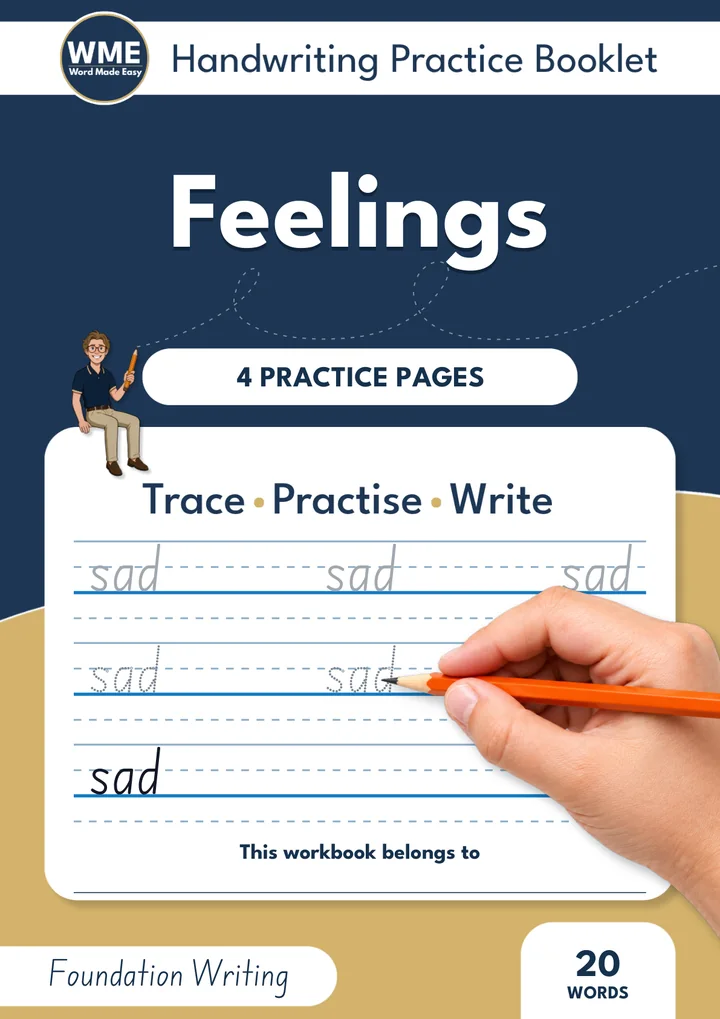
This feelings handwriting workbook introduces 20 words for emotions and related states, from happy and sad to frustrated and hopeful. Children discuss illustrated glossary examples, then practise the words through grey tracing, dotted lettering and independent Foundation writing.
Preview what is inside

1 of 4
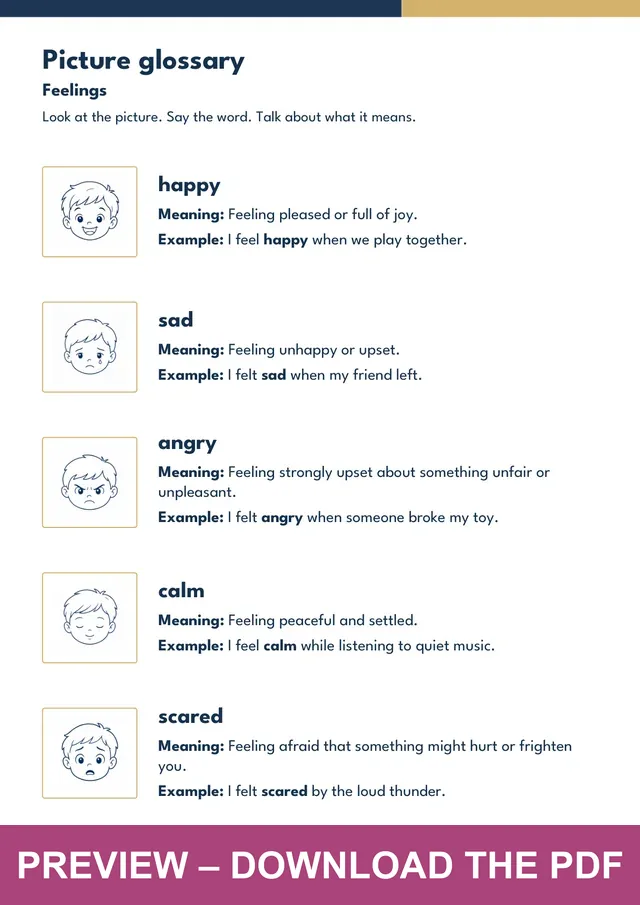
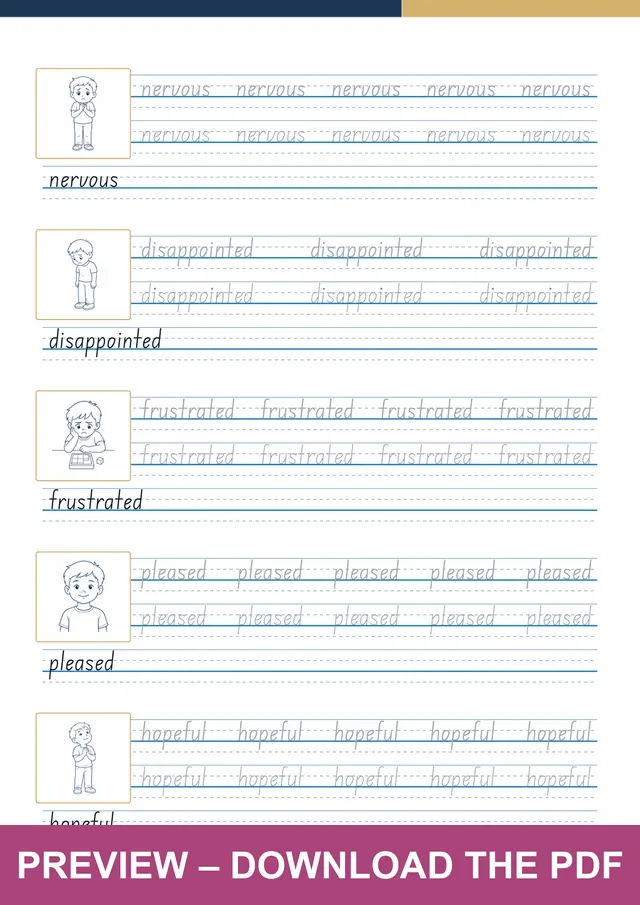
Use the arrows or dots to see the front cover, one glossary page and two handwriting sheets. The three inside-page previews are watermarked; download the PDF for clean printable pages.
Use Alphabet Trace & Write A-Z Practice Workbook when a learner needs a smaller letter-formation task before a feelings word. Keep Alphabet Chart with Picture Prompts (A-Z) as a reference while discussing unfamiliar letter names.
About this feelings handwriting workbook
The collection includes familiar happy, sad and angry alongside calm, worried, proud, lonely, confused and disappointed. Short definitions and example sentences provide language for discussion. The pictures are prompts for considering a possible feeling; an expression alone cannot tell you with certainty what another person feels.
Four glossary pages precede four handwriting sheets. Every word has a three-strip practice group, with two supported tracing stages before a blank guided area. Short words such as sad and shy sit alongside much longer spellings such as disappointed, allowing the adult to select a manageable entry rather than asking every learner to finish the same amount.
What is included?
- 20 words: happy, sad, angry, calm, scared, excited, tired, worried, proud, shy, bored, surprised, lonely, confused, relaxed, nervous, disappointed, frustrated, pleased, hopeful.
- 4 picture-glossary pages with meanings and example sentences.
- 4 handwriting sheets using grey models, dotted letters and independent copying space.
- 12 PDF pages in total: front cover, instructions, glossary, handwriting sheets and two terms pages.
How to use this feelings handwriting workbook
Read a glossary example about a fictional situation and ask which word might fit. Accept that different people may respond differently to the same event. Point to the spelling while saying it, then separate the discussion from the focused pencil task.
For happy, compare the two p letters and their tails below the baseline. For calm, attend to the tall l among the smaller letters. Move from the grey strip to the dotted strip and then an independent attempt. Finish by using the chosen word in a sentence about a story character rather than asking for a personal disclosure.
Teaching and follow-up ideas
- Pause during a familiar story and choose two glossary words that could describe a character at different moments.
- Compare worried and excited in a pretend situation, discussing why people may interpret it differently.
- Make an optional feelings-word card from a practised entry for use in classroom conversation.
- Ask children to match an adult-read example to a small selection of printed words, explaining their choice aloud.
Support and challenge
Let learners use fictional examples or pass on a discussion question. Start with sad or calm if long spellings would distract from careful formation. Read nervous, disappointed and frustrated with the child and model a small portion at a time. Extend the vocabulary by comparing pleased with proud or nervous with worried, without presenting those pairs as exact synonyms.
Where this fits in learning
Build meaning through supported conversation first, then introduce the written labels and handwriting. The resource can accompany classroom work on emotional vocabulary, but it is not a screening tool or therapy activity. After copying, learners may choose words for story discussion, drawings or an optional personal statement with appropriate adult support.
Choosing pages to print
For this feelings handwriting workbook, pDF page 7 contains happy, sad, angry, calm and scared; glossary page 3 introduces the same words. Page 10 contains nervous, disappointed, frustrated, pleased and hopeful. Choose the entries that match a story or planned conversation, rather than assigning a feeling to a child from their appearance. Use one handwriting group at a time if the vocabulary discussion has been demanding. Keep the instructions available for reference and test the pale and dotted models on your printer before making a class set. The terms remain included in the complete download.
The handwriting reference can support explicit modelling of the two p letters in happy before independent copying. NSW handwriting teaching resources.
Resource licence
Free for personal, homeschool or single-classroom use under the terms included in the PDF. Resale, redistribution and uploading the file to another website are not permitted.
Questions about this workbook
What is included in the feelings handwriting workbook?
The 20 entries include happy, sad, angry, calm, scared, excited, worried, proud, lonely, nervous, frustrated and hopeful.
Must children describe their own feelings?
No. Use fictional situations or story characters, and allow children to pass on personal discussion.
Can a picture tell us exactly how someone feels?
No. The illustrations prompt discussion about possibilities rather than proving a person's inner experience.
How many pages are in the download?
There are twelve PDF pages: cover, instructions, four glossary pages, four handwriting sheets and two terms pages.
Which words are useful for a shorter writing task?
Sad, shy or calm offer shorter spellings; choose a word whose meaning the learner understands.
Is this a wellbeing assessment?
No. It is a vocabulary and handwriting resource, not an assessment or therapeutic tool.
Leave a Reply