
Free printable Foundation handwriting resource
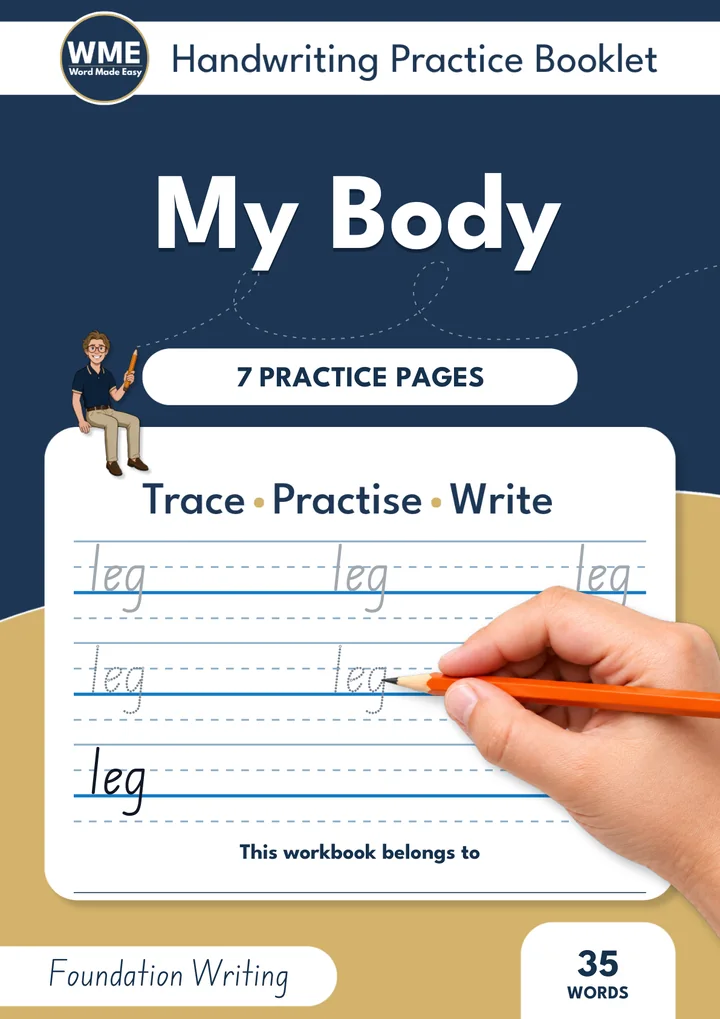
This body parts handwriting workbook connects 35 everyday anatomy words with pictures, short meanings and Foundation writing. Learners locate and discuss entries such as elbow, wrist and eyebrow before tracing the grey and dotted models and copying each name on the guided lines.
Preview what is inside

1 of 4
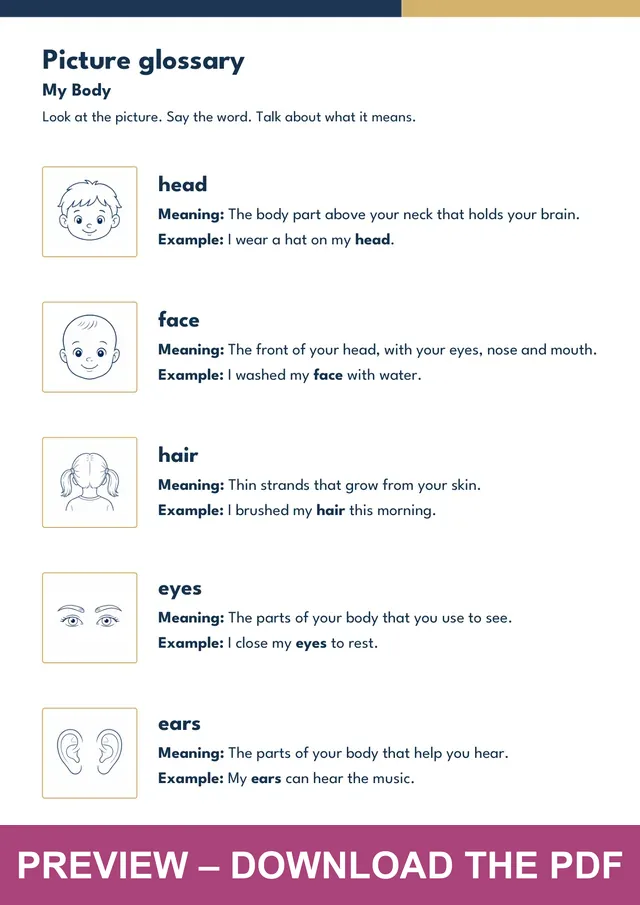
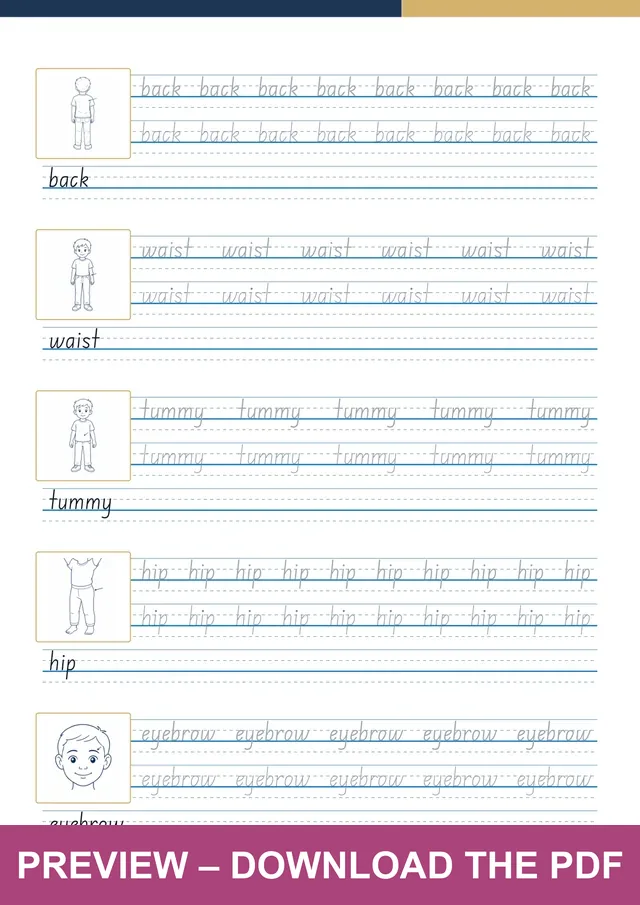
Use the arrows or dots to see the front cover, one glossary page and two handwriting sheets. The three inside-page previews are watermarked; download the PDF for clean printable pages.
Revisit recognition and labelling with Body Parts Labelling Worksheet. If forming the letters is harder than identifying the body part, use selected practice from Alphabet Trace & Write A-Z Practice Workbook.
About this body parts handwriting workbook
The My Body collection moves from head, face, hair, eyes and ears to more specific names including palm, ankle, forehead, waist and hip. The glossary pairs the vocabulary with simple explanations and example sentences. Diagrams help show the part being named, while adult discussion can clarify words for nearby features such as cheek, chin and jaw.
Seven handwriting sheets follow seven glossary pages. Each practice group contains three strips: repeated grey lettering, dotted forms and a black starting word with blank space for independent writing. Some entries are plural, including eyes, ears, teeth and lips; preserve the form printed in the workbook when copying rather than silently changing it to a singular label.
What is included?
- 35 words: head, face, hair, eyes, ears, nose, mouth, teeth, neck, arm, hand, leg, foot, shoulder, elbow, wrist, finger, thumb, palm, knee, ankle, heel, toe, skin, forehead, cheek, chin, jaw, lips, tongue, back, waist, tummy, hip, eyebrow.
- 7 picture-glossary pages with meanings and example sentences.
- 7 handwriting sheets using grey models, dotted letters and independent copying space.
- 18 PDF pages in total: front cover, instructions, glossary, handwriting sheets and two terms pages.
How to use this body parts handwriting workbook
Begin by pointing to a body diagram or a toy figure, then find the same part in the glossary. Read its short meaning and example together. Choose a manageable group such as hand before introducing a longer label such as shoulder.
When modelling hand, compare the tall h and d with the smaller a and n. In eyebrow, slow down at the change between the two familiar spoken parts and check the whole written word. After completing the three strips, ask the pupil to choose the correct label for the diagram again, connecting formation practice with meaning.
Teaching and follow-up ideas
- Place separate labels around a simple drawn figure, choosing only words already rehearsed.
- Compare hand, finger, thumb and palm and explain how the words refer to different parts of the same area.
- Play an adult-led clue game using a glossary meaning while children find the matching entry.
- Group selected words by location, such as face or arm, then copy one label from each group.
Support and challenge
Use a picture or toy rather than requiring learners to touch themselves or other people. Offer a short word such as arm when writing stamina is limited. Read spellings like shoulder, tongue and eyebrow aloud and avoid treating picture recognition as proof of decoding. A pupil ready for more can add a short spoken description of a part's location before writing its label on separate paper.
Where this fits in learning
Introduce body vocabulary through pictures and ordinary conversation, then link each meaning to the written name. Select handwriting groups according to the learner's formation skills rather than anatomical order. Once words can be copied accurately, move to labelling a drawing or comparing nearby features. This is an educational vocabulary resource, not a medical reference or a diagnostic activity.
Choosing pages to print
For this body parts handwriting workbook, pDF page 10 introduces head, face, hair, eyes and ears in handwriting groups, matching glossary page 3. Page 16 contains back, waist, tummy, hip and eyebrow. Use those page numbers when selecting a small set in the print dialogue, and keep the relevant glossary explanation available for adult reading. There is no need to print every body word for a short lesson. Check the diagrams, pale letters and blue baselines on a test copy, particularly if the printer has an economy setting that makes light details difficult to see.
Use the handwriting guidance to help model tall and descending letters when pupils move from arm to longer body labels. NSW handwriting teaching resources.
Resource licence
Free for personal, homeschool or single-classroom use under the terms included in the PDF. Resale, redistribution and uploading the file to another website are not permitted.
Questions about this workbook
What is included in the body parts handwriting workbook?
There are 35, including head, hand, elbow, wrist, ankle, forehead, tongue, waist and eyebrow.
Does it include labels for the face?
Yes. Entries include eyes, nose, mouth, forehead, cheek, chin, jaw, lips and eyebrow.
Can I use a toy or diagram instead of pointing to a child?
Yes. A figure or diagram gives a useful shared reference for the vocabulary discussion.
What is the complete page count?
The PDF has eighteen pages: cover, instructions, seven glossary pages, seven handwriting sheets and two terms pages.
Are all body words singular?
No. Some printed entries are plural, such as eyes, ears, teeth and lips.
What can children do after copying?
Choose a practised word to label a simple drawing and explain where the part is located.
Leave a Reply