
Free printable Foundation handwriting resource
This farm animal words handwriting workbook brings together 25 animal names, including adult and young-animal vocabulary. Children explore cow, calf, sheep, lamb and other glossary entries, then trace and copy the names using Foundation letter forms and guided writing strips.
Preview what is inside
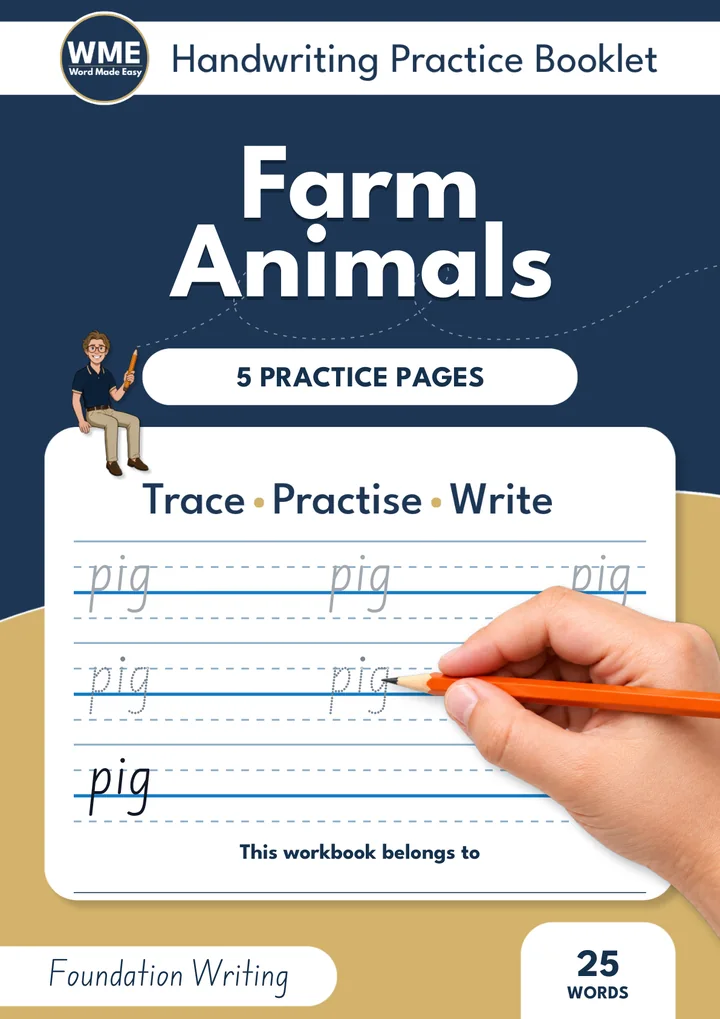

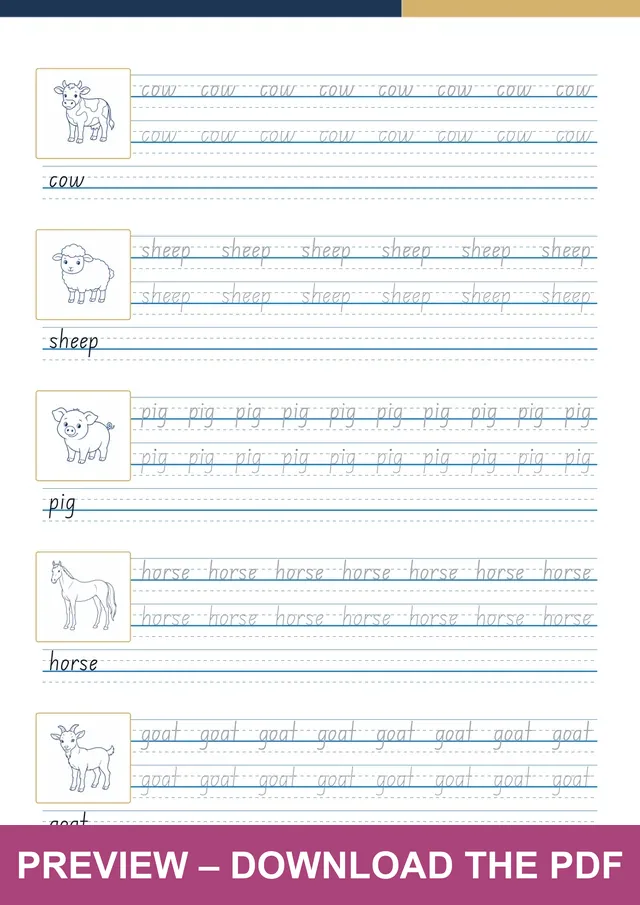
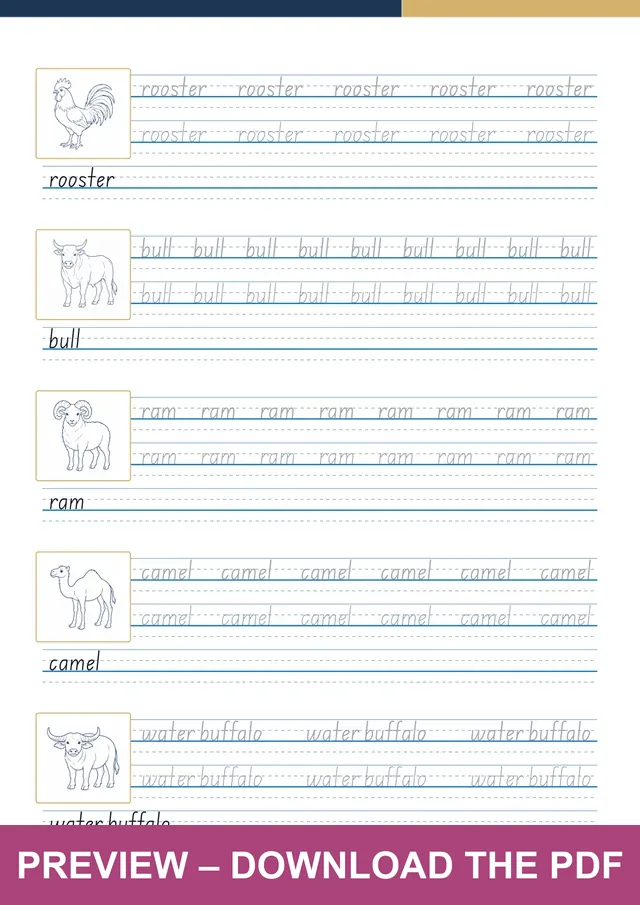
1 of 4
Use the arrows or dots to see the front cover, one glossary page and two handwriting sheets. The three inside-page previews are watermarked; download the PDF for clean printable pages.
For a shorter introductory selection, use Farm Animals Trace & Write Handwriting Workbook. Once names are familiar, Farm Animal Missing Letters Worksheet changes the task from copying to completing animal vocabulary.
About this farm animal words handwriting workbook
The vocabulary extends beyond the first familiar farm animals to calf, lamb, piglet, chick, duckling and gosling. Later words include rooster, bull, ram, camel and water buffalo, giving adults scope to discuss farms in different places. Short glossary meanings and example sentences support understanding before handwriting.
Five practice sheets contain up to five word groups each. Grey models lead to dotted letter forms and then independent copies following a black starting model. Water buffalo is a two-word entry, so the learner needs to preserve the gap inside the animal name as well as the space before repeating it. This Foundation edition is a larger collection than the earlier eight-word farm handwriting resource.
What is included?
- 25 words: cow, sheep, pig, horse, goat, hen, duck, goose, donkey, chicken, calf, lamb, piglet, chick, duckling, gosling, foal, pony, rabbit, turkey, rooster, bull, ram, camel, water buffalo.
- 5 picture-glossary pages with meanings and example sentences.
- 5 handwriting sheets using grey models, dotted letters and independent copying space.
- 14 PDF pages in total: front cover, instructions, glossary, handwriting sheets and two terms pages.
How to use this farm animal words handwriting workbook
Choose a familiar adult animal and its young, such as sheep and lamb, using toy figures or pictures. Find both glossary entries and read their meanings aloud. Explain that knowing a relationship does not mean the two names will share a spelling.
Practise cow or pig first if a short word suits the learner. Model the descending g in pig and compare it with the letters resting on the baseline. When tackling water buffalo, point to the internal word space before tracing, then check that it remains clear in the independent attempt.
Teaching and follow-up ideas
- Match cow with calf, sheep with lamb and pig with piglet using the glossary to check each pair.
- Create labels for a model farm after practising a few selected words.
- Compare hen, chicken and rooster with an adult reading the explanations, then discuss how the names relate.
- Find camel and water buffalo in the collection and talk about how animals kept on farms vary between places.
Support and challenge
Use only two or three familiar animals at first, with a physical or pictured reference. Adult-read words such as gosling and donkey may need oral rehearsal before any pencil work. Give a learner time to return to the model between letters in a longer name. Confident pupils can create an adult-and-young pair of labels or dictate a sentence that uses both names accurately.
Where this fits in learning
Start with recognising animals and hearing their names. Add glossary discussion of relationships such as adult and young, then use the writing groups to record those names. The list is thematic, not a decodable reading sequence, and no single farm is expected to contain every animal shown. A next step is selecting labels independently for a scene or comparing the collection with familiar pet vocabulary.
Choosing pages to print
For this farm animal words handwriting workbook, pair glossary page 3 with handwriting page 8 for cow, sheep, pig, horse and goat. PDF page 12 contains rooster, bull, ram, camel and water buffalo. For adult-and-young comparisons, keep the relevant glossary pages beside the selected writing sheets rather than printing the whole collection for one session. Check the small picture prompts and pale lettering on a test copy, especially around the two-word water buffalo entry. The instructions can be kept as a shared reference while each learner works on an appropriate animal group.
Refer to the handwriting teaching materials when modelling g in pig or maintaining spacing in water buffalo. NSW handwriting teaching resources.
Resource licence
Free for personal, homeschool or single-classroom use under the terms included in the PDF. Resale, redistribution and uploading the file to another website are not permitted.
Questions about this workbook
What is included in the farm animal words handwriting workbook?
This Foundation edition has 25 words, five glossary pages and five handwriting sheets. The earlier workbook practises eight animal names.
Are young-animal names included?
Yes. Examples include calf, lamb, piglet, chick, duckling, gosling and foal.
Why does the list contain camel and water buffalo?
The vocabulary includes animals kept on farms in different parts of the world, rather than describing one particular farm.
How many total pages are there?
Fourteen: cover, instructions, five glossary pages, five handwriting sheets and two terms pages.
How should water buffalo be copied?
Keep the gap between water and buffalo, then leave another clear gap before repeating the complete name.
Must pupils read every animal word alone?
No. Read unfamiliar names and the glossary explanations with them before handwriting practice.
Leave a Reply