
Free printable Foundation handwriting resource
This vegetable words handwriting workbook combines 30 food names with glossary explanations and Foundation tracing. Learners explore carrot, broccoli, okra and other pictured entries, then follow grey and dotted models before copying each word or two-word label onto guided lines.
Preview what is inside
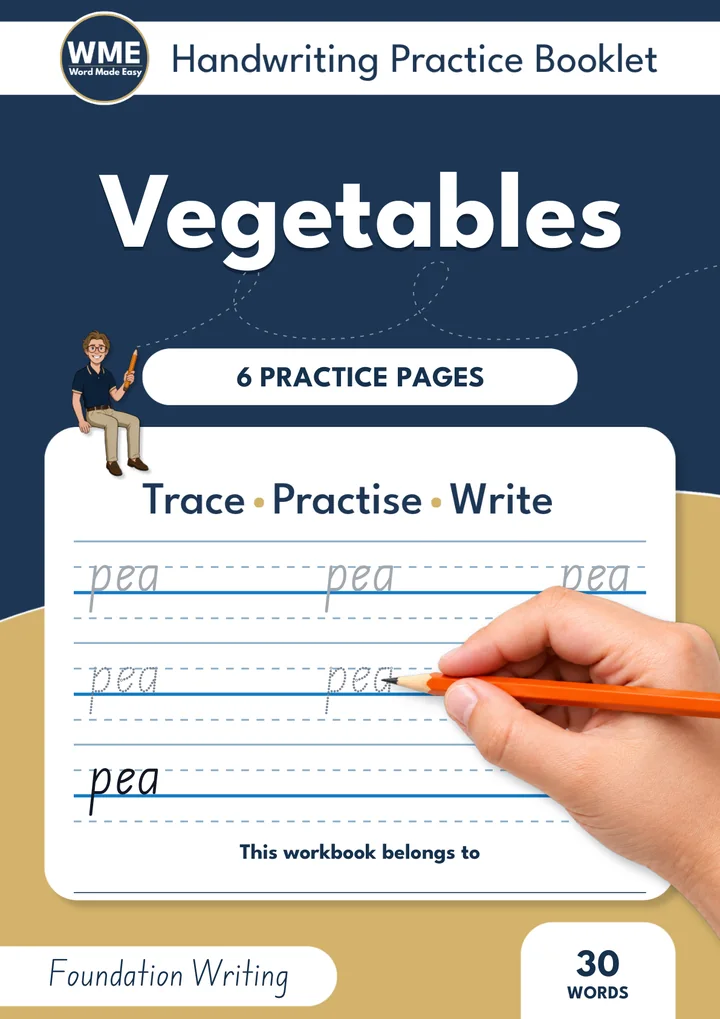

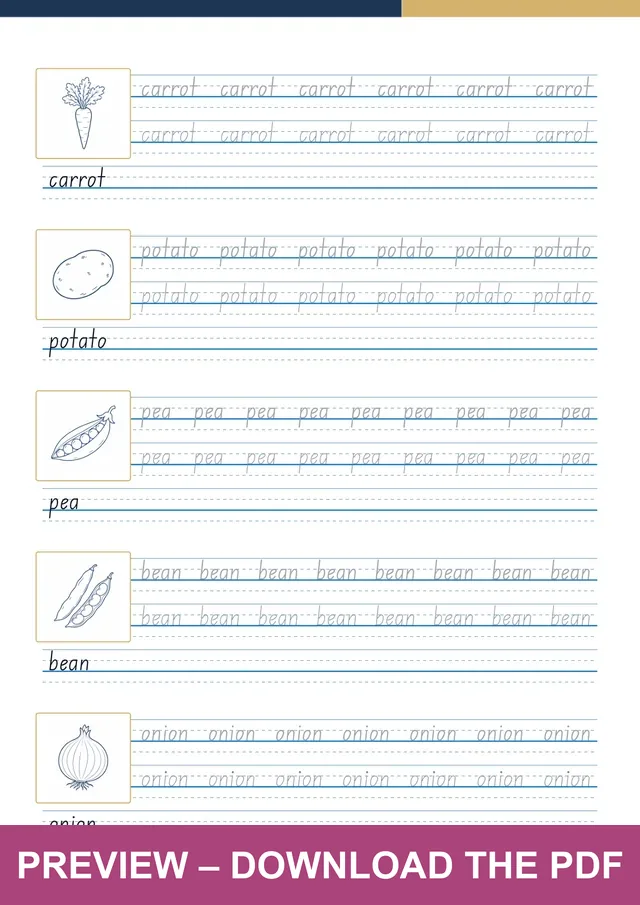

1 of 4
Use the arrows or dots to see the front cover, one glossary page and two handwriting sheets. The three inside-page previews are watermarked; download the PDF for clean printable pages.
Compare food vocabulary with Fruit Matching and Colouring Worksheet after discussing the vegetable entries. Use Alphabet Trace & Write A-Z Practice Workbook when a learner benefits from rehearsing letters separately before a long label.
About this vegetable words handwriting workbook
The collection moves from carrot, potato, pea, bean and onion to cassava, taro, aubergine and pak choi. It uses familiar cooking vocabulary, so tomato, cucumber and mushroom appear alongside other foods commonly grouped as vegetables. The glossary explains the individual entries; this is not intended as a strict botanical sorting task.
Six glossary pages introduce the words before six handwriting sheets. Each practice group uses a repeated grey model, dotted lettering and a final independent strip beginning with a black word. Sweet potato, bell pepper and pak choi require attention to an internal space, while short pea and yam provide a smaller writing demand.
What is included?
- 30 words: carrot, potato, pea, bean, onion, broccoli, cabbage, sweetcorn, tomato, cucumber, lettuce, cauliflower, spinach, celery, garlic, leek, radish, beetroot, pumpkin, bell pepper, sweet potato, yam, cassava, taro, okra, aubergine, courgette, kale, mushroom, pak choi.
- 6 picture-glossary pages with meanings and example sentences.
- 6 handwriting sheets using grey models, dotted letters and independent copying space.
- 16 PDF pages in total: front cover, instructions, glossary, handwriting sheets and two terms pages.
How to use this vegetable words handwriting workbook
Choose a glossary picture such as carrot and read its explanation together. Ask the learner to describe what can be seen, then point to the written label. Introduce unfamiliar foods such as cassava through their meanings before asking for pencil work.
On the carrot strip, model the repeated r letters at a consistent height. For broccoli, pause to compare the adjacent c letters rather than rushing over them. Complete each supported strip before trying the independent model, and review whether a reader can recognise the whole label. In sweet potato, preserve the space between the two words.
Teaching and follow-up ideas
- Create a pretend market stall with picture labels copied from selected practice groups.
- Compare onion, garlic and leek through the glossary descriptions and discuss how their names differ.
- Choose a new word such as taro or pak choi and explain its meaning to a partner with adult support.
- Make a short written shopping list using two familiar vegetable names after rehearsing their letter forms.
Support and challenge
Use the pictures and glossary sentences to establish vocabulary without requiring real food. Start with pea or yam if a longer spelling is too demanding. Cover the rest of a page to reveal only the chosen group, and let pupils check the solid model frequently. A learner ready for an extension can compare two-word labels or dictate an additional sentence about a pictured food on separate paper.
Where this fits in learning
Build the spoken meaning of each food name first, connect it to the glossary label and then practise writing it. Adults may explain regional names such as aubergine and courgette when useful. The handwriting collection does not assume that pupils can decode every word or that all entries belong to the same scientific plant category. Follow it with learner-chosen labels, lists or supported descriptions.
Choosing pages to print
For this vegetable words handwriting workbook, the first writing sheet is PDF page 9, covering carrot, potato, pea, bean and onion; glossary page 3 introduces the same group. Page 14 contains aubergine, courgette, kale, mushroom and pak choi, which can support a discussion of less familiar names. Print the group suited to your current topic rather than treating all six practice sheets as one assignment. Use the instruction page to revisit the three-strip routine, and check that your printer preserves the pale models and the guide lines before making multiple copies.
Consult the handwriting teaching reference for modelling repeated letter forms before practising carrot and broccoli independently. NSW handwriting teaching resources.
Resource licence
Free for personal, homeschool or single-classroom use under the terms included in the PDF. Resale, redistribution and uploading the file to another website are not permitted.
Questions about this workbook
What is included in the vegetable words handwriting workbook?
There are 30 entries, including carrot, potato, broccoli, spinach, cassava, taro, okra, aubergine and pak choi.
Why are tomato and mushroom included?
The collection uses everyday cooking vocabulary rather than a strict botanical classification of plants.
Does it use British-English food names?
Yes. Entries include aubergine and courgette, which adults can compare with regional alternatives if helpful.
How many pages does the PDF have?
Sixteen: cover, instructions, six glossary pages, six handwriting sheets and two terms pages.
Which entries contain two words?
Bell pepper, sweet potato and pak choi are examples of labels with an internal word space.
Is real food required for the activities?
No. The glossary pictures and explanations provide a starting point for vocabulary and handwriting.
Leave a Reply