
If you want to learn how to create a fillable form in Word, this guide covers the 6 easy steps. Knowing how to create a fillable form in Word lets you turn a simple document into a professional, interactive form where users click and type directly into fields – perfect for job applications, contact forms, surveys, and registration documents. You’ll learn how to create a fillable form in Word using the Developer tab and Rich Text Content Controls.
No printing, no PDFs, no complicated tools. Word has all the form-building features you need – they’re just hidden by default.
What Is a Fillable Form in Word?
Before you learn how to create a fillable form in Word, it helps to understand what one is. A fillable form is a Word document that contains interactive fields where users can enter information digitally.
Instead of static text, you create areas where users can:
- Type their name
- Enter an email address
- Add contact details
- Fill out structured information
These forms are powered by a feature called Content Controls, specifically the Rich Text Content Control. Once your form is complete, if you need to combine it with other documents you can learn how to merge multiple Word documents into one file.
Why Create a Fillable Form in Word?
Knowing how to create a fillable form in Word offers several advantages over PDFs or external form builders:
- No need for external software
- Easy to share and edit
- Works across most devices
- Saves time and paper
- Keeps formatting clean and consistent
Watch the Video Tutorial
If you prefer to see this in action, the full video walkthrough is below, showing each method step by step.
How to Create a Fillable Form in Word: Step-by-Step
Step 1: Enable the Developer Tab in Word
Before you can create a fillable form in Word, you need to enable the Developer tab. The form-building tools live there and are hidden by default.
- Click File
- Select Options
- Go to Customize Ribbon
- Find and tick Developer
- Click OK
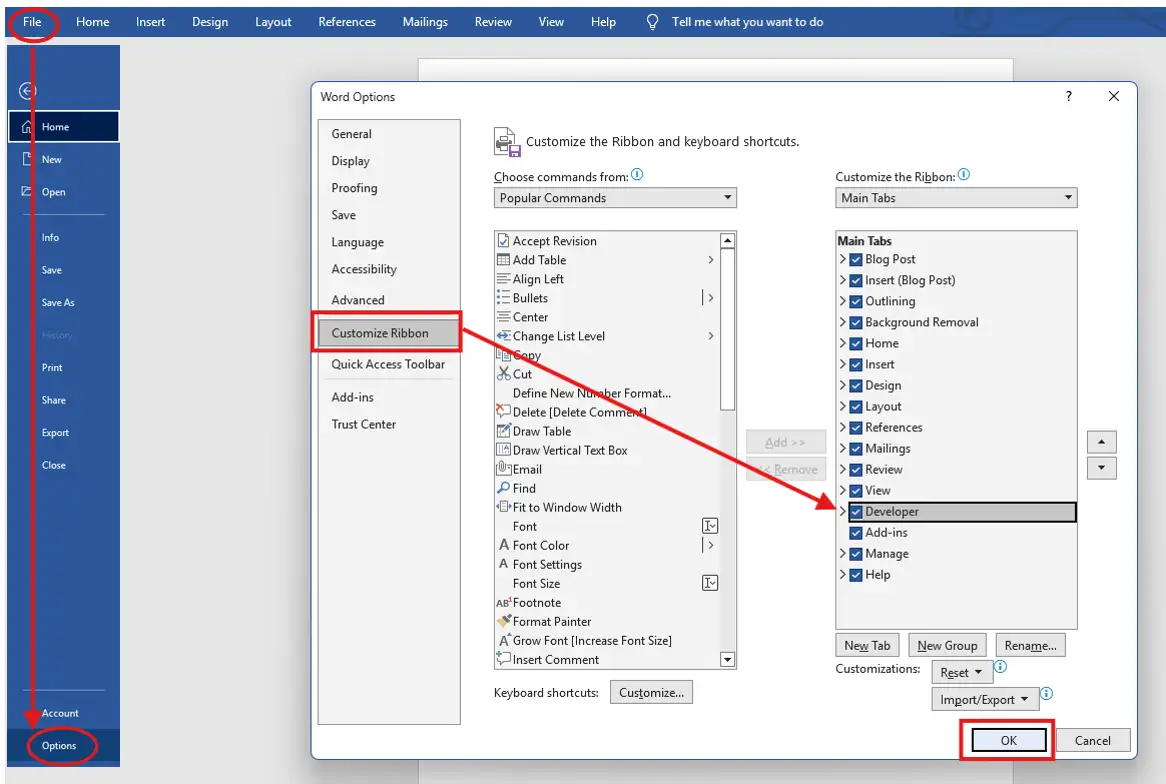
Once enabled, you’ll see the Developer tab appear in the ribbon at the top of Word.
Step 2: Create Your Form Layout
Before you add fillable fields, design the structure of your Word form. Type out the labels that will guide the user, for example:
- Name
- Email Address
- Address
- Phone Number
- Date of Birth
- Comments / Notes
💡 Tip: Think of this like building a digital version of a paper form. A clean layout makes the fillable form easier to use later.
Step 3: Insert Fillable Fields (Rich Text Content Control)
This is the core step in how to create a fillable form in Word. Adding interactive fields turns your static labels into something users can actually fill in.
- Place your cursor next to a label (e.g., “Name”)
- Go to the Developer tab
- Click the Rich Text Content Control (icon with Aa and lines)

A field will appear where users can type. Repeat this process for every label in your form.
💡 Tip: You can copy and paste fields (Ctrl + C / Ctrl + V) to save time when creating multiple inputs.
Step 4: Format Your Fields
You can customise how your fillable form fields look to match your document style:
- Change font type
- Adjust font size
- Align with labels
- Add bold or colour for emphasis
Consistent formatting makes the fillable form look polished and professional.
Step 5: Add Placeholder Instructions
Want to guide users on what to enter? When you create a fillable form in Word, you can add helpful placeholder text inside each field that disappears when the user clicks in.
Steps:
- Click on the content control field you want to edit
- Go to Developer ? Properties
- Enter text in the Title field (e.g., “Enter your full name here”)
- Click OK
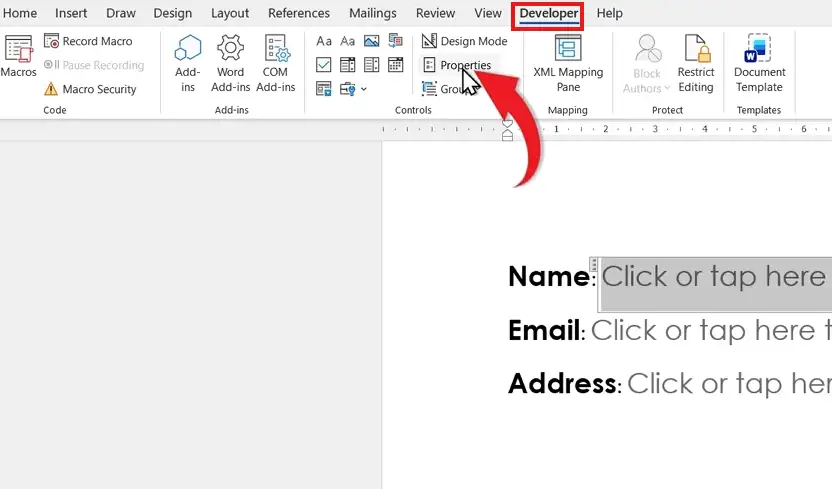
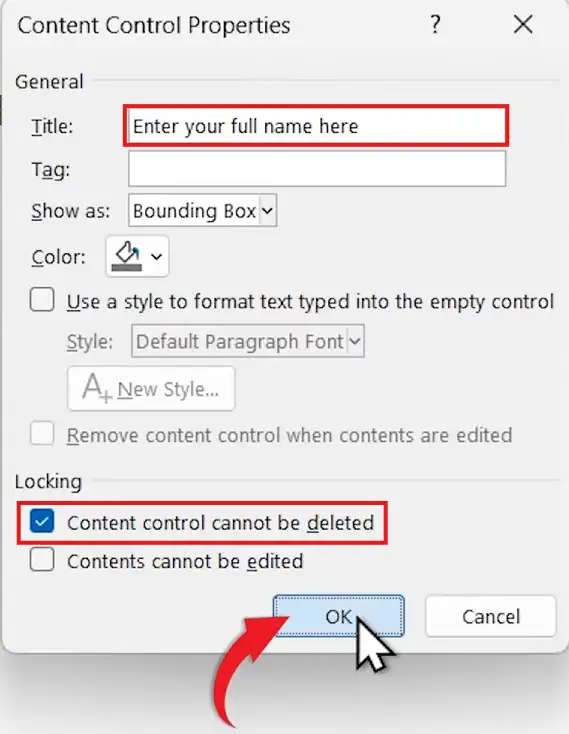
This text will disappear when the user starts typing.
Step 6: Protect the Form (Restrict Editing)
The final step in how to create a fillable form in Word is to lock it so users can only fill in fields – not edit the rest of the document.
Steps:
- Go to the Developer tab
- Click Restrict Editing
- Tick Allow only this type of editing
- Select Filling in forms from the dropdown
- Click Start Enforcing Protection
- (Optional) Add a password
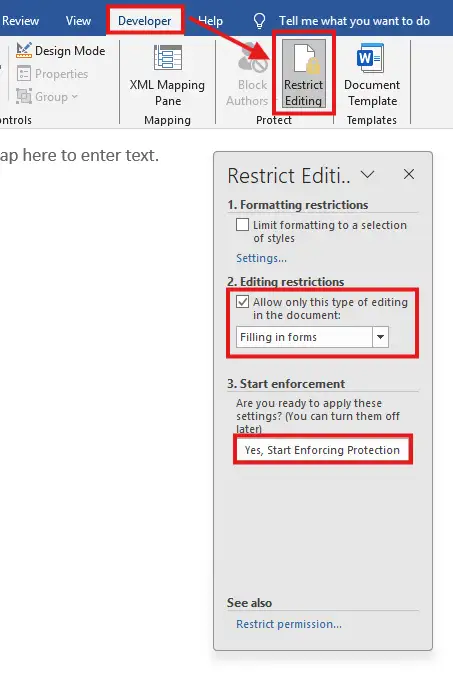
Now users can only interact with the form fields – not the rest of the document. For stronger document security, you can also learn how to password protect a Word document so only authorised users can open it at all.
Test Your Fillable Form
Once your fillable form is complete and protected, test it before sharing:
- Click inside fields and type to confirm they work
- Ensure placeholder text disappears correctly when typing
- Confirm that non-editable areas are locked
- Press Tab to move between fields – make sure the order is logical
This ensures your form works exactly as intended for your users.
Best Use Cases for Fillable Forms in Word
Once you know how to create a fillable form in Word, these are the most common use cases:
- Employee onboarding documents
- Client intake forms
- Internal business templates
- Event registrations
- Feedback and survey forms
- Job application forms
Pro Tips for Better Fillable Forms in Word
- Keep layouts simple and clean
- Use consistent spacing between fields
- Add clear placeholder instructions for each field
- Test the form before sharing
- Use Restrict Editing to prevent accidental changes to the form structure
- Consider adding clickable checkboxes – see the guide on how to insert a clickable checkbox in Word
- To add choices people can pick from, see How to Create a Drop-Down List in Word.
FAQs
How do I create a fillable form in Word?
To create a fillable form in Word, enable the Developer tab via File ? Options ? Customize Ribbon. Then design your form layout, insert Rich Text Content Controls from the Developer tab next to each label, and protect the form with Restrict Editing ? Filling in forms.
What is a Word fillable form?
A Word fillable form is an interactive document with editable fields where users can type information directly. The rest of the document is locked, so only the fields can be filled in.
How do I make a form in Word?
Enable the Developer tab in Word Options, type your form labels, then use Content Controls (Rich Text, Plain Text, Checkbox, Drop-down) from the Developer tab to add fillable fields next to each label.
Can users edit the form structure?
No, not if you enable editing restrictions via Developer ? Restrict Editing ? Filling in forms. Users can only fill in the content control fields you’ve added.
Do I need special software to open a Word fillable form?
No. Anyone with Microsoft Word can open and complete a fillable form. The form opens like a normal Word document but only allows typing in the designated fields.
Can I add dropdowns and checkboxes to a fillable form in Word?
Yes. The Developer tab includes additional controls like dropdown lists and checkboxes – for a full walkthrough of adding interactive checkboxes, see the guide on how to insert a clickable checkbox in Word.
Can I remove protection from a Word form later?
Yes. Go back to Developer ? Restrict Editing and click Stop Protection. If you set a password, you’ll need to enter it to unlock the form.
Is a Word fillable form better than a PDF form?
It depends on your needs. Word forms are easier to edit and create, while PDFs are better for fixed, secure distribution. If you need to update the form regularly, Word is the better choice.
Conclusion
Now that you know how to create a fillable form in Word in 6 easy steps – enabling the Developer tab, designing your layout, inserting Rich Text Content Controls, formatting fields, adding placeholder instructions, and protecting the form – you can streamline data collection without needing extra tools.
Once you master this feature, you’ll be able to transform any basic Word document into an interactive, user-friendly form in minutes – perfect for job applications, surveys, registrations, and any structured data you need to collect.
Related Tutorials
- How to Insert a Clickable Checkbox in Microsoft Word
- How to Password Protect a Word Document
- How to Merge Multiple Word Documents into One File
Word Tutorials
Recently Added on Word Made Easy
Browse the complete collection for help with formatting, layout, pages, tables, images, and document setup.
For Microsoft support documentation, visit the official Microsoft guidance.
Leave a Reply