Skip to content
Word Made Easy
Home Word Tutorials PowerPoint Tutorials Teacher Resources YouTube Videos
★★★★★★★★★★No ratings yet

OB Word Family Handwriting Workbook

Teacher Resources, Handwriting, Foundation, CVC Word Families

Free printable Foundation handwriting resource

Explore cob, hob, job, rob and sob in this ob word family workbook. The glossary explains unfamiliar nouns and actions before one Foundation handwriting sheet practises the shared short-o ending.

5 topic words1 handwriting sheetPicture glossaryFoundation writing

Preview what is inside

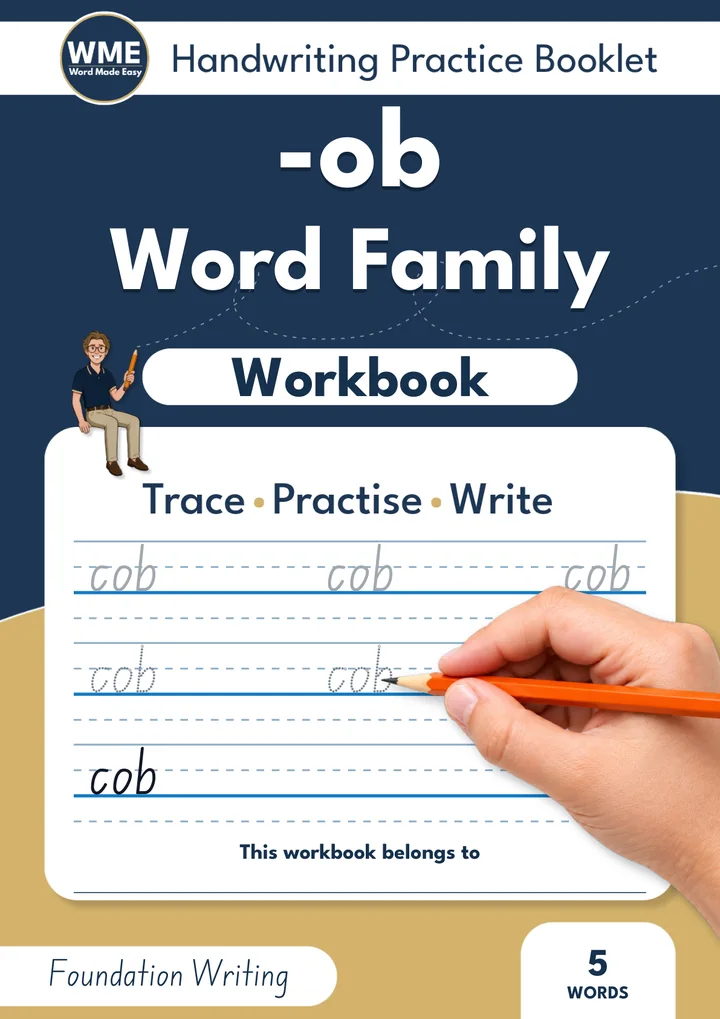
ob word family front cover
Clean front cover
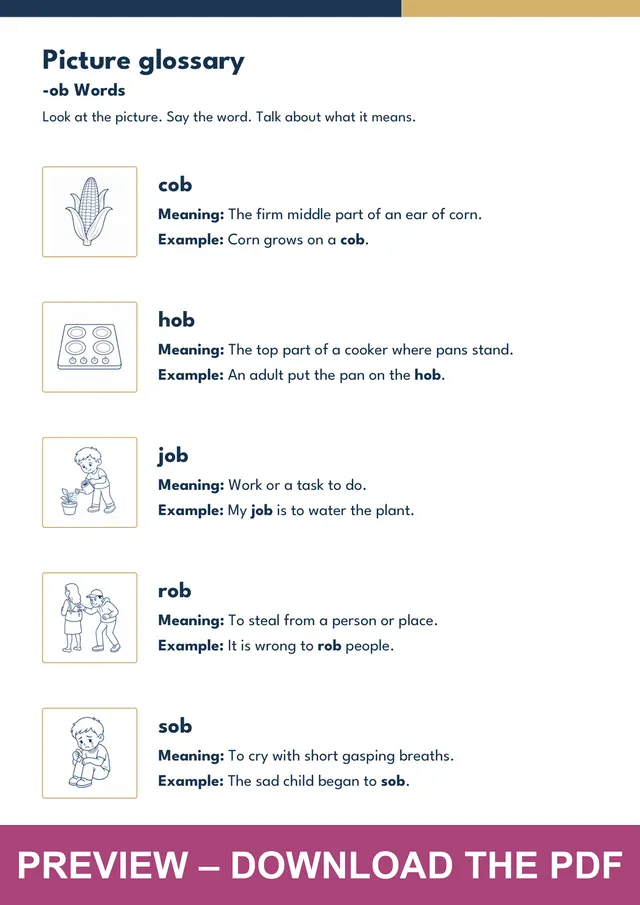
-ob word family picture glossary preview, PDF page 3
Picture glossary preview
-ob word family first handwriting sheet preview, PDF page 4
First handwriting sheet preview

1 of 3

Use the arrows or dots to see the front cover, one glossary page and one handwriting sheet. The two inside-page previews are watermarked; download the PDF for clean printable pages.

CVC Word Families

UT Word Family Handwriting Workbook UN Word Family Handwriting Workbook UM Word Family Handwriting Workbook UG Word Family Handwriting Workbook UB Word Family Handwriting Workbook OT Word Family Handwriting Workbook
See More

Get the free PDF

Enter your email address, then choose whether you would also like occasional emails about new Word Made Easy Teacher Resources.

I agree that Word Made Easy may email me occasional updates about new Teacher Resources. I can unsubscribe at any time. Choose Download only if you do not want marketing emails.

Read the Privacy Policy for details about storage, retention and your rights.

Rate this resource

Your feedback helps us improve and helps other teachers find useful resources.

Choose a star rating

Compare the ob ending with the groups on CVC Word Families Poster. For the individual letter movements used in cob and sob, select the relevant examples from Alphabet Letter Formation Worksheets A-Z.

About this ob word family

Cob and hob may need direct explanation, while job, rob and sob are best introduced in sentences. A job can be a task; sob describes crying, and rob means stealing from someone or somewhere. Discuss those meanings calmly through the printed examples.

The final b has a tall stem and rounded lower part. Initial j descends below the baseline, whereas c, r and s mainly occupy the smaller-letter area. Repeating o-b after these different starts helps children notice both the stable ending and the changing first movement.

What is included?

  • 5 words: cob, hob, job, rob, sob.
  • 1 picture-glossary page with meanings and example sentences.
  • 1 handwriting sheet using grey models, dotted letters and independent copying space.
  • 6 PDF pages in total: front cover, instructions, glossary, handwriting sheets and two terms pages.

How to use this ob word family

Begin with cob and identify the meaning shown in the glossary. Blend the sounds, then compare job by changing the first letter. Read the full new word before asking what it means.

Model a closed o followed by a correctly oriented b. Trace the grey strip, follow the dots and copy from the black example. Check the b stem height and leave a clear space before repeating the word.

Use an ordinary classroom task to explain job. Read the sob sentence without asking children to share upsetting experiences. Explain rob as a word in a story and distinguish learning its meaning from approving the action.

Meanings in the ob word family glossary

cob

Meaning: The firm middle part of an ear of corn.

Example: Corn grows on a cob.

hob

Meaning: The top part of a cooker where pans stand.

Example: An adult put the pan on the hob.

job

Meaning: Work or a task to do.

Example: My job is to water the plant.

rob

Meaning: To steal from a person or place.

Example: It is wrong to rob people.

sob

Meaning: To cry with short gasping breaths.

Example: The sad child began to sob.

Teaching and follow-up ideas

  • Name a small classroom job and identify the target word in an oral sentence.
  • Use a kitchen photograph to explain hob without taking learners near a hot surface.
  • Compare j in job with h in hob for descending and ascending strokes.
  • Read cob and sob from word cards after discussing their different meanings.

Support and challenge

Start with cob and job if hob is unfamiliar. Rehearse b separately when it is reversed. Challenge pupils to give a clear oral example of a job that is not paid employment.

Where this fits in learning

The ob word family combines short-o reading with vocabulary that benefits from adult explanation. Introduce the relevant initial sounds first. Once secure, compare job and jog to make the final consonant carry useful information.

For further teacher reference when modelling the letter movements in cob and sob, NSW Education collects handwriting sequences and advice on formation, posture and pencil grasp. These are background teaching resources, not a claim that this booklet follows a particular syllabus: NSW handwriting teaching resources.

Resource licence

Free for personal, homeschool or single-classroom use under the terms included in the PDF. Resale, redistribution and uploading the file to another website are not permitted.


Your PDF has been downloaded

Check your Downloads folder. Before you go, we would appreciate your quick feedback.

How useful is this resource?

Would you share it?
Facebook WhatsApp Pinterest Email

Questions about this workbook

How should rob and sob be introduced?

Use the neutral glossary definitions and fictional example sentences. Children do not need to describe personal experiences to understand or practise these words.

Which ob word family spellings are practised?

cob, hob, job, rob, sob. The glossary gives a meaning and sentence for every entry.

What is in the downloadable PDF?

There are 6 pages altogether: a front cover, one instruction page, 1 glossary page(s), 1 handwriting sheet(s) and two terms pages.

What handwriting style does this edition use?

Foundation letterforms, with grey models and dotted tracing followed by copying into ruled space.

Can I use cob on its own?

Yes. Choose the word group that matches your lesson and leave the others for another session. Read its glossary meaning and example first.


Related resources

  • CVC Word Families Poster
  • Alphabet Letter Formation Worksheets A-Z
  • CVC Word Unscrambling Worksheet
Browse all Handwriting resources

Like this:

Like Loading…
CVC words Handwriting word families Workbook
←IT Word Family Handwriting Workbook
OD Word Family Handwriting Workbook→

Comments

Leave a ReplyCancel reply

Meet the Author

Patrick Elliott standing outdoors holding his dog.

I’m Patrick Elliott, the creator of Word Made Easy. I’m an educator and Inclusion Lead, and I use Microsoft Word and PowerPoint daily for planning, documentation, and classroom resources.

Every guide is tested step-by-step before publishing (usually in Microsoft 365). You’ll also find practical walkthroughs on my YouTube channel.

More:About me.Contact.YouTube

Explore More

  • Word Tutorials
  • PowerPoint Tutorials
  • Teacher Resources
  • YouTube Videos

YouTube

Recent Tutorials

  • How to View Two Pages Side by Side in Word: 2 Easy Methods (Quick Guide)August 29, 2026
  • Open Two Documents Side by Side in Word: 2 Easy Steps (Quick Guide)August 29, 2026
  • How to Open Word in Safe Mode: 2 Easy Methods (Quick Guide)August 29, 2026
  • How to Replace Text in Word: 2 Easy Methods (Quick Guide)August 29, 2026
  • How to Export a Single Page in Word: 5 Easy Steps (Quick Guide)August 29, 2026

Recent Teacher Resources

  • Fry Sight Words 91-100 Handwriting WorkbookSeptember 8, 2026
  • Fry Sight Words 81-90 Handwriting WorkbookSeptember 8, 2026
  • Fry Sight Words 71-80 Handwriting WorkbookSeptember 8, 2026
  • Fry Sight Words 61-70 Handwriting WorkbookSeptember 8, 2026
  • Fry Sight Words 51-60 Handwriting WorkbookSeptember 8, 2026
Word Made Easy

Explore

  • →Home
  • →Word Tutorials
  • →PowerPoint Tutorials
  • →Teacher Resources
  • →YouTube Videos

Categories

  • →Page Layout & Sections
  • →Tables, Images & Media
  • →Word Formatting Basics
  • →Word Productivity & Automation

Author

  • →About Me
  • →Contact
  • →YouTube
Privacy Policy Cookie Policy Terms of Use
© 2012–2026 Word Made Easy. Content is protected.
Your privacy choices

We use cookies and similar technologies to make this site work, understand how it is used, and show relevant content and advertising. You can accept all cookies, deny non-essential cookies, or manage your preferences. You can change your choice at any time.

Functional Always active
The technical storage or access is strictly necessary for the legitimate purpose of enabling the use of a specific service explicitly requested by the subscriber or user, or for the sole purpose of carrying out the transmission of a communication over an electronic communications network.
Preferences
The technical storage or access is necessary for the legitimate purpose of storing preferences that are not requested by the subscriber or user.
Statistics
The technical storage or access that is used exclusively for statistical purposes. The technical storage or access that is used exclusively for anonymous statistical purposes. Without a subpoena, voluntary compliance on the part of your Internet Service Provider, or additional records from a third party, information stored or retrieved for this purpose alone cannot usually be used to identify you.
Marketing
The technical storage or access is required to create user profiles to send advertising, or to track the user on a website or across several websites for similar marketing purposes.
  • Manage options
  • Manage services
  • Manage {vendor_count} vendors
  • Read more about these purposes
Manage preferences
  • {title}
  • {title}
  • {title}

Discover more from Word Made Easy

Subscribe now to keep reading and get access to the full archive.

Continue reading

%d