
Fry Sight Words 11-20 Handwriting Workbook
Free printable Foundation handwriting resource
Fry sight words 11-20 introduce pronouns, linking words and common verb forms. Pupils explore each word in context before tracing and independently writing he, was, for, on, are, as, with, his, they and I.
Preview what is inside

1 of 3
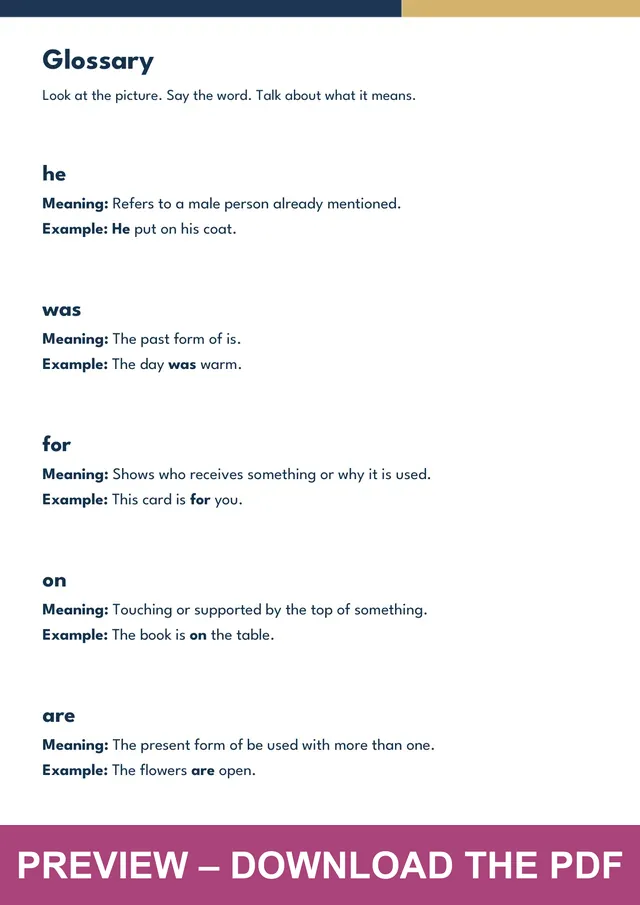
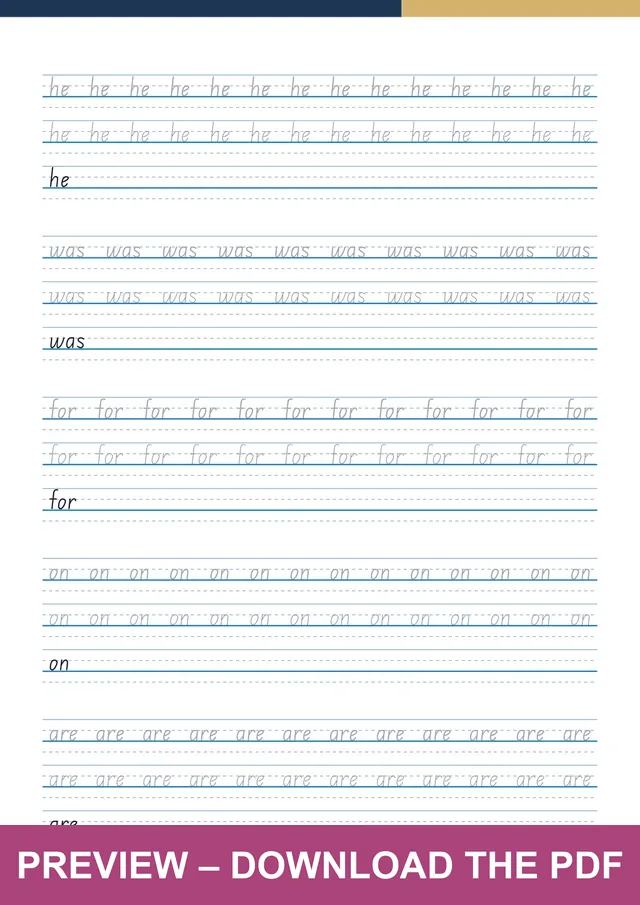
Use the arrows or dots to see the front cover, one glossary page and one handwriting sheet. The two inside-page previews are watermarked; download the PDF for clean printable pages.
If pupils need to revisit individual letter movements first, use Alphabet Letter Formation Worksheets A-Z. Compare words that require close spelling attention with Phonics Tricky Words Poster, then contrast these common words with the decodable patterns collected on CVC Word Families Poster.
About this Fry sight words 11-20
This set brings together words that help pupils talk about people, possession, location and past or present states. The contrast between he, his and they supports careful reading, while was and are invite useful discussion about how a sentence changes.
Capital I receives repeated handwriting practice as a word in its own right. The glossary examples make clear that recognising a word quickly and understanding its job in a sentence are connected but distinct skills.
The Fry sight words 11-20 set can be taught as one sequence or revisited in smaller groups according to pupils' reading and handwriting needs.
What is included?
- 10 words: he, was, for, on, are, as, with, his, they, I.
- 2 picture-glossary pages with meanings and example sentences.
- 2 handwriting sheets using grey models, dotted letters and independent copying space.
- 8 PDF pages in total: front cover, instructions, glossary, handwriting sheets and two terms pages.
How to use this Fry sight words 11-20
Introduce the words through pairs: he/his, was/are and he/they. Read the relevant glossary examples aloud, then model the handwriting strip for one pair. Pupils complete the grey, dotted and independent rows before checking letter height and spacing.
Return to I separately and reinforce its capital form wherever it appears in a sentence. The second sheet can be taught on another day or used for short retrieval practice.
Meanings in the Fry sight words 11-20 glossary
he
Meaning: Refers to a male person already mentioned.
Example: He put on his coat.
was
Meaning: The past form of is.
Example: The day was warm.
for
Meaning: Shows who receives something or why it is used.
Example: This card is for you.
on
Meaning: Touching or supported by the top of something.
Example: The book is on the table.
are
Meaning: The present form of be used with more than one.
Example: The flowers are open.
as
Meaning: Shows that two things happen or are compared in a certain way.
Example: Wave as the bus leaves.
with
Meaning: Together or accompanied by.
Example: I went with my friend.
his
Meaning: Belonging to a male person already mentioned.
Example: His bag is by the chair.
they
Meaning: Refers to people or things already mentioned.
Example: They are playing outside.
I
Meaning: The word a speaker uses for themself.
Example: I can write my name.
Teaching and follow-up ideas
- Replace he with they in an oral sentence and discuss the verb change.
- Match he with his and I with my during a quick pronoun warm-up.
- Find the capital I in the booklet and explain why it is capitalised.
- Use on and with to describe classroom objects and partners before writing.
Support and challenge
Offer one contrast at a time and read the example aloud before tracing. A transparent writing strip or finger-tracing pass can help pupils maintain direction on with and they.
For challenge, pupils can compose two linked sentences using I and they, then underline a second target word such as with, on or for.
Where this fits in learning
This workbook follows the 1-10 set and extends automatic recognition into words used for people, relationships and sentence structure. It works best alongside oral sentence building rather than as isolated copying. The next set introduces choice, possession and the number word one.
For Fry sight words 11-20, When practising he, was, they and I, discuss the regular and less predictable parts of each spelling instead of treating every common word as visually indivisible. See the high-frequency-word guidance in the Department for Education reading framework.
Resource licence
Free for personal, homeschool or single-classroom use under the terms included in the PDF. Resale, redistribution and uploading the file to another website are not permitted.
Questions about this workbook
Which Fry sight words are included in positions 11-20?
he, was, for, on, are, as, with, his, they, I. Each word has a meaning, an example sentence and handwriting practice.
What is included in the downloadable PDF?
The eight-page PDF contains a cover, instructions, two glossary pages, two handwriting practice pages and two terms-of-use pages.
How does each handwriting activity work?
Pupils trace grey models, follow dotted letters and then copy the word independently on Foundation writing guides.
Should children memorise every word as an indivisible shape?
No. Use the glossary and sentences for meaning, draw attention to known letter-sound patterns and explicitly explain any less predictable spelling.
Can I print only one five-word practice page?
Yes. The Fry sight words 11-20 workbook divides the ten words into two groups of five, so teachers can print the group that matches current learning.
Leave a Reply