
Fry Sight Words 31-40 Handwriting Workbook
Free printable Foundation handwriting resource
Fry sight words 31-40 develop handwriting and word recognition through but, not, what, all, were, we, when, your, can and said. Glossary examples lead into tracing and independent copying.
Preview what is inside
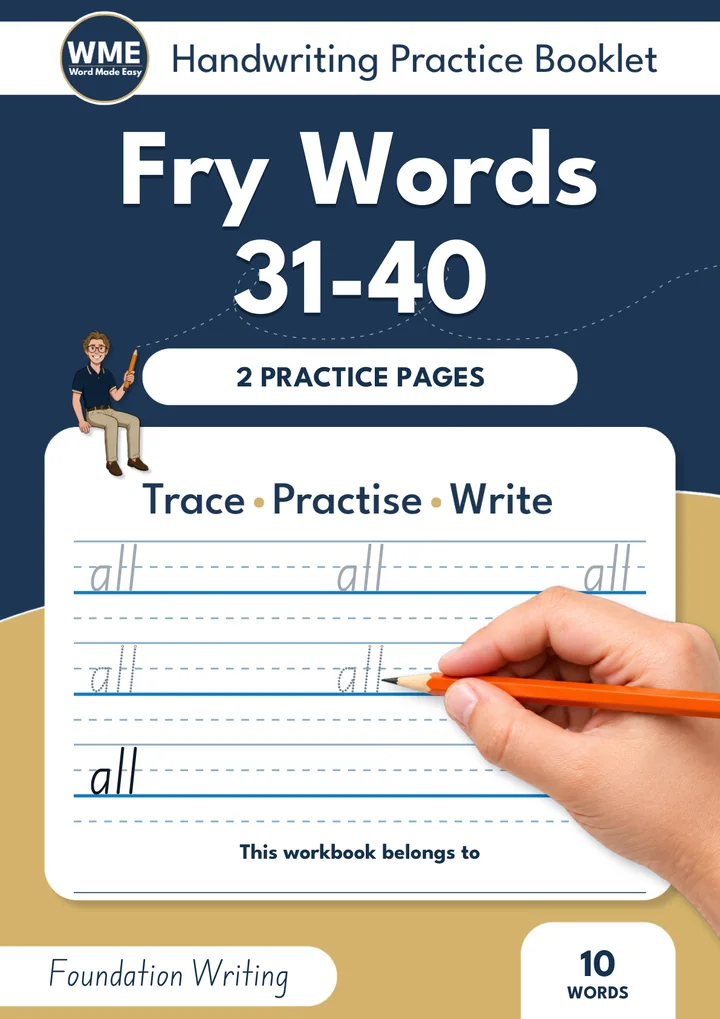

1 of 3
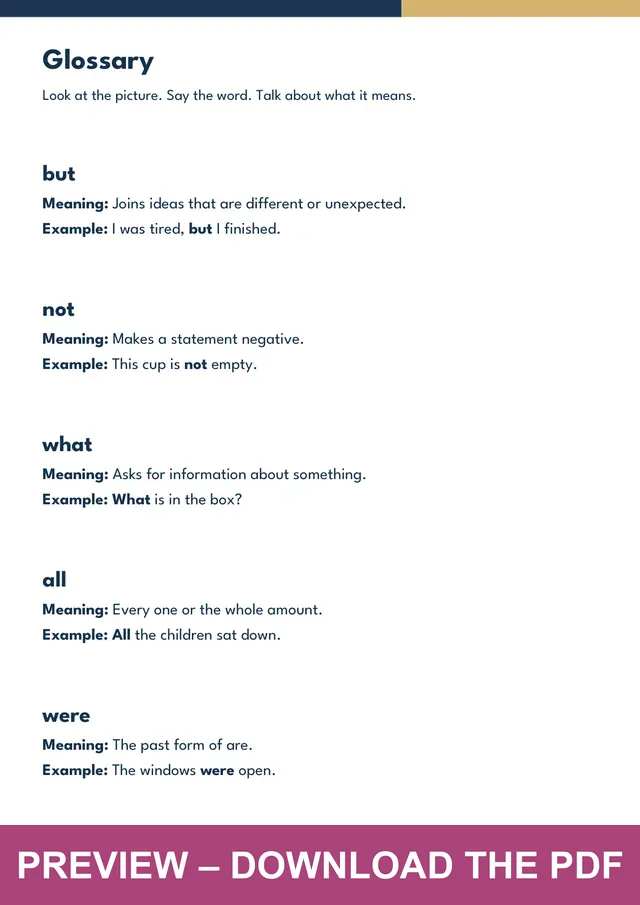
Use the arrows or dots to see the front cover, one glossary page and one handwriting sheet. The two inside-page previews are watermarked; download the PDF for clean printable pages.
If pupils need to revisit individual letter movements first, use Alphabet Letter Formation Worksheets A-Z. Compare words that require close spelling attention with Phonics Tricky Words Poster, then contrast these common words with the decodable patterns collected on CVC Word Families Poster.
About this Fry sight words 31-40
This group is particularly useful for questions, negatives and talking about groups. What and when begin questions, not changes a statement, and but links contrasting ideas. We, all and were frequently appear together in shared-reading sentences.
The set also includes said, whose spelling deserves explicit attention rather than being treated as a word pupils simply guess. The workbook supports repeated writing while the glossary keeps meaning and sentence use visible.
The Fry sight words 31-40 set can be taught as one sequence or revisited in smaller groups according to pupils' reading and handwriting needs.
What is included?
- 10 words: but, not, what, all, were, we, when, your, can, said.
- 2 picture-glossary pages with meanings and example sentences.
- 2 handwriting sheets using grey models, dotted letters and independent copying space.
- 8 PDF pages in total: front cover, instructions, glossary, handwriting sheets and two terms pages.
How to use this Fry sight words 31-40
Read the question-word examples with clear expression and compare what with when. Model one target at a time, drawing attention to the direction of w and the sequence of letters in said. Pupils trace the grey row, follow the dots and then copy from the black model.
After both groups have been practised, dictate a short phrase containing we can or all were. Treat this as retrieval, not a speed test.
Meanings in the Fry sight words 31-40 glossary
but
Meaning: Joins ideas that are different or unexpected.
Example: I was tired, but I finished.
not
Meaning: Makes a statement negative.
Example: This cup is not empty.
what
Meaning: Asks for information about something.
Example: What is in the box?
all
Meaning: Every one or the whole amount.
Example: All the children sat down.
were
Meaning: The past form of are.
Example: The windows were open.
we
Meaning: The speaker together with one or more other people.
Example: We read a story together.
when
Meaning: Asks or tells at what time something happens.
Example: Tell me when you are ready.
your
Meaning: Belonging to the person being spoken to.
Example: Please bring your book.
can
Meaning: To be able to do something.
Example: I can hop on one foot.
said
Meaning: The past form of say.
Example: She said hello to us.
Teaching and follow-up ideas
- Sort what and when under a Questions heading.
- Change a positive oral statement by adding not.
- Complete the stem We can… with a class action.
- Build a contrast using but, then locate both ideas in the sentence.
Support and challenge
Rehearse w formation before attempting what, were, we and when. Provide the spoken sentence first so pupils do not have to invent language while concentrating on handwriting.
For challenge, pupils can write one question beginning with What or When and a response containing we, can or said.
Where this fits in learning
Positions 31-40 move beyond naming and pointing words into language that shapes questions, contrasts and group statements. They suit pupils who can copy short words accurately but still need repeated encounters for fluent recognition. The 41-50 set develops choices, conditions and additional pronouns.
For Fry sight words 31-40, Said deserves explicit attention to its unusual vowel spelling, whereas many other words in this group can draw on developing phonic knowledge. For the underlying teaching principle, consult the Department for Education reading framework.
Resource licence
Free for personal, homeschool or single-classroom use under the terms included in the PDF. Resale, redistribution and uploading the file to another website are not permitted.
Questions about this workbook
Which Fry sight words are included in positions 31-40?
but, not, what, all, were, we, when, your, can, said. Each word has a meaning, an example sentence and handwriting practice.
What is included in the downloadable PDF?
The eight-page PDF contains a cover, instructions, two glossary pages, two handwriting practice pages and two terms-of-use pages.
How does each handwriting activity work?
Pupils trace grey models, follow dotted letters and then copy the word independently on Foundation writing guides.
Should children memorise every word as an indivisible shape?
No. Use the glossary and sentences for meaning, draw attention to known letter-sound patterns and explicitly explain any less predictable spelling.
Can I print only one five-word practice page?
Yes. The Fry sight words 31-40 workbook divides the ten words into two groups of five, so teachers can print the group that matches current learning.
Leave a Reply