Skip to content
Word Made Easy
Home Word Tutorials PowerPoint Tutorials Teacher Resources YouTube Videos
★★★★★★★★★★No ratings yet

IB Word Family Handwriting Workbook

Teacher Resources, Handwriting, Foundation, CVC Word Families

Free printable Foundation handwriting resource

Meet bib, fib, nib and rib in this ib word family workbook. A compact glossary explains four very different meanings before a single Foundation handwriting sheet practises the short-i ending.

4 topic words1 handwriting sheetPicture glossaryFoundation writing

Preview what is inside

ib word family front cover
Clean front cover
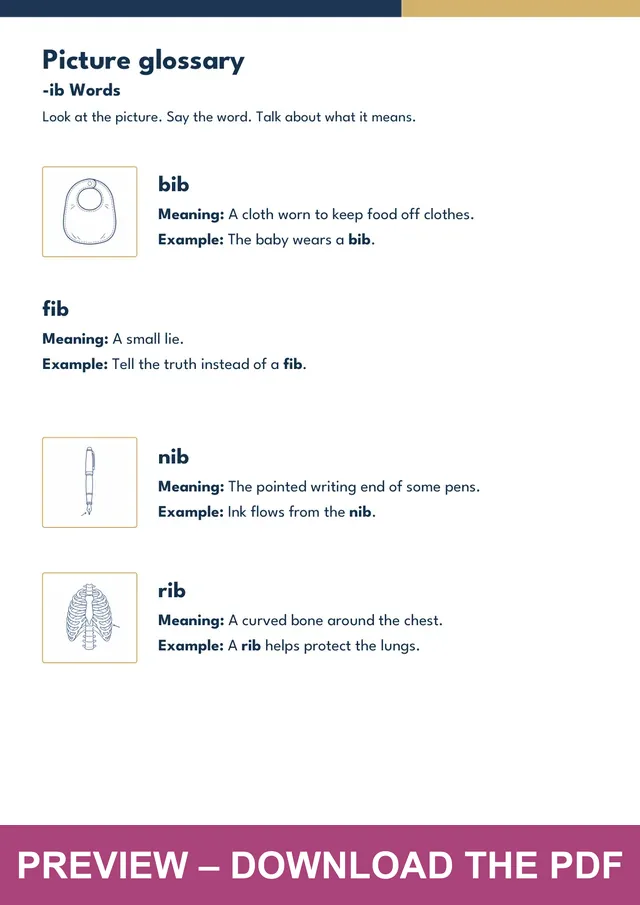
-ib word family picture glossary preview, PDF page 3
Picture glossary preview
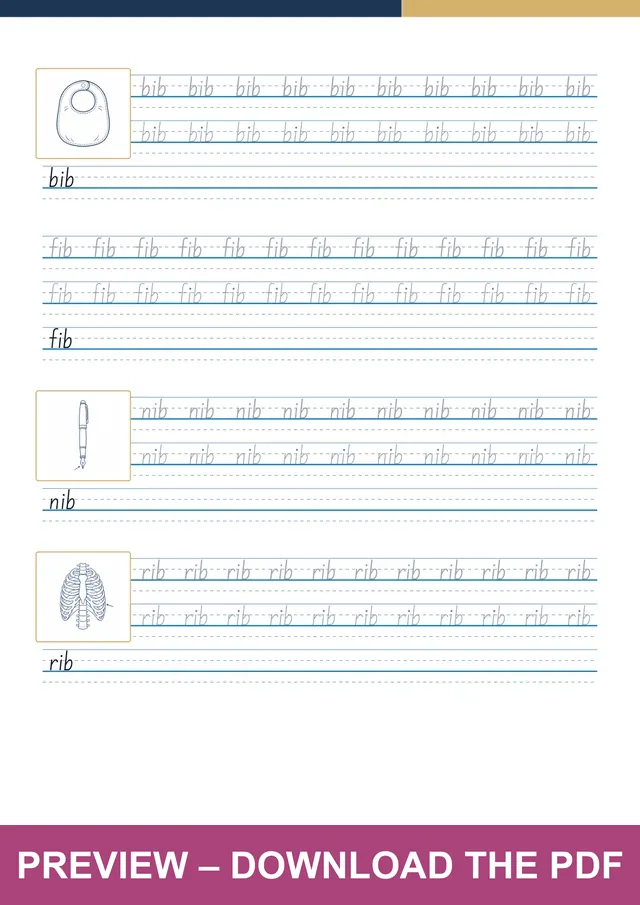
-ib word family first handwriting sheet preview, PDF page 4
First handwriting sheet preview

1 of 3

Use the arrows or dots to see the front cover, one glossary page and one handwriting sheet. The two inside-page previews are watermarked; download the PDF for clean printable pages.

CVC Word Families

UT Word Family Handwriting Workbook UN Word Family Handwriting Workbook UM Word Family Handwriting Workbook UG Word Family Handwriting Workbook UB Word Family Handwriting Workbook OT Word Family Handwriting Workbook
See More

Get the free PDF

Enter your email address, then choose whether you would also like occasional emails about new Word Made Easy Teacher Resources.

I agree that Word Made Easy may email me occasional updates about new Teacher Resources. I can unsubscribe at any time. Choose Download only if you do not want marketing emails.

Read the Privacy Policy for details about storage, retention and your rights.

Rate this resource

Your feedback helps us improve and helps other teachers find useful resources.

Choose a star rating

Compare the ib ending with the groups on CVC Word Families Poster. For the individual letter movements used in bib and rib, select the relevant examples from Alphabet Letter Formation Worksheets A-Z.

About this ib word family

Bib is often familiar from mealtimes; nib names the point of a pen, rib refers to part of the body, and fib means an untrue statement. Check those meanings before asking for fluent reading or copying. Four short words can still contain substantial new vocabulary.

Bib places b at both ends, with the short i between them. This makes it useful for comparing repeated b formations without confusing them with d. The dot on i should be added clearly above its short stem.

What is included?

  • 4 words: bib, fib, nib, rib.
  • 1 picture-glossary page with meanings and example sentences.
  • 1 handwriting sheet using grey models, dotted letters and independent copying space.
  • 6 PDF pages in total: front cover, instructions, glossary, handwriting sheets and two terms pages.

How to use this ib word family

Begin with a bib or its glossary picture, say the word and blend its three sounds. Point to the first and last b, then ask the child to find the i between them. Trace the pale models before progressing to dotted and independent writing.

Introduce nib through a suitable pen image and rib through the printed definition. Use a fictional example to discuss fib; there is no need to ask children to disclose times they have lied. Read the complete glossary sentences aloud if their language goes beyond the pupil's independent reading.

When checking a copied word, look for two things separately: correct letter order and controlled formation. Ask a partner to read it without the picture, then compare any unclear b or i with the model.

Meanings in the ib word family glossary

bib

Meaning: A cloth worn to keep food off clothes.

Example: The baby wears a bib.

fib

Meaning: A small lie.

Example: Tell the truth instead of a fib.

nib

Meaning: The pointed writing end of some pens.

Example: Ink flows from the nib.

rib

Meaning: A curved bone around the chest.

Example: A rib helps protect the lungs.

Teaching and follow-up ideas

  • Compare the two b letters in bib and identify a consistent starting movement.
  • Find a pen nib in a clear photograph and connect it to the printed word.
  • Sort bib and nib as objects, rib as a body part and fib as a word needing a story context.
  • Check that every independently written i has a dot.

Support and challenge

Keep bib visible while rehearsing b to reduce reversal errors. Explain nib before expecting its picture to be recognised. For challenge, children can devise a fictional sentence with fib and explain why it is untrue.

Where this fits in learning

The ib word family suits focused short-i work with a small vocabulary load. Do not assume four words means no teaching is needed: nib and fib may be new. Follow with a contrast such as bib and bin when the final consonant can be checked carefully.

For further teacher reference when modelling the letter movements in bib and rib, NSW Education collects handwriting sequences and advice on formation, posture and pencil grasp. These are background teaching resources, not a claim that this booklet follows a particular syllabus: NSW handwriting teaching resources.

Resource licence

Free for personal, homeschool or single-classroom use under the terms included in the PDF. Resale, redistribution and uploading the file to another website are not permitted.


Your PDF has been downloaded

Check your Downloads folder. Before you go, we would appreciate your quick feedback.

How useful is this resource?

Would you share it?
Facebook WhatsApp Pinterest Email

Questions about this workbook

Why introduce the meanings before tracing?

Nib, rib and fib may be unfamiliar even when children can decode their letters. Understanding the glossary example makes the copying purposeful.

Which ib word family spellings are practised?

bib, fib, nib, rib. The glossary gives a meaning and sentence for every entry.

What is in the downloadable PDF?

There are 6 pages altogether: a front cover, one instruction page, 1 glossary page(s), 1 handwriting sheet(s) and two terms pages.

What handwriting style does this edition use?

Foundation letterforms, with grey models and dotted tracing followed by copying into ruled space.

Can I use bib on its own?

Yes. Choose the word group that matches your lesson and leave the others for another session. Read its glossary meaning and example first.


Related resources

  • CVC Word Families Poster
  • Alphabet Letter Formation Worksheets A-Z
  • CVC Word Unscrambling Worksheet
Browse all Handwriting resources

Like this:

Like Loading…
CVC words Handwriting word families Workbook
←ET Word Family Handwriting Workbook
ID Word Family Handwriting Workbook→

Comments

Leave a ReplyCancel reply

Meet the Author

Patrick Elliott standing outdoors holding his dog.

I’m Patrick Elliott, the creator of Word Made Easy. I’m an educator and Inclusion Lead, and I use Microsoft Word and PowerPoint daily for planning, documentation, and classroom resources.

Every guide is tested step-by-step before publishing (usually in Microsoft 365). You’ll also find practical walkthroughs on my YouTube channel.

More:About me.Contact.YouTube

Explore More

  • Word Tutorials
  • PowerPoint Tutorials
  • Teacher Resources
  • YouTube Videos

YouTube

Recent Tutorials

  • How to View Two Pages Side by Side in Word: 2 Easy Methods (Quick Guide)August 29, 2026
  • Open Two Documents Side by Side in Word: 2 Easy Steps (Quick Guide)August 29, 2026
  • How to Open Word in Safe Mode: 2 Easy Methods (Quick Guide)August 29, 2026
  • How to Replace Text in Word: 2 Easy Methods (Quick Guide)August 29, 2026
  • How to Export a Single Page in Word: 5 Easy Steps (Quick Guide)August 29, 2026

Recent Teacher Resources

  • Fry Sight Words 91-100 Handwriting WorkbookSeptember 8, 2026
  • Fry Sight Words 81-90 Handwriting WorkbookSeptember 8, 2026
  • Fry Sight Words 71-80 Handwriting WorkbookSeptember 8, 2026
  • Fry Sight Words 61-70 Handwriting WorkbookSeptember 8, 2026
  • Fry Sight Words 51-60 Handwriting WorkbookSeptember 8, 2026
Word Made Easy

Explore

  • →Home
  • →Word Tutorials
  • →PowerPoint Tutorials
  • →Teacher Resources
  • →YouTube Videos

Categories

  • →Page Layout & Sections
  • →Tables, Images & Media
  • →Word Formatting Basics
  • →Word Productivity & Automation

Author

  • →About Me
  • →Contact
  • →YouTube
Privacy Policy Cookie Policy Terms of Use
© 2012–2026 Word Made Easy. Content is protected.
Your privacy choices

We use cookies and similar technologies to make this site work, understand how it is used, and show relevant content and advertising. You can accept all cookies, deny non-essential cookies, or manage your preferences. You can change your choice at any time.

Functional Always active
The technical storage or access is strictly necessary for the legitimate purpose of enabling the use of a specific service explicitly requested by the subscriber or user, or for the sole purpose of carrying out the transmission of a communication over an electronic communications network.
Preferences
The technical storage or access is necessary for the legitimate purpose of storing preferences that are not requested by the subscriber or user.
Statistics
The technical storage or access that is used exclusively for statistical purposes. The technical storage or access that is used exclusively for anonymous statistical purposes. Without a subpoena, voluntary compliance on the part of your Internet Service Provider, or additional records from a third party, information stored or retrieved for this purpose alone cannot usually be used to identify you.
Marketing
The technical storage or access is required to create user profiles to send advertising, or to track the user on a website or across several websites for similar marketing purposes.
  • Manage options
  • Manage services
  • Manage {vendor_count} vendors
  • Read more about these purposes
Manage preferences
  • {title}
  • {title}
  • {title}

Discover more from Word Made Easy

Subscribe now to keep reading and get access to the full archive.

Continue reading

%d