
ID Word Family Handwriting Workbook
Free printable Foundation handwriting resource
Practise did, hid, kid and lid with this id word family booklet. Glossary examples help explain the past actions did and hid, while the handwriting sheet rehearses the same short-i ending in Foundation script.
Preview what is inside
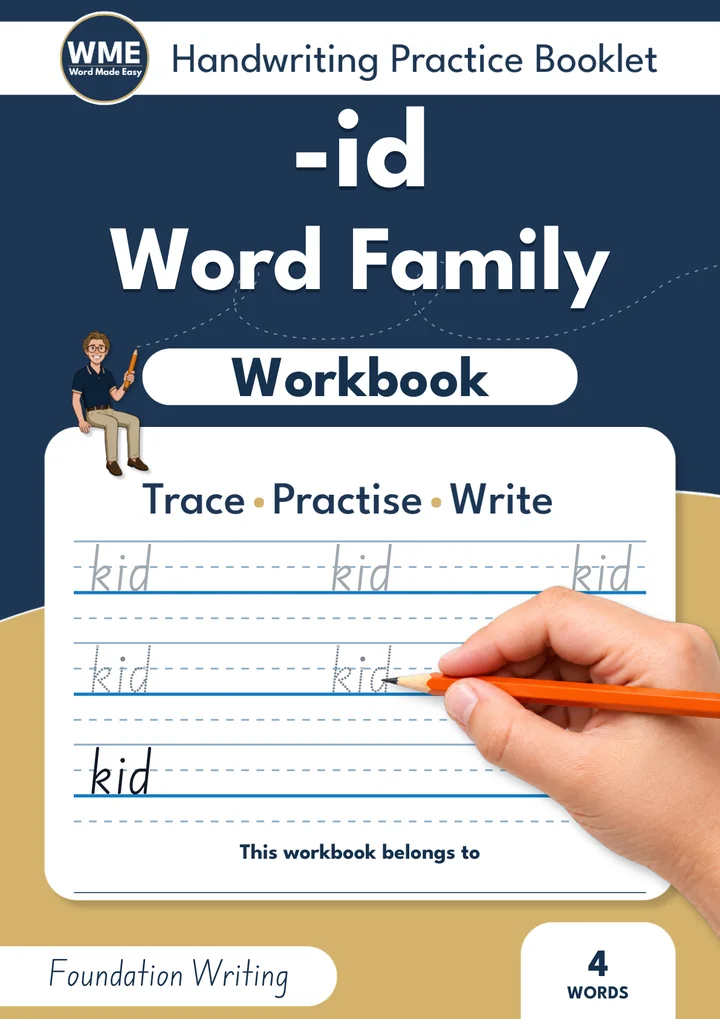


1 of 3
Use the arrows or dots to see the front cover, one glossary page and one handwriting sheet. The two inside-page previews are watermarked; download the PDF for clean printable pages.
Compare the id ending with the groups on CVC Word Families Poster. For the individual letter movements used in did and lid, select the relevant examples from Alphabet Letter Formation Worksheets A-Z.
About this id word family
Kid and lid offer concrete meanings; did and hid need a sentence or demonstration. Read the chosen kid definition rather than assuming every learner knows whether it means a child or a young goat in this context.
Did contains d twice. Both should have the same orientation and a tall stem, with a short dotted i between them. In hid and lid, the initial tall letter also provides practice in keeping height consistent across the word.
What is included?
- 4 words: did, hid, kid, lid.
- 1 picture-glossary page with meanings and example sentences.
- 1 handwriting sheet using grey models, dotted letters and independent copying space.
- 6 PDF pages in total: front cover, instructions, glossary, handwriting sheets and two terms pages.
How to use this id word family
Read lid and identify a suitable container lid. Blend l-i-d and point to the small i between two tall letters. Show how the three strips reduce support from grey models to dots and then independent copying.
Use the glossary sentence for hid, then hide a harmless classroom object and describe what happened. Make the past meaning explicit before returning to the printed word. For did, use a short oral sentence about a completed task.
Check did slowly rather than accepting it because the middle vowel is correct. Ask pupils to compare its two d letters, then read the word they actually wrote. A reversed final letter changes what the reader sees.
Meanings in the id word family glossary
did
Meaning: Performed an action in the past.
Example: I did my work.
hid
Meaning: Put something out of sight in the past.
Example: The cat hid under the bed.
kid
Meaning: A young goat; also an informal word for a child.
Example: The kid stays near its mother goat.
lid
Meaning: A cover for a container.
Example: Put the lid on the pot.
Teaching and follow-up ideas
- Match a written lid label to a container lid.
- Describe where a toy hid after a brief hide-and-find demonstration.
- Compare both d letters in did using the printed model.
- Sort did and hid as past actions and explain the meanings of kid and lid separately.
Support and challenge
Practise a single d movement before the repeated d letters in did. Keep the glossary available for hid and read its sentence aloud. Extend through an oral contrast between hide and hid without claiming that the longer spelling appears on the sheet.
Where this fits in learning
Use the id word family after short i, d and the initial consonants have been introduced. It can reinforce word meaning as well as copying, especially for past-action vocabulary. Next, contrast lid and lip to draw attention to the final letter.
For further teacher reference when modelling the letter movements in did and lid, NSW Education collects handwriting sequences and advice on formation, posture and pencil grasp. These are background teaching resources, not a claim that this booklet follows a particular syllabus: NSW handwriting teaching resources.
Resource licence
Free for personal, homeschool or single-classroom use under the terms included in the PDF. Resale, redistribution and uploading the file to another website are not permitted.
Questions about this workbook
How can I explain hid without guessing from a picture?
Use the glossary sentence and a simple demonstration of an object hidden earlier. The word describes hiding in the past.
Which id word family spellings are practised?
did, hid, kid, lid. The glossary gives a meaning and sentence for every entry.
What is in the downloadable PDF?
There are 6 pages altogether: a front cover, one instruction page, 1 glossary page(s), 1 handwriting sheet(s) and two terms pages.
What handwriting style does this edition use?
Foundation letterforms, with grey models and dotted tracing followed by copying into ruled space.
Can I use did on its own?
Yes. Choose the word group that matches your lesson and leave the others for another session. Read its glossary meaning and example first.
Leave a Reply