Free printable guided reading resource
This free Max the Monkey reading comprehension worksheet gives young readers a short, accessible jungle passage followed by five multiple-choice questions. Pupils retrieve clear facts about Max, his home, his favourite food and what he does with two bunches of bananas.
Preview the reading comprehension worksheet
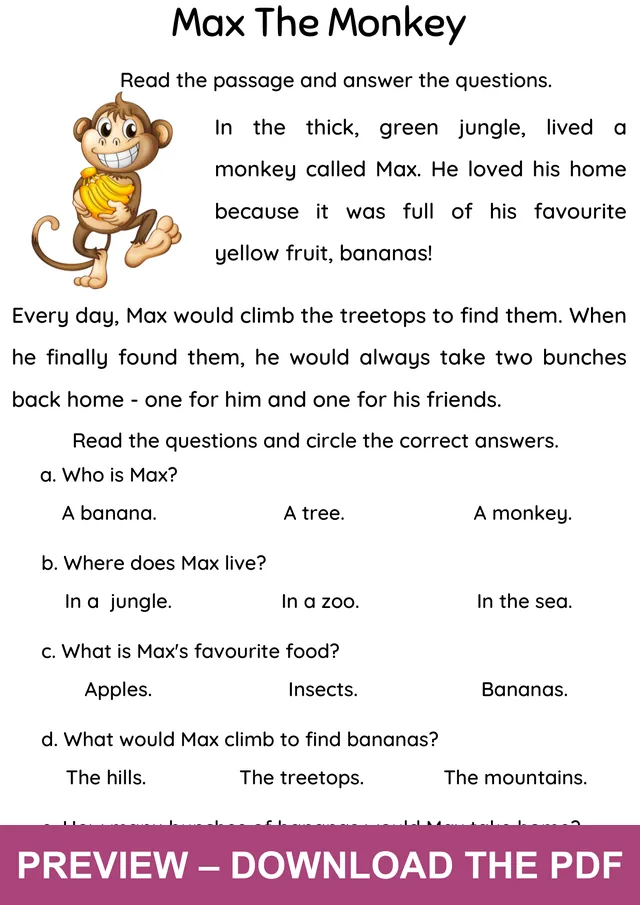
The Max the Monkey worksheet is shown as a reduced-resolution, watermarked preview. The downloaded PDF contains the clean printable activity.
Before independent reading, use the Short A CVC Words Poster to rehearse blending. For another meaning-focused activity, try the CVC Reading and Comprehension Worksheet.
About the Max the Monkey reading comprehension
The passage introduces Max, a monkey who lives in the jungle and loves bananas. Readers learn that he climbs to the treetops and takes two bunches of bananas: one for himself and one for his friends. The information is stated directly, so the page is well suited to early retrieval practice.
Five questions ask children to identify who Max is, where he lives, his favourite food, what he climbs and how many bunches he takes. Each question offers three answer choices, allowing pupils to show understanding without a heavy writing demand. Use the Max the Monkey reading comprehension worksheet to model how a reader returns to the passage before choosing an answer.
What is included?
A short jungle passage: The text follows one clear character and a simple sequence involving Max and the bananas.
Five multiple-choice questions: Every question checks a fact stated in the passage and provides three possible answers.
One printable activity page: The reading text and questions appear together so pupils can return to the passage while answering.
A three-page PDF package: The activity is followed by the Word Made Easy thank-you and terms-of-use pages.
What children can practise
- reading a short narrative for meaning;
- locating explicitly stated information;
- matching a question to the relevant sentence;
- choosing between three possible answers;
- checking an answer against evidence in the text.
How to use this worksheet
Prepare for reading: Discuss the title and check that pupils understand jungle, treetops and bunches.
Read and return to the text: Ask pupils to read the passage once for overall meaning, then reread the relevant sentence for each question.
Explain the evidence: After circling an answer, invite pupils to point to or read the words that prove their choice.
Teaching and follow-up ideas
- Read the passage aloud and pause before key details so pupils can predict what may happen next.
- Highlight the sentence that answers each question in a different colour.
- Retell the passage orally using the prompts who, where, what and how many.
- Ask pupils to draw Max sharing the second bunch and write one sentence beneath the picture.
Support and challenge
Support: Read the passage together, cover two answer choices and ask the pupil to locate one key word in the text before deciding.
Challenge: Ask pupils to justify every answer in a complete sentence, then write an additional question whose answer can be found in the passage.
Where this fits in guided reading
Use this worksheet when pupils can read short sentences and are beginning to answer literal questions independently. It works well in a guided group, as a brief comprehension check or as supported home practice. The Department for Education reading framework provides wider guidance on developing accurate, fluent reading and comprehension. Revisit the Max the Monkey reading comprehension activity before moving to passages that require pupils to combine details or make a simple inference.
Resource licence
Free for personal and classroom use. You may print copies for yourself or your learners. Resale, redistribution and uploading the file to other websites are not permitted.
Questions about Max the Monkey
What is the Max the Monkey worksheet about?
It contains a short passage about a jungle monkey who climbs trees and collects two bunches of bananas, followed by five comprehension questions.
What kind of questions are included?
The worksheet has five multiple-choice questions, each with three answers. They check facts stated directly in the passage.
Which reading skill does this activity practise?
It focuses on literal retrieval: finding a detail in a short text and selecting the answer that matches the evidence.
How can I support a developing reader?
Read the passage together, pre-teach unfamiliar vocabulary and help the pupil return to the sentence containing the answer.
How many printable pages are included?
There is one printable reading activity page, followed by the Word Made Easy thank-you and terms-of-use pages in the PDF.
May I print copies for my class?
Yes. You may print copies for your own learners under the personal and classroom-use licence.
Leave a Reply