
Free printable Phase 3 phonics resource
This free ai digraph word-to-picture matching worksheet asks pupils to connect nine ai words with their illustrations. The word bank includes snail, train, rain, mail, nail, pain, sail, chain and wait, giving repeated practice with the same vowel digraph in different word positions.
Preview the worksheet
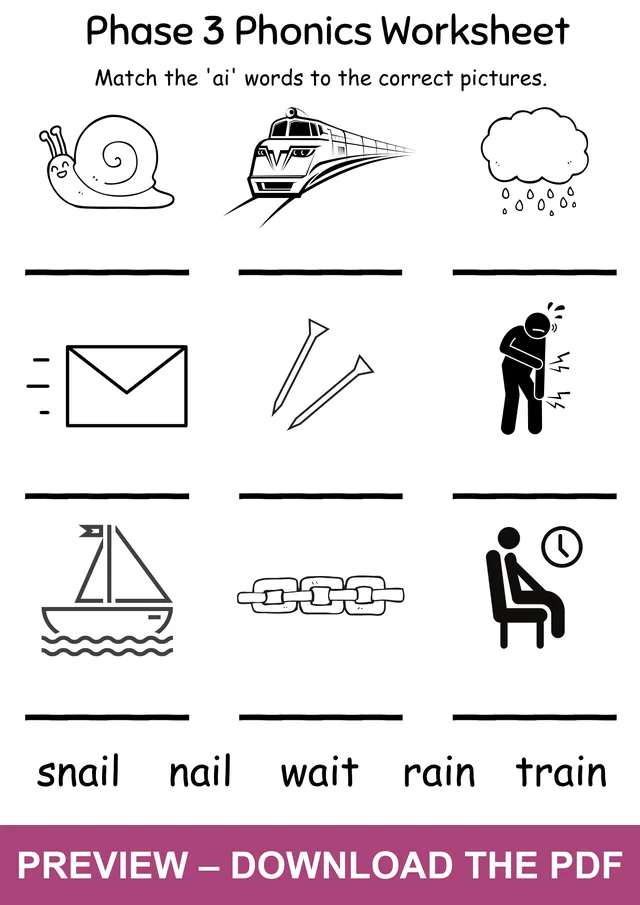
This ai word-to-picture worksheet is shown as a reduced-resolution, watermarked preview. The downloaded PDF is the clean printable version.
Revisit consonant-digraph recognition with the CH Digraph Picture Word Poster before introducing the vowel digraph. After matching the ai set, compare another long-vowel spelling with the EE Word-to-Picture Matching Worksheet.
About this ai digraph matching worksheet
Nine black-and-white illustrations appear above answer lines, with a separate word bank at the bottom. Pupils select from snail, train, rain, mail, nail, pain, sail, chain and wait, then connect or record the word that matches each picture. Every choice contains the adjacent graphemes ai.
The pictures include nouns, an action or state, and words with different surrounding consonants. Some choices contain consonant clusters or spellings beyond a pupil’s current knowledge, so the sheet is best used after ai has been taught and with adult support for any untaught parts.
What is included?
Nine picture prompts: The page illustrates every answer in the word bank.
Nine ai spellings: Snail, train, rain, mail, nail, pain, sail, chain and wait all contain the target digraph.
Writing or matching lines: Each image has a clear space for linking or recording its label.
Three-page PDF package: One printable worksheet is followed by the Word Made Easy thank-you and terms-of-use pages.
What children will practise
- recognising ai inside a complete written word;
- blending through consonants around a vowel digraph;
- using picture meaning to confirm a decoded choice;
- distinguishing similar-looking words such as mail, nail and sail;
- checking that each label is used once.
How to use the ai matching worksheet
Read the bank first: Underline ai in every word and blend the choices together before pupils attempt individual matches.
Match by decoding: Ask the learner to read a word, locate the picture that fits and explain which details ruled out neighbouring choices.
Review the set: Read all nine completed pairs and compare the initial consonants in mail, nail and sail.
AI digraph teaching ideas
- Cut apart copied words and place them beneath the pictures before writing.
- Sort words by the number of phonemes or by their initial grapheme.
- Cover the bank and spell one familiar answer from sound talk.
- Use two matched words in an oral sentence to check vocabulary understanding.
Support and challenge
Support: Reduce the bank to three choices, mark the ai digraph and read any untaught consonant cluster with the pupil.
Challenge: Hide the word bank, write labels from the pictures and add a new ai word that is not shown on the page.
Where ai matching fits in Phase 3
Use the ai digraph word-to-picture matching worksheet after explicit teaching and oral blending with the target correspondence. The Department for Education reading framework supports a planned cumulative sequence, so pre-teach any surrounding graphemes that your programme introduces later.
Resource licence
Free for personal and classroom use. You may print copies for yourself or your learners. Resale, redistribution and uploading the file to other websites are not permitted.
Questions about the ai worksheet
Which ai words are included?
The word bank contains snail, train, rain, mail, nail, pain, sail, chain and wait.
What do pupils do on the page?
They read the nine ai words and connect or write each one beside its matching illustration.
Why are mail, nail and sail useful together?
They share the same ail ending, so pupils can compare how changing the initial consonant changes the word.
Should every child complete the sheet independently?
Only if the surrounding graphemes and vocabulary have been taught. Adults can support longer choices while keeping attention on ai.
What is included in the PDF?
The PDF contains one printable worksheet followed by the Word Made Easy thank-you and terms-of-use pages.
Can I use the worksheet for home practice?
Yes. You may print it for your own learners and share the resource-page link with families.
Leave a Reply