
Free printable Phase 3 phonics resource
This free ee word-to-picture matching worksheet asks pupils to connect nine written words with their illustrations: feet, bee, sheep, peel, sleep, tree, queen, teeth and seed. The varied consonants keep attention on the shared long-vowel digraph.
Preview the worksheet
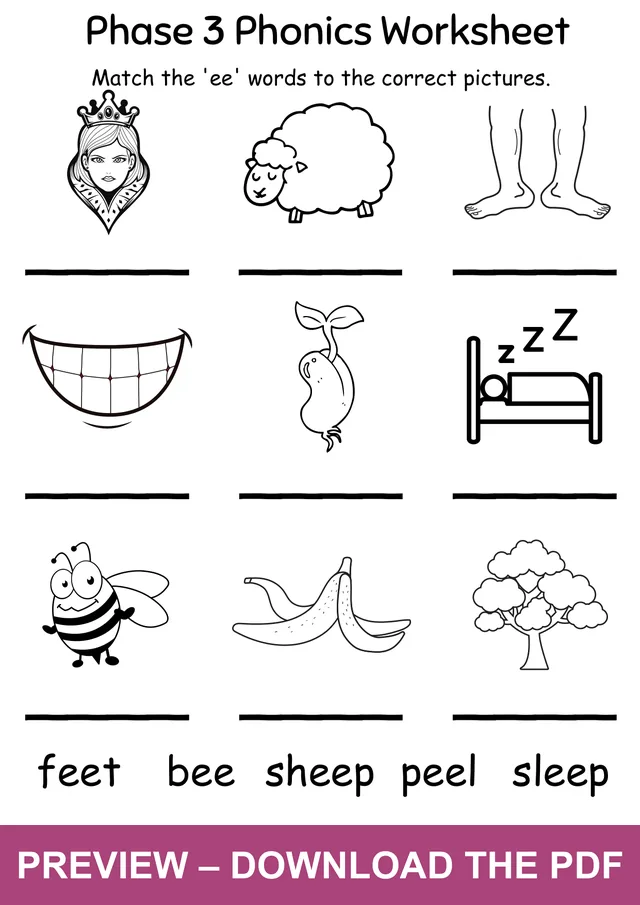
This ee word-to-picture matching page is shown as a reduced-resolution, watermarked preview. The downloaded PDF is the clean printable version.
Compare the matching routine with the earlier AI Digraph Word-to-Picture Matching Worksheet. After pupils can read the ee bank, move to the EE Picture Word Writing Worksheet to reduce the support.
About this ee word-to-picture matching worksheet
Nine outline drawings appear above individual answer lines, while the word bank provides feet, bee, sheep, peel, sleep, tree, queen, teeth and seed. Pupils read a choice, locate the matching image and connect or record the label.
Every answer contains ee, but the word shapes and surrounding consonants differ. The list includes singular and plural nouns, an action word and longer consonant patterns, giving children repeated sight of the target digraph without presenting nine near-identical spellings.
What is included?
Nine ee labels: The complete word bank is printed beneath the activity.
Nine visual matches: Each answer has one corresponding black-and-white picture.
Response lines: Children can connect choices or copy the correct spelling beneath an image.
Three-page PDF package: The worksheet is followed by the Word Made Easy thank-you and terms-of-use pages.
What children will practise
- spotting ee inside a complete word;
- blending through the long vowel and surrounding consonants;
- distinguishing feet from teeth and tree from seed;
- using picture meaning to verify a reading;
- copying a selected word accurately when required.
How to use the ee matching worksheet
Scan the word bank: Highlight ee in every choice and read the list together before matching.
Choose from meaning and print: Blend one word, compare the available pictures and connect only when both sound and meaning agree.
Check all nine: Reread the completed labels and make sure no word or picture has been used twice.
EE word follow-up ideas
- Sort the words by whether ee appears near the beginning or end.
- Compare the final consonants in bee, tree and three orally, without adding unsupported spellings to the sheet.
- Cover the bank and write bee, feet or seed from a picture.
- Use one noun and the action word sleep in separate oral sentences.
Support and challenge
Support: Offer three words at a time, pre-teach queen and peel, and mark the shared digraph before asking for a match.
Challenge: Hide the bank, label as many pictures as possible and add an independently chosen ee word in a sentence.
Where ee matching fits in learning
Use the ee word-to-picture matching worksheet after pupils can recognise and blend the digraph in short examples. Support consonant clusters or longer words according to the school’s sequence, then move towards picture labelling and sentence reading without a visible bank.
Resource licence
Free for personal and classroom use. You may print copies for yourself or your learners. Resale, redistribution and uploading the file to other websites are not permitted.
Questions about the ee matching worksheet
Which ee words are included?
The worksheet uses feet, bee, sheep, peel, sleep, tree, queen, teeth and seed.
What is the pupil's task?
Pupils read each word and connect it to the matching illustration or copy it onto the relevant answer line.
Do all choices contain the same vowel digraph?
Yes. Every word contains the adjacent letters ee representing the target long-vowel spelling.
How can I reduce the reading demand?
Present three choices at a time and adult-read any word containing consonants or vocabulary not yet taught.
How many printable pages are in the resource?
There is one printable activity page followed by the Word Made Easy thank-you and terms-of-use pages.
Can pupils write the labels instead of drawing lines?
Yes. The answer spaces allow children to copy the selected word beneath its picture.
Leave a Reply